
On 7 February 2005, Ellen MacArthur completed a solo, non-stop voyage around the world in 71 days, 14 hours, 18 minutes and 33 seconds. Sailing the trimaran B&Q/Castorama, she covered 27,354 nautical miles and beat the existing record by more than a day. The achievement brought an English sailor from Derbyshire international renown. After retiring from competitive sailing, MacArthur put her experience of finite resources at sea to work in a different field: promoting a circular economy through the Ellen MacArthur Foundation.
A childhood interest takes shape
Ellen Patricia MacArthur was born on 8 July 1976 in Whatstandwell, Derbyshire, near Matlock. Her early interest in sailing was driven by a wish to emulate Sophie Burke, whom she admired. The original account also recalls MacArthur saving pocket money at the age of eight to buy a dinghy, which she named Threepenny Bit. It describes her childhood interest in the sea as the beginning of a path from schoolgirl sailor to professional competitor.
MacArthur’s route into major international racing was built through demanding solo sailing. She competed in the Mini Transat, a solo transatlantic race, completing it at 22. In June 2000, she sailed the monohull Kingfisher from Plymouth to Newport, Rhode Island, in 14 days, 23 hours and 11 minutes. The passage set a record for a single-handed woman sailing a monohull east to west, as well as for a woman sailing single-handed in any vessel.
That year she also took part in the Vendée Globe, the solo, non-stop round-the-world race. She finished second in the 2000–01 edition aboard Kingfisher, completing the course in 94 days, four hours and 25 minutes. At 24, she was the youngest competitor to complete the voyage. Her result set a world record for a single-handed, non-stop monohull circumnavigation by a woman; it stood for 20 years, until Clarisse Crémer beat it in the 2020–21 edition. MacArthur was appointed an MBE for services to sport after the race.
Records under sail
MacArthur continued to add to her record-setting passages. In June 2004, she sailed B&Q/Castorama from Ambrose Light in Lower New York Bay to Lizard Point, Cornwall. The crossing took seven days, three hours and 50 minutes, setting a world record for a transatlantic crossing by a woman and beating both the previous crewed record and the single-handed record.
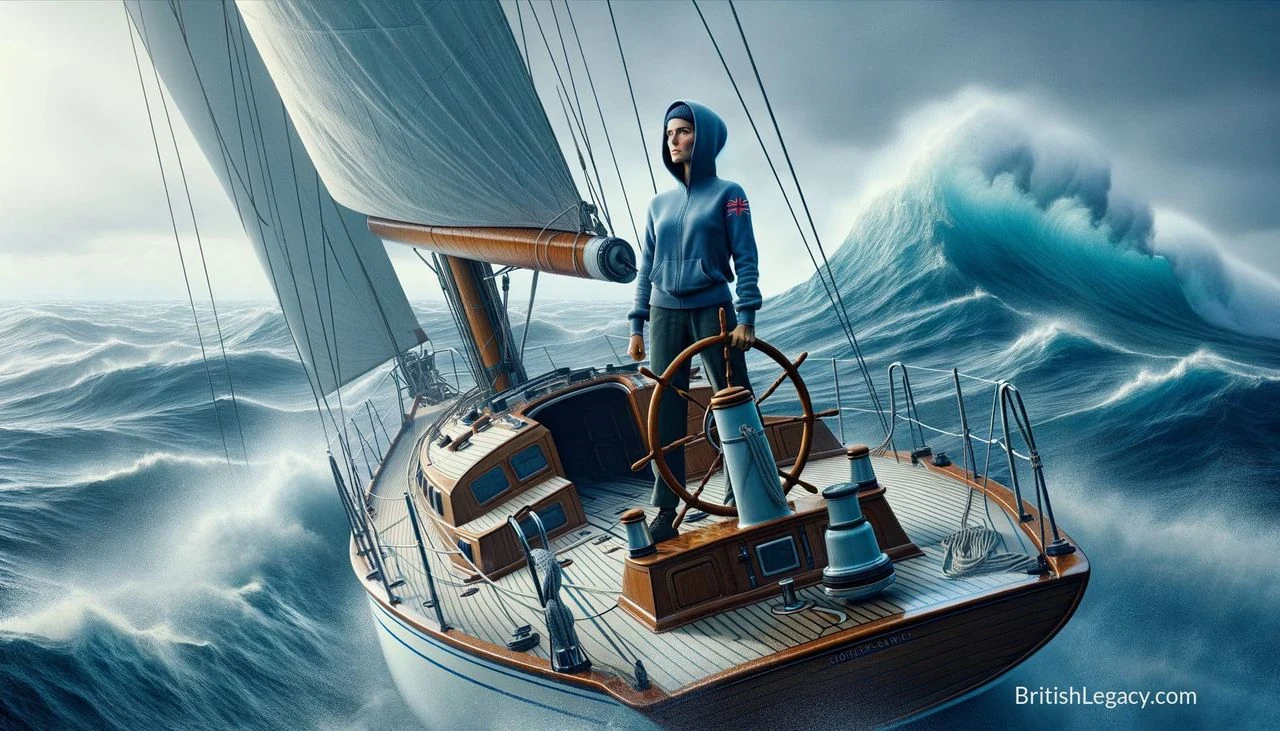
On 28 November 2004, she set off from the United Kingdom aboard the trimaran for the solo circumnavigation that would become her best-known achievement. The route covered 27,354 nautical miles, or 50,660 kilometres, at an average speed of 15.9 knots. MacArthur’s time of 71 days, 14 hours, 18 minutes and 33 seconds beat Francis Joyon’s previous record by one day, eight hours, 35 minutes and 49 seconds. The feat demanded constant attention: she had no more than 20 minutes’ sleep at a time, keeping watch by day and night.
The record stood until January 2008, when Joyon reclaimed it aboard IDEC 2. MacArthur’s achievement was recognised on her return to England. On 8 February 2005, it was announced that she would be made a Dame Commander of the Order of the British Empire for services to sailing. At 28, she was the youngest person to receive the honour. She was also given the honorary rank of Lieutenant Commander in the Royal Naval Reserve. In 2008, she was appointed a Knight of the French Legion of Honour.
From sailing to resource use
MacArthur announced in October 2009 that she intended to retire from competitive racing and concentrate on resource and energy use in the global economy. The shift grew from the close attention to supplies required during long voyages. In September 2010, following her retirement from professional sailing, she announced the launch of the Ellen MacArthur Foundation at the Science Museum. The charity had been founded in June 2009; its public launch came the following year.
The foundation works with businesses, policy-makers, academics and educators to promote the idea of a circular economy. Rather than treating materials as disposable after a single use, the approach seeks to design waste and pollution out of systems and keep resources in use. The foundation’s remit gives MacArthur’s experience at sea a practical connection to questions of production and consumption on land: a sailor who had to plan around limited supplies turned her attention to how economies use resources more broadly.
MacArthur had also established the Ellen MacArthur Trust in 2003, now known as the Ellen MacArthur Cancer Trust. The charity takes young people aged eight to 24 sailing as they recover from cancer, leukaemia and other serious illnesses, aiming to help them regain confidence. In 2008, MacArthur joined other sports figures in an effort that raised £4 million for Rainbows children’s hospice, intended to provide customised sleeping units where terminally ill young people could have family stay with them.
Her work around the circular economy has included partnerships beyond the foundation itself. In 2017, the foundation and the Prince of Wales’s International Sustainability Unit launched a US$2 million prize fund for innovations in plastics-waste management. The foundation is also a founding member and partner of the Platform for Accelerating the Circular Economy, launched through the World Economic Forum. These initiatives demonstrate the range of organisations involved in advancing the ideas MacArthur has championed.
Public life beyond the record
MacArthur’s public profile has extended beyond sailing and environmental work. She appeared on BBC Radio 4’s Desert Island Discs in 2009, choosing The SAS Survival Handbook by John “Lofty” Wiseman as her book and a fluffy worm mascot as her luxury item. She also took part in the BBC television programme Top Gear, where she set the last lap record in a Suzuki Liana before the car and rules changed. Her time was one minute 46.7 seconds, 0.2 seconds faster than Jimmy Carr’s, and she received the programme’s Fastest Driver of the Year award in 2005.
MacArthur has written about her sailing career in several books. Her first autobiography, Taking on the World, appeared in 2002. Race Against Time, published in 2005, recounts the record-breaking voyage day by day, while a second autobiography, Full Circle, followed in 2010. Her record voyage also brought scientific and popular recognition: asteroid 20043 Ellenmacarthur is named after her, as is the dinosaur species Istiorachis macarthurae, identified from fossil finds on the Isle of Wight.
Why Dame Ellen MacArthur deserves a place in British Legacy
MacArthur’s place in British Legacy rests first on a clearly defined achievement. In 2005, she completed a solo, non-stop circumnavigation in a time that beat the existing record by more than a day. The result followed earlier milestones: a second-place finish in the Vendée Globe, a women’s monohull record on that race and record-setting passages across the Atlantic. These were not isolated moments of publicity but a sustained career in demanding solo sailing. Her record made an English sailor from Derbyshire a prominent figure in a field that tests navigation, judgement and endurance under continuous pressure.
Her later work gives that sporting accomplishment a wider public significance. MacArthur established a charity that uses sailing to support young people recovering from serious illness, and she founded a foundation that works with business, policy-makers and education to promote a circular economy. The latter connects the experience of managing scarce supplies at sea with the challenge of using resources more thoughtfully in the wider economy. Her career therefore links British sporting achievement with practical charitable and environmental initiatives. It is this combination—a record earned through exceptional sailing, followed by sustained work to help people and change how organisations think about resources—that makes her story more than a tale of speed around the globe.
Sources
Ellen MacArthur — Wikipedia revision 1377282139 · Ellen MacArthur — Wikipedia
Adapted in part from Ellen MacArthur by Wikipedia contributors, under CC BY-SA 4.0. Text has been edited and combined with the existing article; this adapted text is shared under the same licence. Contributor history.
.jpg)