
In 1816, during a wet summer near Lake Geneva, Mary Shelley imagined a student bringing a manufactured being to life. The idea became Frankenstein; or, The Modern Prometheus, a novel that joined Gothic unease to questions about knowledge, ambition and responsibility. First published anonymously in 1818, it made Shelley a lasting presence in English literature. But she was more than the author of one celebrated book: she wrote novels, short stories, travel writing and biographies, and worked for years to publish and promote the poetry of her husband, Percy Bysshe Shelley.
A London childhood and an unconventional education
Born Mary Wollstonecraft Godwin in London on 30 August 1797, she was the daughter of the political philosopher William Godwin and the philosopher and women’s rights advocate Mary Wollstonecraft. Her mother died eleven days after her birth. Mary was raised by her father, who gave her little formal schooling but encouraged a wide-ranging education. She had a governess and tutor, read from his library and encountered the writers and political thinkers who visited his home. For a girl of her time, this was an unusually extensive education.
In 1812, Godwin sent her to stay with the family of the radical William Baxter near Dundee, Scotland. She returned the following year, later recalling that her imagination had grown among the trees and hills there. In 1814, she began a relationship with Percy Bysshe Shelley, one of her father’s political followers. Percy was already married. In July, Mary and Percy left England for France with her stepsister, Claire Clairmont. They travelled through Europe before financial difficulties brought them back to England that September.
Their early life together was marked by debt, social disapproval and bereavement. Mary and Percy married in December 1816, after Percy’s first wife, Harriet, died by suicide. Mary gave birth to four children; three died young, while their son Percy Florence survived. These experiences sit alongside, rather than explain away, the range of her writing. Her career developed through sustained reading, study and work, as well as through the demands of family life.
The summer that led to Frankenstein
In May 1816, Mary travelled to Geneva with Percy, their young son and Claire. Lord Byron, who had recently had a relationship with Claire, was staying nearby with his physician, John William Polidori. The weather was often rainy, keeping the group indoors. They read ghost stories and talked late into the night; Byron proposed that each of them write one. Discussions about the principle of life, including the possibility of reanimating a corpse, helped prompt Mary’s idea.
She began with the image of a student beside the being he had assembled, which stirred into life. With Percy’s encouragement, she expanded the story into a novel. Frankenstein appeared anonymously on 1 January 1818, with a preface by Percy and a dedication to William Godwin. The novel’s account of Victor Frankenstein and the creature he brings to life is not simply a tale of scientific daring. Its Gothic form gives force to questions about what creators owe to their creations, the costs of unchecked ambition and the isolation that follows abandonment.
The novel has often been described as an early example of science fiction. Its influence is visible in the continuing theatrical and film adaptations that have introduced it to new audiences. The creature has become a cultural figure in its own right, but the book’s lasting interest also lies in its moral and emotional complications. Its concern with invention and responsibility does not settle into a simple warning against knowledge; it asks what happens when the desire to create is separated from care for what has been made.
Work beyond the novel
Frankenstein is only one part of Shelley’s writing. Her novels include Valperga (1823), The Last Man (1826), The Fortunes of Perkin Warbeck (1830), Lodore (1835) and Falkner (1837). The Last Man imagines a world transformed by catastrophe; her historical novels and later fiction explored questions of power, gender and society. She also wrote short stories, essays and biographies, and produced travel writing, including History of a Six Weeks’ Tour (1817) and Rambles in Germany and Italy (1844).
That breadth matters because Shelley’s reputation narrowed after her death. For much of the nineteenth century, readers knew her principally as Percy Bysshe Shelley’s wife and the author of Frankenstein. Many of her other works remained out of print until the twentieth century. Their republication and renewed study helped bring her broader literary achievement into view: not just an originator of a famous story, but a professional writer working across forms and subjects.
Editor, biographer and guardian of a literary legacy
After Percy Bysshe Shelley drowned in 1822, Mary returned to England with their son and resolved to support him and live by her writing. Her father-in-law, Sir Timothy Shelley, opposed publication of a biography of Percy and controlled the financial support available to Mary and her son. She nevertheless devoted much of her career to editing and promoting her husband’s work. She prepared editions of his poems and wrote notes that offered readers context, often working from difficult manuscripts and trying to make the work accessible to a wider public.
Her editorial choices were not without controversy. She sometimes omitted passages, including atheistic material from an early edition of Queen Mab, under pressure from publishers or in deference to public propriety. Yet her labour helped establish Percy Shelley’s reputation at a time when it might otherwise have faded from view. She also wrote numerous biographical pieces for Dionysius Lardner’s Cabinet Cyclopaedia, covering Italian, Spanish, Portuguese and French writers. That work drew on research across languages and periods, and gave her a sustained role as a biographer as well as a novelist.
Mary Shelley died in London on 1 February 1851, aged 53, after years of illness. Her son and daughter-in-law buried her at St Peter’s Church, Bournemouth, near their home, rather than at St Pancras, where she had wished to be buried with her parents. Her later reputation has grown as readers and scholars have looked beyond the novel that first made her famous.
Why Mary Shelley deserves a place in British Legacy
Mary Shelley belongs in British literary history both for the force of Frankenstein and for the scope of the work she produced around it. The novel’s premise remains immediately recognisable, but its importance is not just the invention of a memorable creature. By setting a creator’s ambition against the suffering and isolation of the being he makes, Shelley gave lasting literary form to questions about responsibility, knowledge and the consequences of neglect. The novel’s continued life on stage and screen shows how readily later artists have returned to those questions, while the text itself rewards readers who look beyond its familiar cultural image.
Her wider career makes that legacy richer. Shelley wrote historical and speculative novels, short fiction, travel books and biographical essays at a time when women faced obstacles to recognition as professional authors. She also undertook the difficult, sustained work of editing Percy Bysshe Shelley’s poems and papers, helping bring his writing to later readers while developing an independent literary career of her own. A fuller account of Mary Shelley therefore recognises both the author of Frankenstein and the working writer and editor who made a substantial body of literature. Her British legacy lies in that combination: a novel that continues to prompt debate and a career whose range becomes clearer when it is read on its own terms.
Sources
Mary Shelley — Wikipedia, revision 1376182009
Adapted in part from Mary Shelley by Wikipedia contributors, under CC BY-SA 4.0. Text has been edited and combined with the existing article; this adapted text is shared under the same licence. Contributor history.
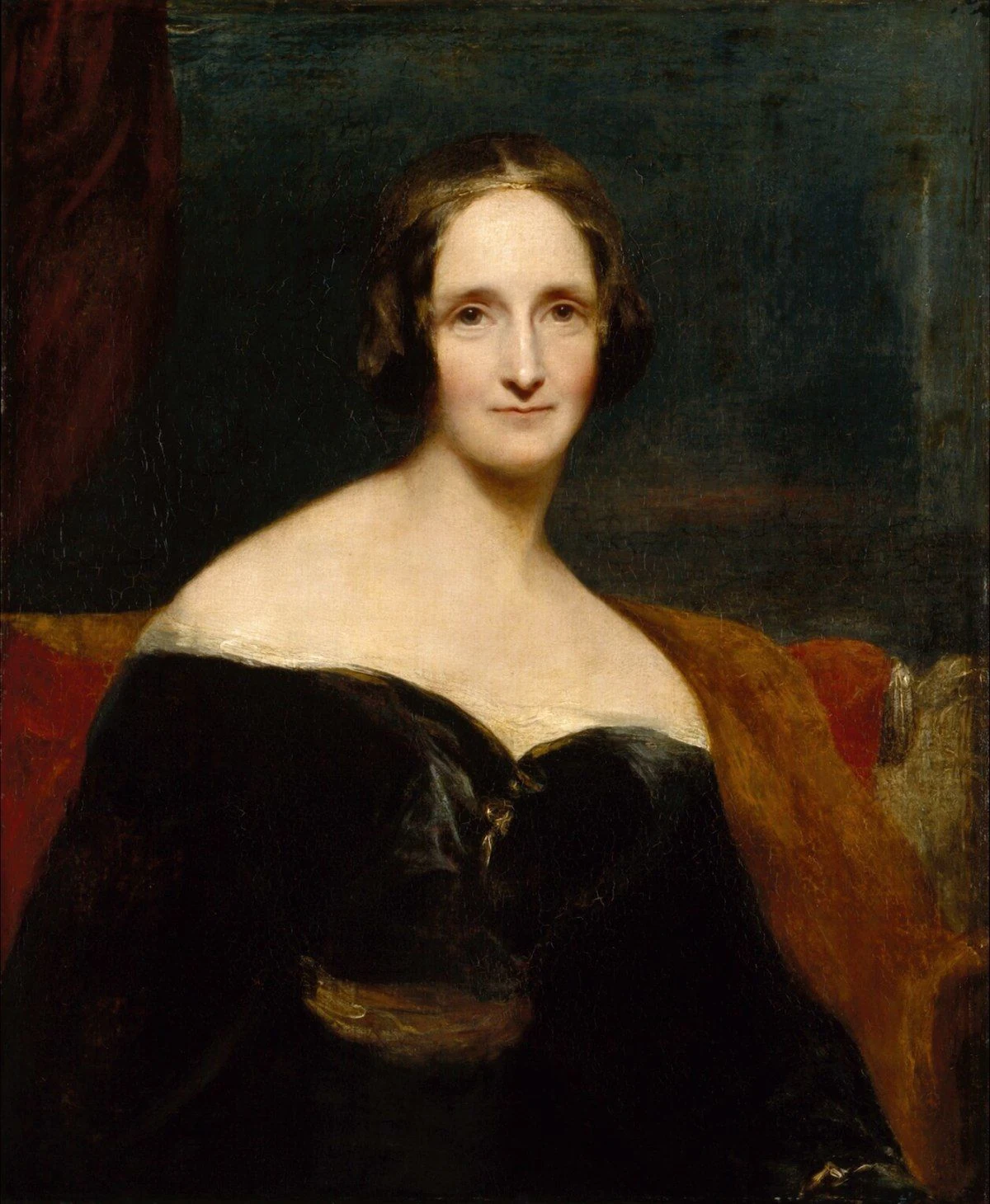
_-_Mary_Wollstonecraft_Shelley_-_NPG_1235_-_National_Portrait_Gallery.jpg)