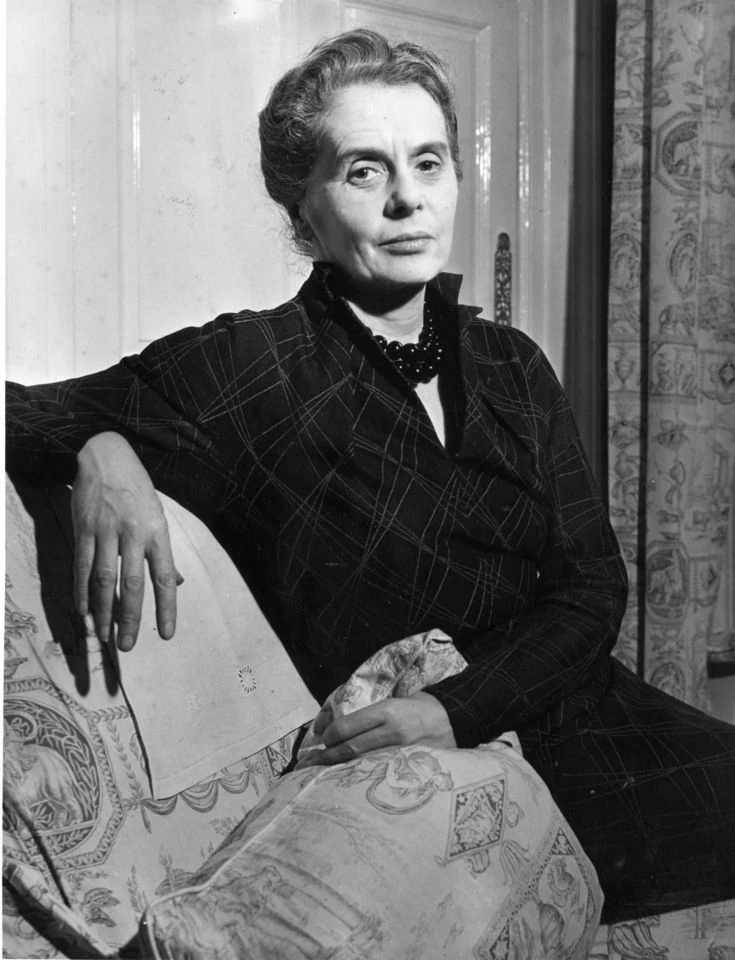
Ninette de Valois helped turn ballet in Britain from a scattered activity into a connected system: a school to train dancers, a company to employ them and a repertory that could be built at home. Born Edris Stannus in County Wicklow, she became a dancer with Sergei Diaghilev’s Ballets Russes before making London the centre of a project that would grow into The Royal Ballet. Her work also reached beyond Britain, shaping ballet in Ireland and Turkey.
Training, performance and a change of direction
Stannus was born on 6 June 1898 at Baltyboys House, near Blessington, County Wicklow. In 1905 she moved to England to live with her grandmother in Kent, and began ballet lessons three years later. At 13, she started professional training at the Lila Field Academy for Children, adopted the name Ninette de Valois and made her professional debut as a principal dancer in pantomime at the Lyceum Theatre in London’s West End.
In 1919 she became principal dancer with the Beecham Opera, then based at the Royal Opera House. She continued studying with teachers including Edouard Espinosa, Enrico Cecchetti and Nicholas Legat. In 1923 she joined Diaghilev’s Ballets Russes, performing around Europe and rising to the rank of soloist. She created roles in works including Les biches and Le Train Bleu, and mentored the young Alicia Markova, who later became one of Britain’s best-known dancers.
De Valois later said that she learned how to run a ballet company from working with Diaghilev. A childhood case of polio had left damage detected by doctors, and in 1924 she stepped back from regular, intensive dancing. Her experience as a performer remained central to her next ambition: creating a company whose dancers would be trained together and given a continuing body of work.
A school and a company take shape
In 1927, de Valois established the Academy of Choreographic Art in London, as well as the Abbey Theatre School of Ballet in Dublin. The London school was intended to supply dancers for a repertory company trained in a distinctively British style. Its pupils gained stage experience in opera and plays at the Old Vic, where de Valois also choreographed short ballets.
Lilian Baylis, who ran the Old Vic, had acquired and refurbished Sadler’s Wells Theatre, intending it to work alongside the Old Vic. She engaged de Valois to stage full-scale dance productions at both theatres. When Sadler’s Wells reopened in 1931, de Valois moved the school into its studios, where it became the Sadler’s Wells Ballet School. The Vic-Wells Ballet was formed that year; the company and school became predecessors of today’s Royal Ballet, Birmingham Royal Ballet and Royal Ballet School.
The new company began with six female dancers, with de Valois herself working as lead dancer and choreographer. Its first full ballet production was staged at the Old Vic on 5 May 1931, with Anton Dolin as guest star; its first performance at Sadler’s Wells followed on 15 May. De Valois retired fully from the stage in 1933, after Markova joined the company and was appointed its prima ballerina. She could then concentrate on directing and developing the institution.
Building a British repertory
Under de Valois’s direction, the company took on classical works associated with the Imperial Russian Ballet while developing a repertory of its own. In 1935 she engaged Frederick Ashton as principal choreographer and Constant Lambert as musical director. She choreographed Job (1931), The Rake’s Progress (1935) and Checkmate (1937), works that became important to the company’s identity.
Job, her first major production for the Vic-Wells Ballet, brought together an entirely British creative team. Its score, Job, a Masque for Dancing, was written by Ralph Vaughan Williams, with orchestrations by Lambert; Gwendolen Raverat designed the production and Geoffrey Keynes wrote its libretto, based on William Blake’s illustrations of the Book of Job. First performed in 1931, it remains the oldest ballet in the Royal Ballet repertory. The company also grew to include dancers such as Margot Fonteyn, Robert Helpmann, Moira Shearer, Beryl Grey and Michael Somes. Its 1949 tour of the United States brought international attention to Fonteyn.
The school and company were formally linked when they received a Royal Charter in 1956. De Valois continued to invite choreographers, including Kenneth MacMillan and George Balanchine, and to develop a succession of dancers. She retired as director of the Royal Ballet in 1963 and from the school in 1970. The touring company she established became Birmingham Royal Ballet.
Beyond London: Ireland and Turkey
De Valois’s institutional work was not confined to England. The Abbey Theatre School of Ballet in Dublin, established from 1927, ran until 1933. Its students formed part of an early effort to create a national ballet school in Ireland; de Valois later supported projects including the Cork Ballet Company and the Irish National Ballet Company.
In Turkey, the government invited her to investigate establishing a ballet school. She visited in the 1940s and helped create a school modelled on the Sadler’s Wells Ballet School. The school became established under Molly Lake and Travis Kemp, who took responsibility for it in 1954 at de Valois’s request. It helped lay the foundations for the Turkish State Ballet. De Valois produced early performances and introduced both classical works and ballets by British choreographers. In 1965 she choreographed Çeşmebaşı, the first full-length work created for the new Turkish State Ballet, with music by Ferit Tuzun and choreography incorporating Turkish folk-dance elements.
Honours and a long working life
De Valois was appointed CBE in 1947 and promoted to Dame Commander in 1951. Later honours included the Order of the Companions of Honour in 1981 and the Order of Merit in 1992. Her awards included the Royal Society of Arts Albert Medal in 1964, the Erasmus Prize in 1974 and a special Laurence Olivier Award in 1992. She also received honorary degrees from several universities, among them London, Oxford, Sheffield, Trinity College Dublin and Aberdeen.
In 1935 she married physician Arthur Blackall Connell. They had no children together; she had two stepsons. She kept her private life distinct from her professional work and continued to make public appearances into old age. De Valois died in Barnes, London, on 8 March 2001, aged 102.
Why Ninette de Valois deserves a place in British Legacy
De Valois deserves a place in British Legacy because she did more than lead a successful dance company: she built the structures that allowed British ballet to train, employ and develop its own artists. The school and company she brought together at Sadler’s Wells became the foundations of the Royal Ballet School and The Royal Ballet. Their growth gave dancers a route from training to professional performance, while the company’s repertory joined classical works with ballets made by British choreographers and composers. Job, created by an entirely British team, is a particularly clear example of that ambition in practice.
Her influence also travelled in both directions. Experience with Diaghilev informed the way she organised a company, while her later work in Ireland and Turkey helped establish schools and institutions beyond London. In Turkey, the school she helped set up contributed to the development of the Turkish State Ballet; in Ireland, her Dublin school formed part of an early attempt to build national ballet provision. These are specific, lasting cultural contributions, not simply measures of reputation. De Valois’s British legacy lies in making ballet sustainable as an art form: through training, repertory, employment and institutions capable of continuing beyond their founder.
Sources
Ninette de Valois (revision 1368360956)
Adapted in part from Ninette de Valois by Wikipedia contributors, under CC BY-SA 4.0. Text has been edited and combined with the existing article; this adapted text is shared under the same licence. Contributor history.