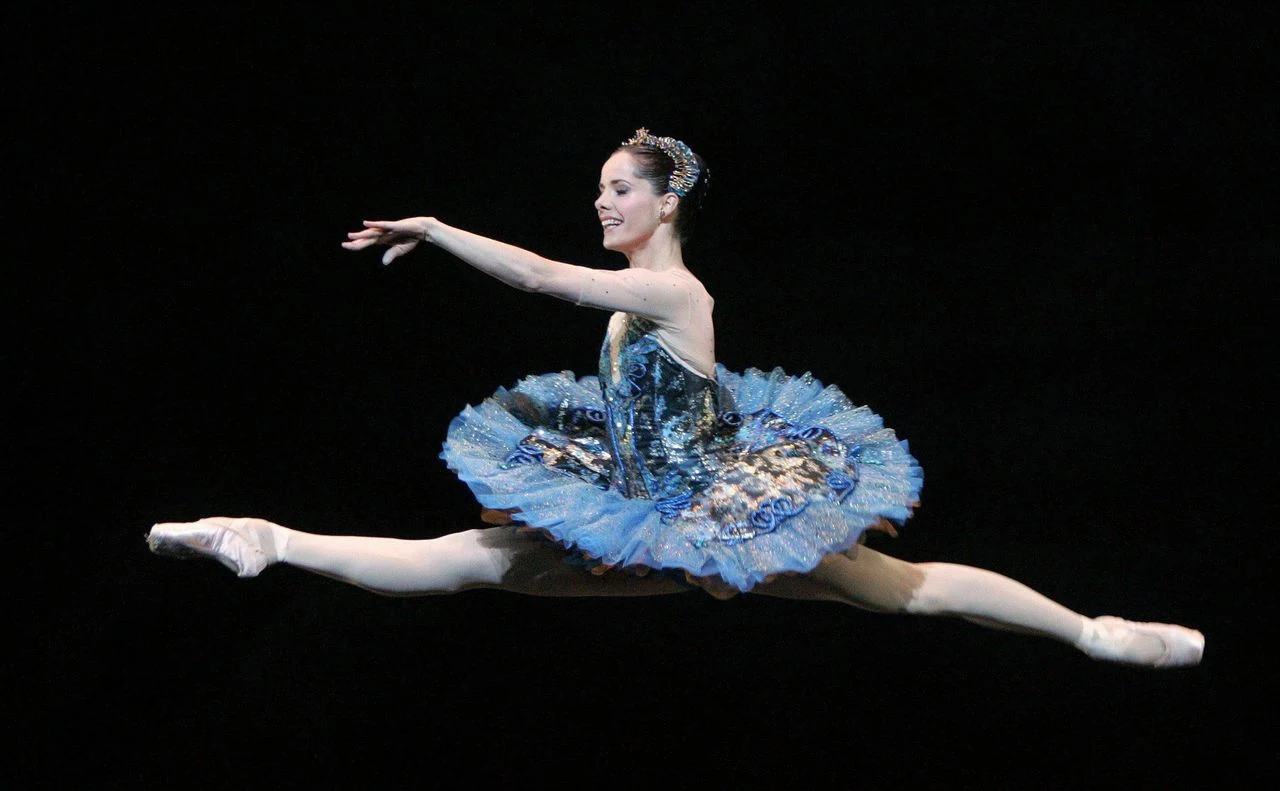
Darcey Bussell’s career brought the Royal Ballet’s classical repertoire to audiences in the theatre, on television and at the 2012 Olympic Games. She joined the company in 1989 and, at 20, became its youngest-ever principal dancer. Over the next two decades she performed more than 80 roles, including parts created for her, before retiring in a final performance at the Royal Opera House in 2007. Her work since then has extended from judging Strictly Come Dancing to championing dance and its place in public life.
Training, and an early breakthrough
Born in London on 27 April 1969, Bussell began dance classes at the Mercury Theatre, home to the Rambert dance company. She studied stagecraft at the Arts Educational School before entering the Royal Ballet School’s Lower School at White Lodge, Richmond Park, in 1982, aged 13. At 16 she moved to the Upper School at Barons Court. While studying, she won the Prix de Lausanne, an international ballet competition, and appeared in school productions, including performances at Covent Garden.
In 1987 she joined Sadler’s Wells Royal Ballet. The following year, while still a student, she was given a leading role in Kenneth MacMillan’s The Prince of the Pagodas. The production helped bring her to the attention of the Royal Ballet. In 1989, on the ballet’s opening night, she moved to the company and was promoted to principal dancer. At 20, she was the youngest person to hold that rank in its history.
The promotion launched a career at the centre of the Royal Ballet. Bussell remained with the company for more than two decades, while also appearing as a guest with companies including New York City Ballet, La Scala Theatre Ballet, the Kirov Ballet, Hamburg Ballet and the Australian Ballet. Her international engagements took her beyond the British stage, but the Royal Ballet remained her principal artistic home.
A repertoire built for range
Bussell danced leading roles across the classical repertoire. These included Princess Aurora in The Sleeping Beauty, Odette and Odile in Swan Lake, the Sugar Plum Fairy in The Nutcracker, and Giselle. She also performed Masha in MacMillan’s Winter Dreams, Princess Rose in The Prince of the Pagodas, and roles in La Bayadère and Manon. The variety mattered: her work encompassed both familiar classical parts and ballets by MacMillan, whose choreography helped shape the Royal Ballet’s modern repertory.
Her association with The Sleeping Beauty ran through several productions. She danced Aurora in four versions, including Sir Anthony Dowell’s staging, which she opened at the Kennedy Center in Washington, DC, before President Bill Clinton. Her performances in Sylvia and Giselle, highlighted in accounts of her career, placed different demands on a dancer: the former’s physical command and the latter’s shifts between human vulnerability and the supernatural.
Across her career, Bussell performed more than 80 roles, and 17 were created for her. That record suggests more than technical versatility: choreographers and companies repeatedly entrusted her with new work as well as established parts. She also appeared with New York City Ballet from 1993, beginning with the pas de deux from George Balanchine’s Agon.
Taking ballet beyond the theatre
Bussell’s work in broadcasting brought her knowledge of dance to audiences who might not regularly attend ballet. She joined the judging panel of the BBC’s Strictly Come Dancing during the final stages of the 2009 series, then returned as a permanent judge in 2012. She left the programme in 2019, after several years in which she assessed a very different style of performance from the classical roles for which she was known.
Television also gave her a platform to introduce other dancers and choreographers. She presented documentaries on ballet figures including Margot Fonteyn, Fred Astaire, Vaslav Nijinsky and Rudolf Nureyev, and co-presented the final of the BBC’s Young Dancer competition in 2015. In Darcey dances Hollywood, she recreated celebrated screen routines with choreographer Kim Gavin. Her television work ranged from dance history to the mental health benefits of movement; in 2021 she presented a series exploring Scotland’s coasts, followed in 2022 by Darcey Bussell’s Royal Roadtrip.
Her appearances have sometimes brought dance into other public events. At the London 2012 Olympic Games closing ceremony, she descended into the stadium as the “Spirit of the Flame”, leading a group of 200 ballerinas and four male dancers before the Olympic flame was extinguished. The performance placed ballet within a globally broadcast celebration staged in the host city.
Bussell has also written for young readers. In 2008, six books launched the Magic Ballerina series, based on an idea and storyline she initiated; the books were written with the help of ghostwriters. She co-wrote The Young Dancer with the Royal Ballet School and published autobiographical books about her ballet career, including Darcey Bussell: Evolved in 2018. The projects offered different routes into the art form: through fiction, practical learning and reflection on a performer’s working life.
Recognition and continued service
Bussell’s honours recognise both her performance career and her later contribution to dance. She was appointed OBE in 1995, made a CBE in 2006 and became a Dame Commander of the Order of the British Empire in 2018. Other recognition has included a gold medal from the John F. Kennedy Center for the Performing Arts, an honorary doctorate from the University of Oxford in 2009 and an honorary doctorate from the Royal Conservatoire of Scotland in 2017.
Her work in dance organisations has continued alongside public appearances. She became president of the Royal Academy of Dance in 2012 and has served as campaign president for Birmingham Royal Ballet’s fundraising campaign. Her other roles have included an ambassador for the giving programme of the New Zealand School of Dance, a board member of the Margot Fonteyn Foundation and international patron of the Sydney Dance Company. She has also developed DDMIX, a dance-fitness programme whose name stands for Diverse Dance Mix, extending her interest in dance into a participatory setting.
In March 2023 Bussell was announced as the first female chair of the board of trustees of Plymouth Theatre Royal. She also presided over the jury at the Prix de Lausanne in 2024, returning in a new capacity to the competition she had won as a student. In 2025 she appeared on a Royal Mail stamp in a set commemorating The Vicar of Dibley, reflecting a television appearance in the sitcom in 1998.
Why Darcey Bussell deserves a place in British Legacy
Bussell’s place in British cultural life rests first on a clearly documented achievement within one of the country’s leading ballet companies. She joined the Royal Ballet as a young dancer and, in 1989, became its youngest-ever principal. More than two decades with the company followed. Her repertoire included major classical roles, works by Kenneth MacMillan and parts created specifically for her. The breadth of that record shows how a performer can contribute both to the inheritance of ballet and to the making of new work. Her retirement in 2007, marked by a performance of MacMillan’s Song of the Earth at the Royal Opera House and broadcast by BBC Two, connected a major career milestone with a British institution and a national broadcaster.
Her wider contribution has been to give dance a public presence beyond the opera house. Through Strictly Come Dancing, documentaries, the Olympic closing ceremony, writing for children and roles in dance organisations, she has reached audiences through several different forms. Those activities do not replace the discipline and achievement of her stage career; they build on them, helping explain dance, celebrate its history and invite participation. Her leadership and advocacy also connect her work to schools, companies and cultural organisations in Britain and overseas. Taken together, Bussell’s performance, broadcasting and service show a sustained British contribution to ballet: not only as an art performed on stage, but as a practice that can be shared with wider communities.
Sources
Adapted in part from Darcey Bussell by Wikipedia contributors, under CC BY-SA 4.0. Text has been edited and combined with the existing article; this adapted text is shared under the same licence. Contributor history.