
David Adjaye’s buildings range from a neighbourhood library in east London to a museum on Washington’s National Mall. Across those different settings, his work has drawn on the histories and identities of the places it serves. The National Museum of African American History and Culture, which opened in 2016, brought him international recognition; projects including Whitechapel’s Idea Store show how his practice has also engaged with public life in Britain.
A childhood across continents
Adjaye was born in Dar es Salaam, Tanzania, on 22 September 1966. His father was a Ghanaian diplomat, and his early years took him to Tanzania, Egypt, Yemen and Lebanon. He moved to Britain at the age of nine. That varied experience preceded his architectural training in London: he studied at London South Bank University, graduating with a degree in architecture in 1990, and completed a master’s programme at the Royal College of Art in 1993.
His undergraduate project, Respite, won the Royal Institute of British Architects’ Bronze Medal for the best undergraduate design project in the UK. The recognition came at the start of a career that moved from houses and studios towards larger public commissions. Early residential projects included a house for artist Chris Ofili in 1999, followed by Dirty House and Glass House in 2002. Adjaye’s work with artists would continue through projects that brought architecture into dialogue with art and exhibition-making.
In 2000 he established Adjaye Associates. The practice grew into an international firm, with offices in Accra, London and New York and projects across several continents. Its global reach grew out of a career whose British base was evident both in its London practice and in buildings made for communities there.
Public buildings and a London practice
The Idea Store in Whitechapel is among Adjaye’s most recognisable British projects. Developed as a public library on the site of a 1960s shopping centre, it was shortlisted for the Stirling Prize in 2006. The project placed a library within the everyday activity of a busy urban area, challenging the expectation that such a service should be set apart from the surrounding community.
Other British commissions included the Bernie Grant Arts Centre and the Stephen Lawrence Centre, both completed in 2007. These projects sit alongside a much wider practice rather than a single architectural style or building type. Adjaye also designed the Nobel Peace Center in Oslo, which opened in 2005, and the Moscow School of Management Skolkovo, completed in 2010. Its single-form design departed from the conventional campus arrangement and was intended to encourage interaction among students.
His public-library work extended to Washington, DC, where two neighbourhood libraries designed by Adjaye opened in 2012: the Francis A. Gregory Neighborhood Library and the Bellevue/William O. Lockridge Library. The projects demonstrate how a practice developed in London took on civic commissions in different communities, responding to distinct settings rather than simply repeating a familiar model.
A museum that places history at its centre
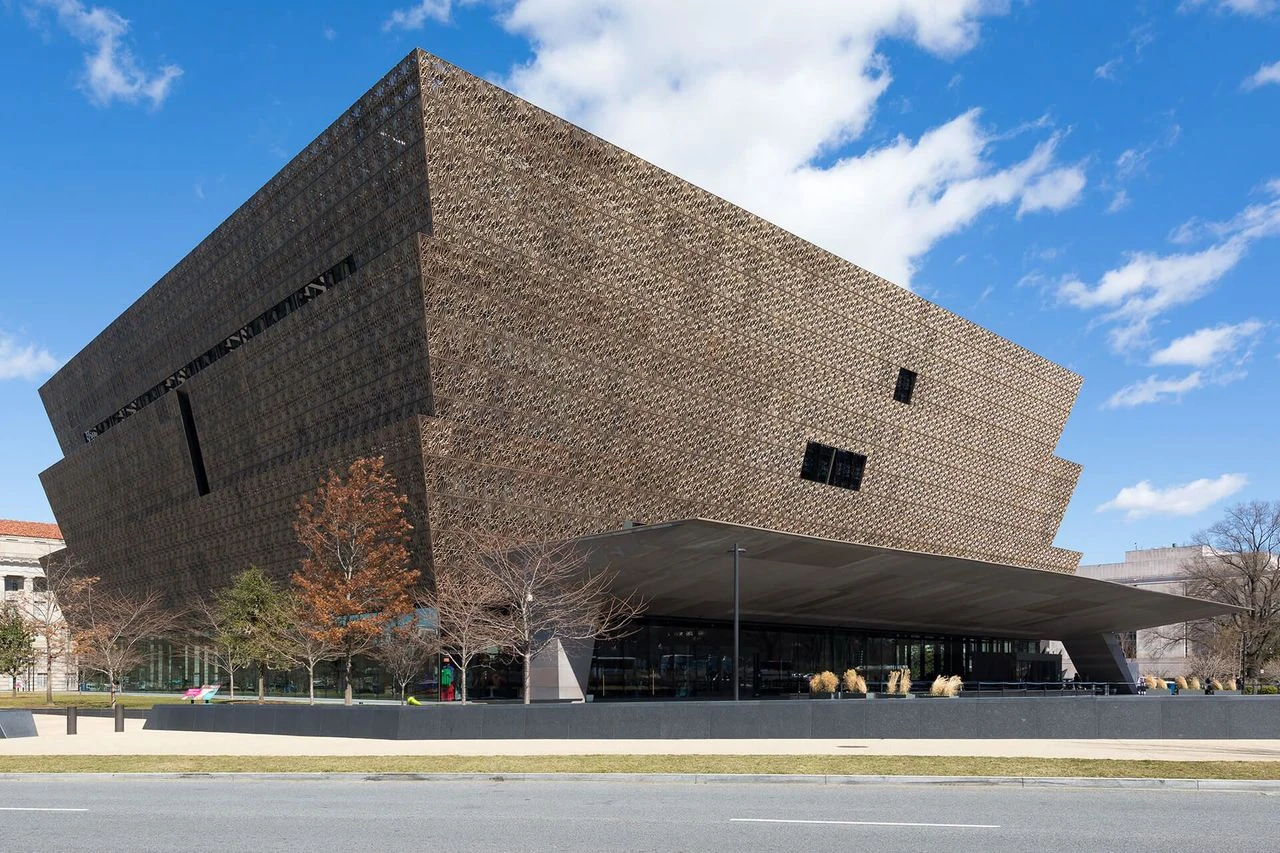
In 2009, Adjaye was selected as lead architect for the team designing the Smithsonian’s National Museum of African American History and Culture in Washington, DC. He worked with the Freelon Group, Davis Brody Bond and SmithGroup on the project. Opened in 2016, the museum became his best-known commission.
The building’s crown-like exterior draws on Yoruba sculpture. Its form gives the museum a distinct presence on the National Mall, close to the Washington Monument, while its subject places African American history within a landscape of national institutions. That architecture serves a purpose beyond appearance: the building’s design gives a prominent public setting to histories and achievements that the museum was created to explore.
The museum was one of several projects through which Adjaye worked across architecture, art and public culture. In 2015, he designed the Aishti Foundation in Beirut, combining gallery and retail space. In San Antonio, Texas, Ruby City, a contemporary art centre designed by Adjaye, opened in 2019. His practice also collaborated with artists on installations and exhibition projects, including work with Chris Ofili and Olafur Eliasson.
Recognition, changing plans and professional life
Adjaye was appointed an Officer of the Order of the British Empire in 2007 for services to British architecture, and was knighted in the 2017 New Year Honours for services to architecture. His recognition also included the RIBA Royal Gold Medal for 2021, awarded for a substantial contribution to international architecture. He was the first African recipient of the medal. In 2022, he was appointed to the Order of Merit.
Some of the projects described as forthcoming in earlier accounts have since changed status. Ruby City opened in 2019. The Africa Institute project in Sharjah, which had been presented as a future commission, was cancelled. In Britain, Adjaye withdrew from involvement in the National Holocaust Memorial and Learning Centre; his practice remained lead architect. These distinctions matter: a design, an active commission and a completed building are not interchangeable stages of a project.
In 2023, three women who had worked at his practice made allegations of sexual assault and harassment against Adjaye. He denied the allegations, and no charges were brought. He apologised for what he called “mistakes” in which he had “blurred the boundaries” between his professional and personal lives. In the aftermath, he resigned as architectural adviser to the Mayor of London. The Africa Institute cancelled its campus project, and his practice was removed from a project at Liverpool’s International Slavery Museum. Adjaye Associates said it had commissioned an independent workplace review and made changes to its governance.
The career described by these projects and honours is not simply a list of commissions. It includes work that opened, plans that changed, and a practice adapting its organisation and responsibilities. That record gives a fuller picture of an architect whose designs have travelled widely while retaining a significant connection to Britain through education, professional practice and public commissions.
Why David Adjaye deserves a place in British Legacy
Adjaye’s place in British Legacy rests on a specific and substantial connection: he moved to Britain as a child, trained as an architect in London and established a practice there that went on to work internationally. The Idea Store in Whitechapel, shortlisted for the Stirling Prize, and the Bernie Grant Arts Centre and Stephen Lawrence Centre show how his work has contributed to public and cultural buildings in Britain. His career also demonstrates how a London-based practice can work across different countries without losing sight of the communities and histories that give each commission its meaning.
The National Museum of African American History and Culture is an American institution, but its design forms part of that wider British architectural story: Adjaye led an international team on a major public commission, using a crown motif drawn from Yoruba sculpture to give the building a distinctive place on the National Mall. The RIBA Bronze Medal and Royal Gold Medal, alongside his OBE and knighthood, mark the recognition his work received in Britain’s architectural institutions. A lasting account of his legacy should include both those achievements and the changing status of projects and professional roles. Taken together, they make his career a distinctive example of architecture connecting British training and practice with public buildings and cultural histories around the world.
Sources
David Adjaye — revision 1376051208
Adapted in part from David Adjaye by Wikipedia contributors, under CC BY-SA 4.0. Text has been edited and combined with the existing article; this adapted text is shared under the same licence. Contributor history.
.jpg)