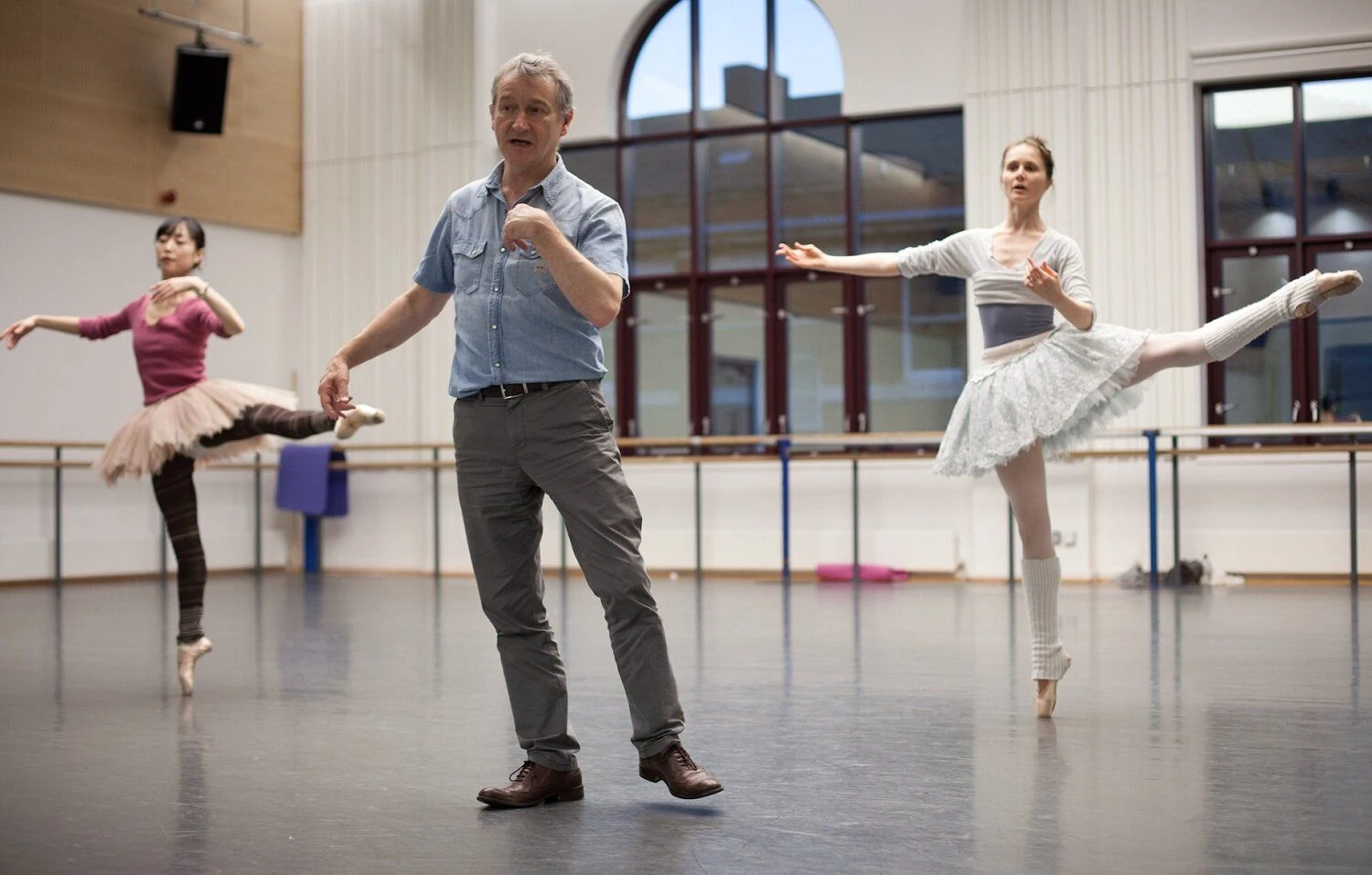
David Bintley’s ballets draw on sharply different worlds: the comic domestic setting of Hobson’s Choice, the political tragedy of Edward II, and the striking imagery of Still Life at the Penguin Cafe. Across a career as a dancer, choreographer and artistic director, he moved between storytelling and spectacle, while shaping the repertoire of Birmingham Royal Ballet (BRB) for almost a quarter of a century.
Training in London, first work in ballet
Bintley was born in Huddersfield on 17 September 1957 and trained professionally in classical ballet at the Royal Ballet School in London. While he was a student, some of his choreography came to the attention of Sir Frederick Ashton, the founder choreographer and artistic director of The Royal Ballet. That early notice connected his training as a dancer with the creative work that would become central to his career.
In 1976, Bintley was offered a contract to dance with Sadler’s Wells Theatre Ballet, the company that later became Birmingham Royal Ballet. His first commission as a choreographer followed in 1978: The Outsider, made for the same company. The move from performing to making work was not a sudden departure from the company’s world; it began within the institution where he had joined as a dancer.
He continued to build a relationship with both Birmingham and London. In 1985, he became resident choreographer of The Royal Ballet at the Royal Opera House in Covent Garden. The appointment gave him a role creating work for one of the country’s leading ballet companies, while his commissions also included pieces for BRB and companies beyond Britain. His career therefore developed across several settings, rather than being confined to a single troupe or style.
Building a choreographic repertoire
Still Life at the Penguin Cafe (1988) was among Bintley’s early major productions. Hobson’s Choice, created the following year, took its starting point from Harold Brighouse’s play. The source story gave the ballet a recognisable dramatic framework; Bintley’s version brought that material into the movement and stage language of ballet. It became one of the works most closely associated with him.
He returned to historical drama in Edward II (1995), drawing on Christopher Marlowe’s play. The work’s subject and source differ markedly from the domestic comedy of Hobson’s Choice, showing the range of material he brought to the stage. In the same year, he also created Carmina Burana. Other productions across his career included Far from the Madding Crowd (1997), Nutcracker Sweeties (1997), Beauty and the Beast (2003), Cyrano (2007) and E=mc² (2009).
The range continued through later works: Cinderella (2010), Aladdin and Faster (both 2012), Prince of the Pagodas (2014), The King Dances (2015) and The Tempest (2016). These titles span adaptations, familiar stories and subjects drawn from other fields. Taken together, they show a choreographer repeatedly choosing different kinds of material, rather than relying on a single signature subject.
Bintley also appeared on television. On Larry Grayson’s Generation Game, he performed “The Clog Dance”. The appearance sits alongside, rather than replacing, his work in the theatre: it brought a dance performance to a broad entertainment programme and is a memorable detail from a career largely associated with ballet companies and stage productions.
Leading Birmingham Royal Ballet
In 1995, Bintley succeeded Sir Peter Wright as artistic director of Birmingham Royal Ballet. The leadership appointment placed him at the head of the company he had first joined as a dancer in 1976. He remained in the post until 2019, making his directorship a long chapter in the company’s history as well as a continuation of his own working relationship with it.
During his tenure, he choreographed at least ten full-length and 12 one-act ballets for BRB. He also commissioned a further 21 ballets by other choreographers. Those figures describe two parts of the artistic-director role: creating work himself and making room in the company’s repertoire for work by others. The leadership of a ballet company is not only a matter of selecting or making productions; it also influences which choreographers and works audiences can encounter through that company.
In March 2018, Bintley announced that he planned to retire at the end of July 2019. Carlos Acosta succeeded him. The announced retirement and the subsequent change of artistic director mark a clear endpoint to his time at BRB, while leaving his own productions and the commissions he had brought to the company as part of its repertory history.
Honours and recognition
Bintley was appointed Commander of the Order of the British Empire (CBE) in the 2001 Birthday Honours for services to dance. He was knighted in the 2020 New Year Honours, also for services to dance. These honours recognise a career that combined performance, choreography and leadership within British ballet.
In January 2015, he received an honorary doctorate from the University of Warwick. It was another form of recognition alongside the honours for dance, and came while he was still artistic director of BRB. Together, the awards and his long leadership tenure place his work in both the cultural life of a major British ballet company and the wider national recognition of services to dance.
Why David Bintley deserves a place in British Legacy
David Bintley’s place in British Legacy rests on a specific, sustained contribution to the country’s ballet life. He began as a dancer with Sadler’s Wells Theatre Ballet, received his first choreographic commission from that company, and later became artistic director of its successor, Birmingham Royal Ballet. That trajectory links his individual creative work to the continuing life of a British company. His leadership lasted from 1995 to 2019, and the record of his tenure includes at least ten full-length and 12 one-act ballets choreographed for BRB, as well as 21 further ballets commissioned from other choreographers.
His repertoire also demonstrates how ballet can carry very different material onto the stage. Hobson’s Choice adapted a play by Harold Brighouse; Edward II drew on Marlowe; and later productions ranged from Beauty and the Beast and Cinderella to E=mc² and The Tempest. The value of that range lies not in a claim that every work had the same effect, but in the breadth of stories and subjects brought into the repertory. By making ballets himself, supporting commissions by others and guiding BRB over a long period, Bintley helped sustain a place for varied choreographic work within British dance. His career connects artistic creation, company leadership and the development of a public repertory: a concrete contribution to the cultural record of ballet in Britain.
Sources
David Bintley — Wikipedia, revision 1325718868 · David Bintley — Wikipedia
Adapted in part from David Bintley by Wikipedia contributors, under CC BY-SA 4.0. Text has been edited and combined with the existing article; this adapted text is shared under the same licence. Contributor history.