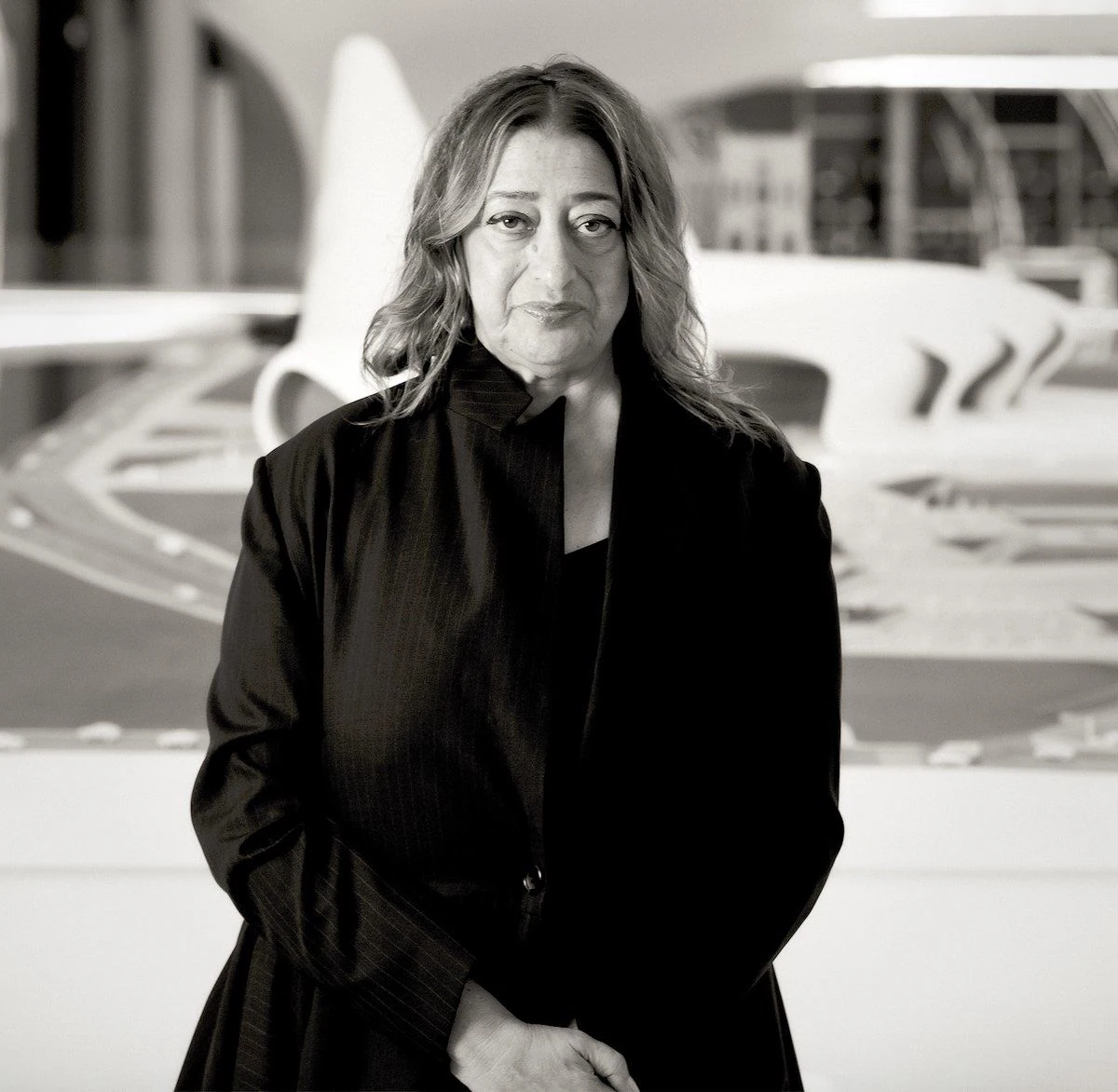
Zaha Hadid’s buildings seem to move even when they are still. Sweeping roofs, sharp diagonals and flowing interiors became hallmarks of a practice that challenged the right angle as architecture’s default. Born in Baghdad, Hadid moved to London to study in 1972, established her own practice there and created works across the world. In Britain, the London Aquatics Centre and Glasgow’s Riverside Museum show how her ideas met the demands of public buildings and civic life.
Baghdad, Beirut and the Architectural Association
Hadid was born in Baghdad on 31 October 1950. She studied mathematics at the American University of Beirut before moving to London in 1972 to attend the Architectural Association School of Architecture. There she studied with Rem Koolhaas, Elia Zenghelis and Bernard Tschumi. Her graduation project, Malevich’s Tektonik, proposed a 14-storey hotel on Hungerford Bridge and was developed as an acrylic painting inspired by the Russian avant-garde artist Kazimir Malevich.
After graduating in 1977, Hadid worked in Rotterdam with Koolhaas and Zenghelis at the Office for Metropolitan Architecture. She became a naturalised British citizen and opened her own London practice, Zaha Hadid Architects, in 1980. In its early years, the practice’s projects were often better known through drawings, paintings and architectural journals than through completed buildings. Ambitious proposals such as The Peak in Hong Kong and an opera house for Cardiff remained unrealised. The Cardiff competition jury selected her design, but the funding body declined to support it.
That gap between imaginative proposals and buildings that could actually be constructed shaped the early part of her career. Hadid’s drawings were not simply illustrations of conventional schemes: they tested how space might be organised through abstraction, diagonals and unexpected relationships between parts. In 1988, her work appeared in the Museum of Modern Art’s exhibition Deconstructivist Architecture in New York. The exhibition, a conference at Tate and wider press attention helped establish her international reputation.
From drawings to built work
Hadid’s first completed building complex was the Vitra Fire Station in Weil am Rhein, Germany, finished in 1993. Its sharp, intersecting concrete and glass forms made her approach tangible. Other early projects included the Bergisel Ski Jump in Innsbruck, completed in 2002, and the Contemporary Arts Center in Cincinnati, which opened in 2003. The Cincinnati commission made her the first woman to design an art museum in the United States.
In 2004, Hadid became the first woman to receive the Pritzker Architecture Prize. At that point, she had completed only four buildings, yet the award recognised the force of the architectural ideas developed across her drawings, teaching and practice. She later won the Royal Institute of British Architects’ Stirling Prize in consecutive years: in 2010 for the MAXXI museum in Rome and in 2011 for Evelyn Grace Academy, a school in Brixton, London.
Her work did not depend on computer design alone. Hadid continued to draw by hand and make models, while her practice also used computer modelling to develop complex forms. The Innovation Tower at Hong Kong Polytechnic University, for example, required computer modelling for its unusually intricate geometry. The combination of hand drawing, physical models and digital tools formed part of a broader method: technology helped realise designs, but did not define their starting point.
Buildings for Britain
The London Aquatics Centre was designed for the 2012 Olympic Games and completed in 2011. Hadid described its form as inspired by water in motion. Its roof dips in a broad arch above three swimming pools, supported by only three points. The main pools were designed to accommodate 17,500 spectators. The centre was the first Olympic building to begin construction and the last to be completed; its complex roof contributed to a final cost of £269 million, around three times the original estimate.
The building’s sweeping roof made it one of the Games’ most recognisable venues, but the project also illustrates the practical demands of turning an expressive design into a major public facility. After the Olympics, the venue was adapted for public use. Its role therefore extended beyond the sporting event for which it was built, while its architecture remained a conspicuous part of the Olympic landscape in east London.
Hadid’s British work was not limited to the capital. The Riverside Museum in Glasgow, completed in 2011, houses the city’s transport collection on the banks of the Clyde. Hadid described its form as a wave and as folds in movement. Its roofline rises and falls in a sequence of peaks, while the building opens towards both city and river. She also designed the Evelyn Grace Academy in Brixton, which won the Stirling Prize, and the extension to the Serpentine Gallery in Kensington Gardens, where a contemporary structure was added beside the nineteenth-century Magazine building.
At the Serpentine, the project joined new construction to an existing historic building. Hadid worked with architect and heritage specialist Liam O’Connor on the extension and the restoration of the original arrangement. In Oxford, her practice designed the Investcorp Building at St Antony’s College, completed in 2015. These commissions show the variety of her British projects: a school, a museum, a gallery extension and an academic building, each responding to a different setting and use.
A global practice and a public reputation
Hadid’s commissions also included the Guangzhou Opera House in China, Rome’s MAXXI museum and the Heydar Aliyev Centre in Azerbaijan. She was made a Dame Commander of the Order of the British Empire in 2012 for services to architecture. In February 2016, she became the first woman to receive the RIBA Royal Gold Medal in her own right. These honours recognised a career that had moved from radical proposals to buildings realised across several continents.
Teaching remained part of that career. Hadid taught at the Architectural Association and held academic posts and visiting professorships at institutions including Harvard, Columbia, Yale and the University of Applied Arts in Vienna. She also designed beyond architecture, creating interiors, furniture and other objects. Her London practice continued after her death, and projects already under way were completed in subsequent years.
Hadid died in Miami on 31 March 2016, aged 65, after a heart attack while being treated for bronchitis. Her work had attracted both praise and criticism: its scale and unusual forms could be admired as formal invention or challenged for the way they occupied their settings. That response is part of the history of an architect who repeatedly asked clients, builders and the public to consider forms of space beyond familiar conventions.
Why Zaha Hadid deserves a place in British Legacy
Hadid’s place in British Legacy rests on a substantial, specific connection to Britain. London was where she trained, where she established her practice in 1980 and where she developed a career that became international. Her British buildings brought that work into public and civic settings: the Aquatics Centre gave the London Olympics a distinctive architectural landmark; the Riverside Museum created a new home for Glasgow’s transport collection; and Evelyn Grace Academy brought her design approach into a school in Brixton. Her extension to the Serpentine Gallery also joined contemporary design to a historic building, while the Investcorp Building added another London-based institutional commission.
Her contribution was not only a collection of striking forms. Hadid showed that architecture could challenge established ideas about geometry while still addressing the needs of particular buildings and users. The Aquatics Centre’s roof and pools had to serve an Olympic event and a later public role; the Riverside Museum had to connect its galleries to both city and river. Her work brought engineering, visual experimentation and public use into the same discussion. Her teaching and the recognition she received from British architectural institutions extended that influence beyond individual projects. Remembering Hadid in a British context does not require claiming her as exclusively British: she was an Iraqi and British architect whose London education, practice and built work made a lasting contribution to architecture in the UK and beyond.
Sources
Zaha Hadid — Wikipedia revision · Zaha Hadid — Wikipedia
Adapted in part from Zaha Hadid by Wikipedia contributors, under CC BY-SA 4.0. Text has been edited and combined with the existing article; this adapted text is shared under the same licence. Contributor history.