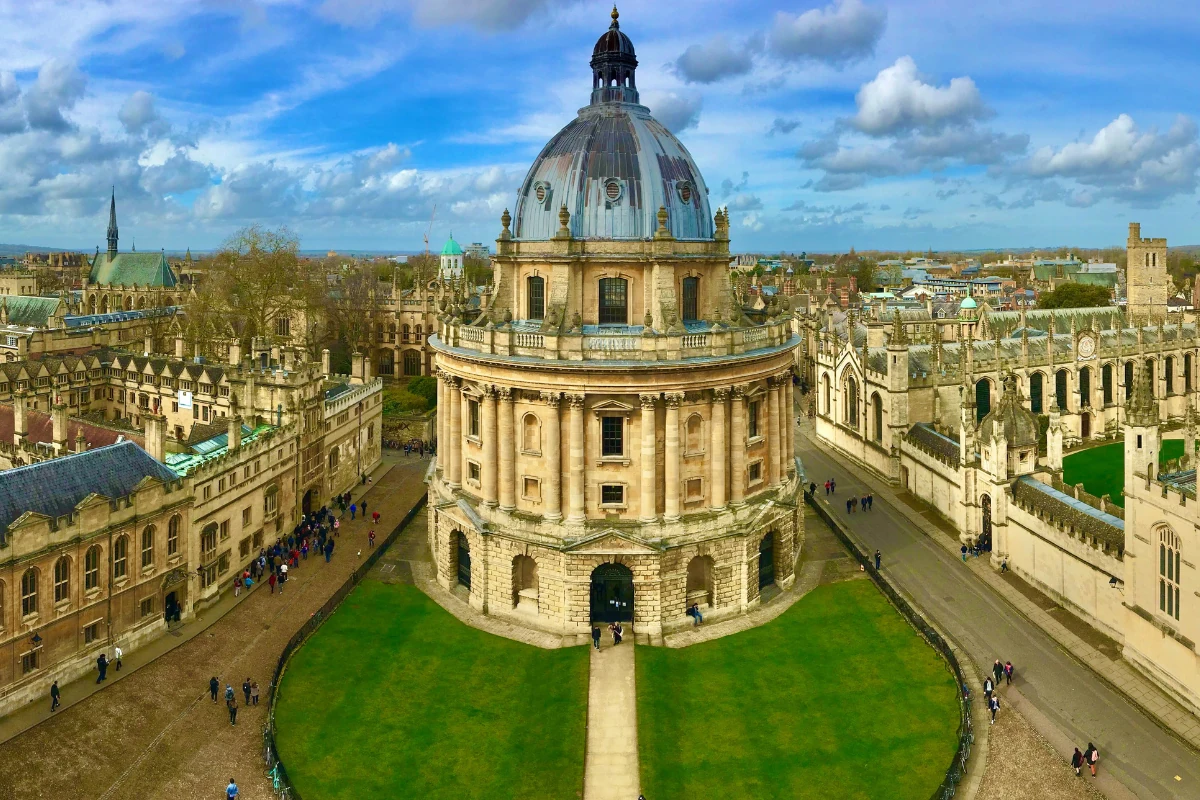
Teaching was taking place at Oxford by 1096, although the university’s foundation date is unknown. From that uncertain beginning grew a collegiate research university whose buildings and institutions are woven into the city around them. Oxford’s history includes scholarship and scientific societies, the creation of a second English university after scholars left for Cambridge, and a long struggle to widen access to education. Its influence is visible not only in the people who studied or worked there, but in its libraries, museums, publishing and research.
A university takes shape
Oxford emerged during the 12th century within the religious and educational culture of western Europe. Its early teaching was conducted by clerics, and theology and canon law were central to the curriculum. The surviving record does not establish a single founding date. Teaching is documented by 1096, and the university expanded rapidly from 1167, when Henry II prohibited English students from attending the University of Paris. Scholars returned to England and an academic community flourished at Oxford.
Conflict between students and townspeople led some academics to flee to Cambridge in 1209; they later formed the University of Cambridge. Oxford’s head had the title of chancellor by at least 1214, its masters were recognised as a corporation in 1231, and Henry III granted it a royal charter in 1248. Benefactors established colleges as residential scholarly communities. University College traces its foundation to William of Durham’s endowment in 1249; Merton College, founded by Walter de Merton, helped establish a model for collegiate life.
The university changed with the intellectual and political currents around it. Renaissance learning encouraged the study of Greek and biblical scholarship. During the English Reformation, some Catholic scholars left for continental Europe, and Oxford’s reputation and enrolments later declined during the Age of Enlightenment. In the 17th century, Archbishop William Laud codified statutes and supported the University Press and Bodleian Library. Oxford became a Royalist centre during the Civil War, while the town supported Parliament.
Scientific inquiry also took root in college life. In the 1650s, Wadham Warden John Wilkins guided a group that included Robert Boyle and Robert Hooke. Their Oxford Philosophical Club is associated with the group that went on to found the Royal Society. It is one example of the university’s history as a place where scholarship and institutional change developed together.
Colleges, teaching and reform
Oxford is a city university, not a campus enclosed in one place. Colleges, academic departments, libraries and other facilities are distributed through the city. Students belong to a college or hall as well as to the university; colleges manage their own membership and activities, and undergraduate teaching is organised through both colleges and academic departments.
The tutorial is a defining feature of undergraduate study. Typically, one to four students meet an academic for an hour to discuss an essay or problem sheet. Lectures, seminars and laboratory work also form part of teaching. Colleges offer accommodation, libraries and social and cultural activities, while the central university conducts examinations and awards degrees. This collegiate arrangement links small-group teaching with a large research institution.
Reform gradually changed who could study and what could be studied. During the 19th century, the curriculum expanded beyond its traditional emphasis on classical subjects to include scientific and medical studies. Administrative reforms brought written entrance examinations and greater tolerance of religious dissent. Oxford introduced research doctorates in the early 20th century and was the first British university to establish a Doctor of Philosophy degree, in 1917.
Women’s access came in stages. The university allowed examinations for women in 1875, and women’s colleges were founded from 1878, including Lady Margaret Hall and Somerville College. Women became eligible for full membership and degrees in 1920, but a quota limiting their numbers remained until 1957. Formerly men-only colleges began admitting women in 1974; Oriel was the last to do so, in 1985. These changes mark a substantial shift from an institution in which access had long been restricted by gender and, for much of its history, religious requirements.
Libraries, museums and public scholarship
The Bodleian Libraries are central to Oxford’s academic work and public identity. The original Bodleian Library opened in 1602, and the wider library group brings together collections across the university. As a legal deposit library, the Bodleian can request a copy of every book published in the UK. Its collections support research across subjects and preserve printed books, manuscripts and other materials for future readers.
Oxford’s cultural institutions extend beyond the library. The Ashmolean Museum, founded in 1683, is described in the university article as the oldest museum in the UK and the oldest university museum in the world. The University Museum of Natural History holds zoological, entomological and geological specimens; the Pitt Rivers Museum displays archaeological and anthropological collections. The Museum of the History of Science and Christ Church Picture Gallery add further collections. These institutions make objects and scholarship accessible beyond the university’s teaching rooms.
Publishing has been another route by which Oxford’s work reaches a wider readership. Oxford University Press is the world’s largest university press by number of publications and publishes more than 6,000 new books a year. Its titles include the Oxford English Dictionary and academic, professional and reference works. In combination, the press, libraries and museums give the university a role not only in producing knowledge but also in organising, preserving and circulating it.
Public life, culture and an international reach
Oxford’s alumni and former members have entered many fields, from politics and law to literature and science. The university article records 31 British prime ministers among its alumni, as well as heads of state and government from other countries. Its list of notable Oxonians includes Margaret Thatcher, Theresa May, Boris Johnson, David Cameron, Rishi Sunak and Keir Starmer. Such associations are a measure of the university’s reach, though they do not by themselves explain the varied careers or views of those who studied there.
The university’s cultural associations include writers J. R. R. Tolkien and C. S. Lewis, and mathematician and writer Lewis Carroll. Oxford has also served as a setting for fiction, from Evelyn Waugh’s Brideshead Revisited to Colin Dexter’s Inspector Morse novels and Philip Pullman’s His Dark Materials. Its student societies, including the Oxford Union debating society, provide settings for argument and public speaking. The city’s university buildings, libraries and colleges have become part of the way Oxford is represented in literature and popular culture.
Oxford’s influence is not confined to Britain, and its institutions have changed alongside its international profile. The university is a member of the Russell Group and participates in international academic networks. It has also faced criticism over admissions and the sources of some donations. Those debates belong within a fuller account of the institution: prestige and reach do not remove questions about access, responsibility or the choices made in sustaining a university.
Why University of Oxford deserves a place in British Legacy
The University of Oxford deserves a place in British Legacy because its history shows how an institution can help shape the country’s intellectual and civic life over a long period. Its medieval development established a collegiate model that still influences how students are taught and live. Its tutorial system puts close discussion at the centre of undergraduate education, while its academic departments and research activity connect that tradition to a modern university. The story also records change rather than an unbroken ideal: reforms expanded subjects, loosened religious restrictions and, over time, opened colleges and degrees to women.
Oxford’s legacy is tangible in resources used by people beyond its own students. The Bodleian preserves and makes accessible books and manuscripts; its museums care for collections in art, science, archaeology and anthropology; Oxford University Press circulates scholarship and reference works to readers around the world. The university has also contributed to British public life through generations of alumni in politics, law, culture and other fields, while its international networks extend the reach of its teaching and research. These specific institutions and changes explain its British connection more clearly than prestige alone. They make Oxford a significant part of the country’s educational history, and an institution whose influence can be examined through both its achievements and the continuing debates surrounding it.
Sources
University of Oxford — Wikipedia revision 1379320952
Adapted in part from University of Oxford by Wikipedia contributors, under CC BY-SA 4.0. Text has been edited and combined with the existing article; this adapted text is shared under the same licence. Contributor history.