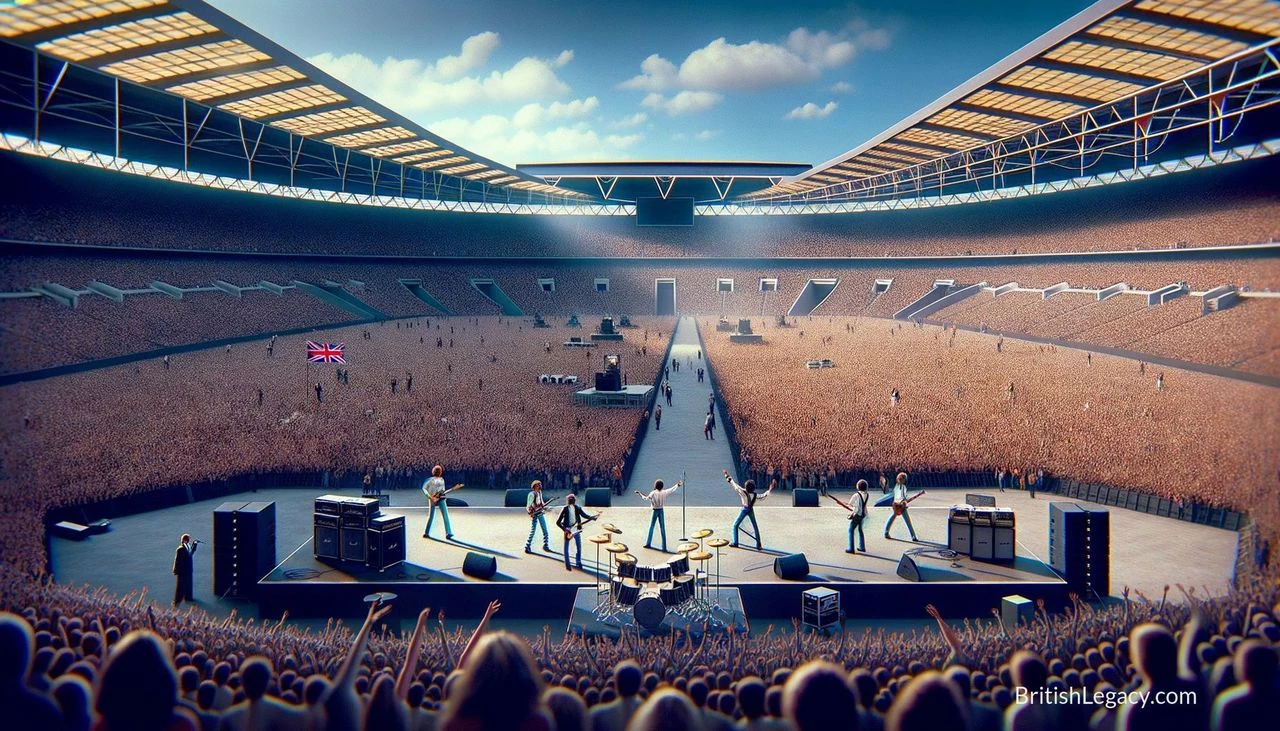
On 13 July 1985, a concert at Wembley Stadium became part of a much larger undertaking. Live Aid linked London with Philadelphia by satellite, while television carried performances and appeals for famine relief to audiences around the world. The event grew out of Band Aid’s charity single, but its scale made it something new: a day-long, two-venue broadcast that put popular music at the centre of a campaign for aid to Ethiopia.
From Band Aid to two stadiums
The immediate background was the famine in Ethiopia and the attention it received in British news coverage in 1984. Bob Geldof, then the Boomtown Rats’ lead singer, and Ultravox frontman Midge Ure wrote “Do They Know It’s Christmas?” as a fundraising single. Recorded by a group of British and Irish musicians under the name Band Aid, it was released in November 1984 and raised substantially more money than its organisers had initially expected.
The idea of a concert followed. Geldof and Ure organised Live Aid to raise further funds, with the event held simultaneously at Wembley Stadium in London and John F. Kennedy Stadium in Philadelphia. The concerts were not the only performances connected with the initiative: concerts inspired by it also took place in a number of other countries. The London and Philadelphia events began at different local times and overlapped for hours, making their coordination as much a broadcast undertaking as a musical one.
Wembley drew an attendance of 72,000; Philadelphia’s was 89,484. Among the organisers, Harvey Goldsmith was responsible for the Wembley concert, while Michael C. Mitchell put together the American leg. The undertaking depended on many more people and organisations, from production and broadcast teams to the performers who agreed to appear. Its reach rested on that collaboration, not on the two stadiums alone.
A concert built for television
Live Aid was among the largest satellite television broadcasts attempted at the time. An estimated 1.9 billion people in 150 nations watched the live transmission. The broadcast did not give every audience the same version of the day: the BBC, American networks and other broadcasters used different feeds, schedules and edits. Technical problems and the competing demands of the two stages also affected what viewers saw and heard. In Britain, BBC television coverage was accompanied by a BBC Radio 1 feed.
The format brought together a succession of artists rather than a single headline act. At Wembley, the Coldstream Guards opened with a Royal Salute, followed by Status Quo, the Style Council, the Boomtown Rats, Elvis Costello, U2, Dire Straits, Queen, David Bowie, the Who, Elton John and Paul McCartney, among others. The American programme included Joan Baez, the Four Tops, Madonna, Tom Petty and the Heartbreakers, Eric Clapton and Bob Dylan. Phil Collins performed at both principal venues, travelling from Wembley to Philadelphia between his appearances.
That international connection was not always smooth. A planned live duet between David Bowie in London and Mick Jagger in Philadelphia was abandoned because the delay in the transatlantic signal made a real-time performance impractical. Instead, the pair’s video for “Dancing in the Street” was shown during the broadcast. At Wembley, technical faults affected performances too: the television feed failed briefly during the Who’s set, and Paul McCartney’s microphone did not work properly at the start of “Let It Be”. Such interruptions are part of the event’s history as a pioneering live broadcast, not just a footnote to its performances.
Queen’s Wembley set
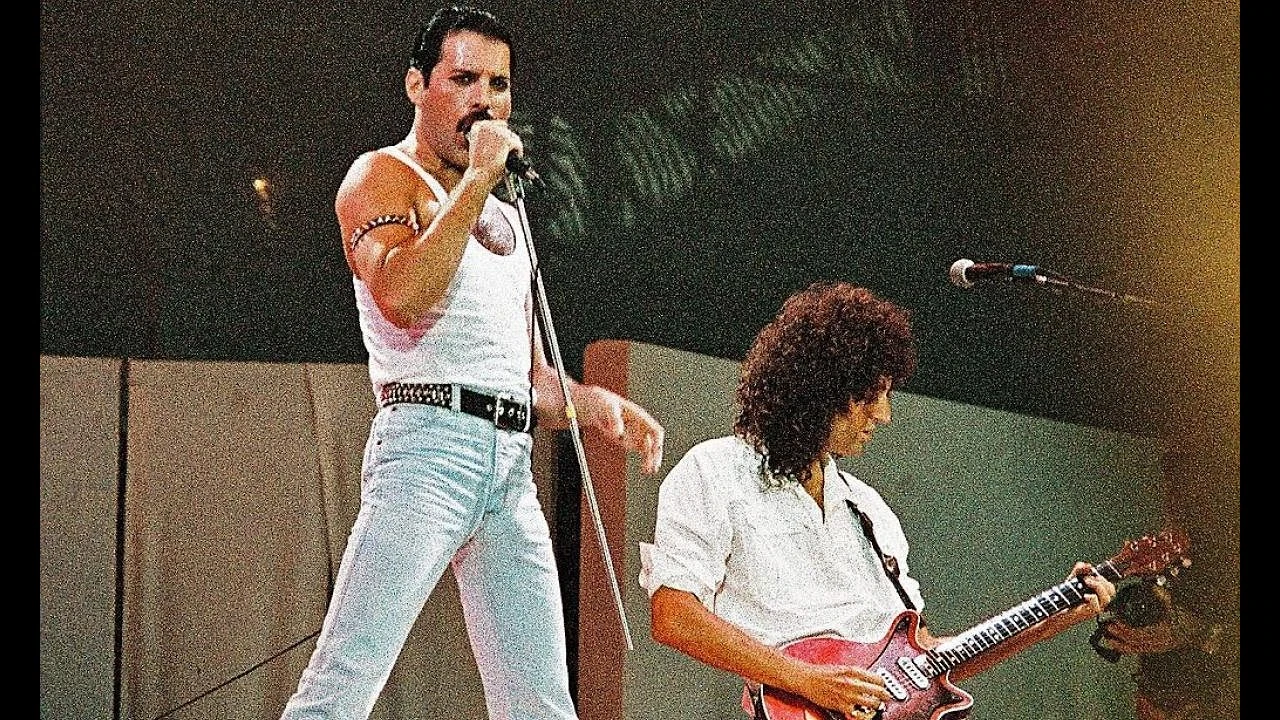
Queen began its Wembley performance at 6.41 pm. The set lasted 21 minutes and comprised six songs, opening with a shortened version of “Bohemian Rhapsody” and ending with “We Are the Champions”. In between came “Radio Ga Ga”, “Hammer to Fall”, “Crazy Little Thing Called Love” and “We Will Rock You”. Freddie Mercury drew the crowd into the performance, including during the call-and-response vocal section that became known as “The Note Heard Round the World”.
The set’s reputation has endured, but it was one part of a packed programme. U2’s extended performance of “Bad” ran so long that the band had to drop a third song. David Bowie introduced famine footage during his set, and Elton John had the day’s longest Wembley performance. The concert’s many distinct moments made it difficult to reduce Live Aid to a single act; Queen’s performance became its most frequently recalled musical image, while the event itself depended on the range of artists and the broadcast joining them.
Raising money, and questions of impact
Viewers were repeatedly encouraged to donate. In Britain, the BBC operated hundreds of telephone lines for contributions by credit card, and broadcast the means of giving throughout the event. Geldof publicly pressed for donations during the programme. After a video about the famine was shown, the rate of giving increased. The concerts eventually raised an estimated $127 million for famine relief in African nations.
The scale of the audience and the money raised did not settle every question about the consequences of the campaign. Live Aid’s impact on famine relief has been debated, and the concert’s success should not be mistaken for proof that one event could resolve the causes of hunger. The public attention it generated was itself significant: one aid worker described humanitarian concern as having moved to the centre of Western foreign policy. The event also exposed a continuing challenge for high-profile relief efforts: turning public attention and charitable contributions into effective assistance.
Claims about the diversion of Live Aid funds have also circulated. The Wikipedia account records that the BBC’s Editorial Complaints Unit found no evidence to support statements that funds raised by Band Aid and Live Aid had been diverted as alleged, and that the BBC apologised. That distinction matters when describing the controversy: the claims should not be repeated as established fact. The broader debate about how aid is delivered and monitored remains part of the history of the campaign, alongside its fundraising achievements.
After Live Aid
Live Aid established a model of celebrity-led fundraising on an exceptional scale and helped keep famine relief in public view. It is often linked to later benefit events, including Live 8, held in 2005 with a focus on debt cancellation for developing nations. The concert also had a substantial cultural afterlife. Queen’s set was recreated in the 2018 film Bohemian Rhapsody, and footage of the performance continues to shape how many viewers remember the day.
The lasting story is not simply that a large sum was raised or that famous musicians appeared. Live Aid brought together performers, organisers, broadcasters and audiences across national borders, using a still-ambitious television link to make a fundraising appeal at unprecedented scale. Its legacy includes both the reach of that appeal and the questions raised by the relationship between media attention, charitable action and the realities of famine.
Why Live Aid deserves a place in British Legacy
Live Aid belongs in British Legacy because its London concert placed British music, broadcasting and event organisation at the centre of an international undertaking. Wembley was one half of a two-stadium benefit, not an isolated British show: its connection with Philadelphia helped make the event a shared live broadcast, while performers and audiences in many countries extended its reach. The British contribution included the organising work of Bob Geldof and Midge Ure, the Wembley production led by Harvey Goldsmith, and performances by artists including Queen, U2, David Bowie, Elton John and Paul McCartney.
The event also demonstrated how popular culture could direct public attention and donations towards a humanitarian crisis. Its estimated global television audience and the funds raised show the practical scale of that mobilisation, while the later debate about aid’s effectiveness cautions against treating a concert as a solution in itself. That tension is part of the legacy, not a reason to flatten it into either unqualified celebration or dismissal. Live Aid remains a significant British cultural event because it combined music, television and fundraising in a form that travelled beyond the stadium and continued to influence how large benefit concerts are imagined.
Sources
Live Aid — Wikipedia revision 1377845668
Adapted in part from Live Aid by Wikipedia contributors, under CC BY-SA 4.0. Text has been edited and combined with the existing article; this adapted text is shared under the same licence. Contributor history.