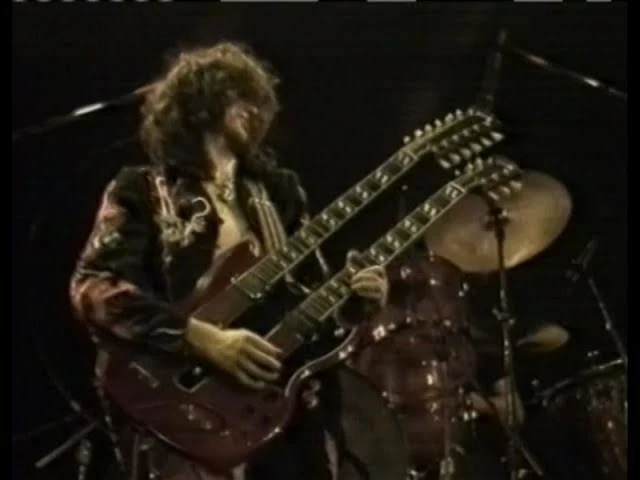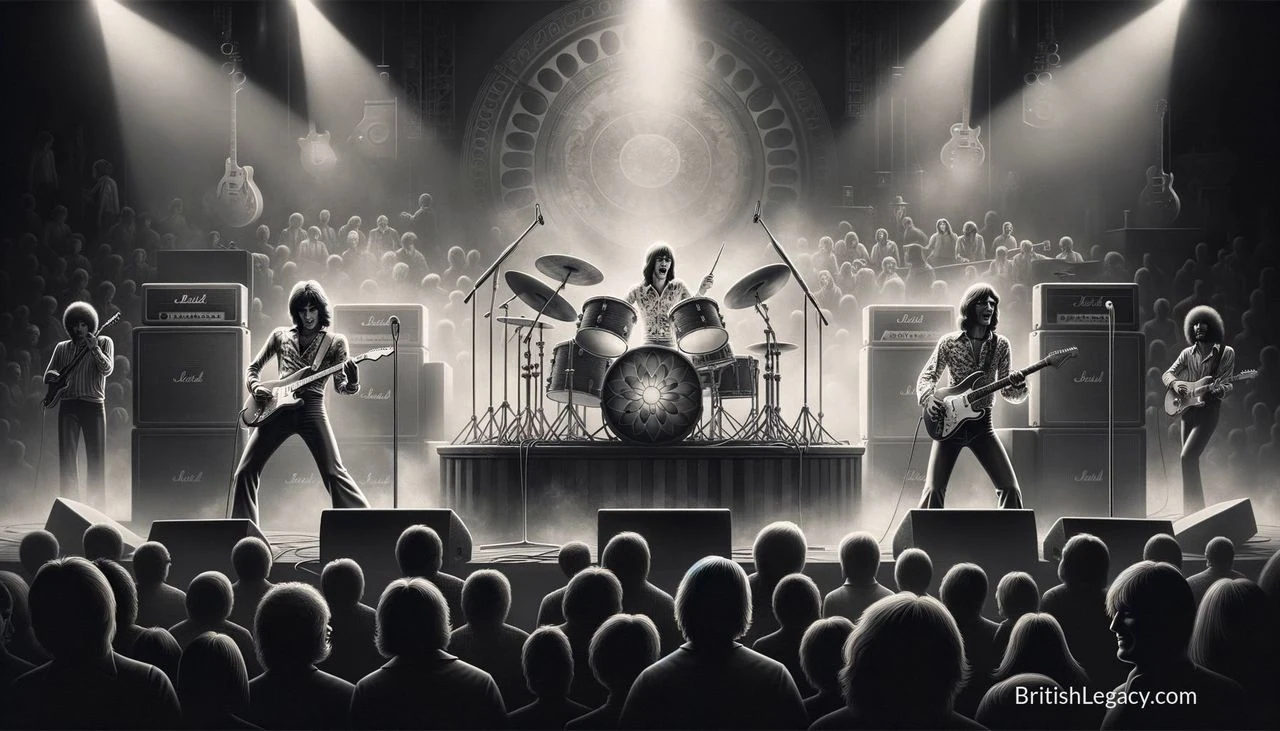
Over five nights in May 1975, Led Zeppelin brought their large-scale rock show to Earl’s Court in London. The residency, running from 17 to 25 May, placed the four-piece before an audience in one of the capital’s major exhibition venues. Its long sets moved between familiar songs and deeper selections, drawing on the blues, rock and folk influences that shaped the band’s music.
A band at a turning point
Led Zeppelin had formed in 1968 around singer Robert Plant, guitarist Jimmy Page, bassist and multi-instrumentalist John Paul Jones, and drummer John Bonham. By the time of the Earl’s Court concerts, the group had built an international following through its records and live performances. Their fifth album, Physical Graffiti, had been released in February 1975, shortly before the London dates.
The timing gave the residency a particular place in the band’s story: it followed a new album and came after years of rapid growth in their audience. The concerts offered room for music from across their catalogue, rather than restricting the set to a short sequence of familiar songs. The scale of the venue and the run of dates also made the performances a major London engagement for a band whose reputation extended well beyond Britain.
Long sets and shifting arrangements
The Earl’s Court performances were noted for their lengthy setlists, combining best-known songs with less familiar material. Their music drew together blues, rock and folk, and the extended format allowed the group to move between tightly shaped songs and looser passages. The concerts’ range was part of their appeal: they presented a band able to shift its sound across a long evening rather than relying on one repeated effect.
“Stairway to Heaven” was among the most prominent performances. Its gradual rise from a quieter opening to a more forceful close made space for Page’s guitar solo, a defining moment in the song. “Whole Lotta Love” offered a different kind of showcase. The number could open out into extended playing and medleys, bringing blues material into a freer, more improvisational passage.
Each musician contributed a distinct part to that expansive sound. Page’s guitar, Plant’s vocals, Jones’s work across instruments and Bonham’s drumming supplied contrasting colours and a strong rhythmic foundation. The group’s arrangements could be cohesive without being confined to a single mood: the same set might move from a carefully built song to an extended jam.
Earl’s Court as a live setting
The concerts took place at Earl’s Court Exhibition Centre, a large London venue. Its scale suited a multi-night engagement by a group with a substantial following, while also presenting a challenge: a band had to make its music carry across a sizeable space. The original account describes lighting, stage design and sound as contributors to the atmosphere, but offers no specific production details. What is clear from its description of the performances is that the show combined a large venue with long, varied sets.
The concerts were filmed, according to the original account, and recordings later circulated as bootlegs. Their continuing interest rests not only on the band’s best-known songs but also on the opportunity to hear the group stretch arrangements and bring blues passages into its live performances. The Earl’s Court dates have consequently remained a point of reference for listeners interested in Led Zeppelin on stage. Claims about their influence on musicians or about their place in the history of live rock are harder to establish from the available account, so the significance of the residency is best expressed through its documented setting, dates and musical programme.
Why Led Zeppelin at Earl’s Court deserves a place in British Legacy
The Earl’s Court residency belongs in British Legacy because it brings together two concrete strands of the story of British rock: a band formed in 1968 and a major London venue hosting five of its concerts in May 1975. The dates came soon after the release of Physical Graffiti, and the performances drew on a catalogue that could fill extended sets. That combination makes the residency a useful episode in the history of Led Zeppelin’s live work, rather than simply a list of appearances by a famous group.
The concerts also show the musical range described in the account: songs such as “Stairway to Heaven” alongside the open-ended passages and blues medleys associated with “Whole Lotta Love”. Page, Plant, Jones and Bonham brought guitar, voice, multi-instrumental playing and drums together in a format built for a large room and a long evening. The surviving interest in the performances, including their circulation as filmed material and bootlegs, gives listeners a way to engage with that particular moment in British music. Earl’s Court is therefore significant here not as a symbol of national character, but as the London setting for a substantial live engagement by one of Britain’s best-known rock bands.