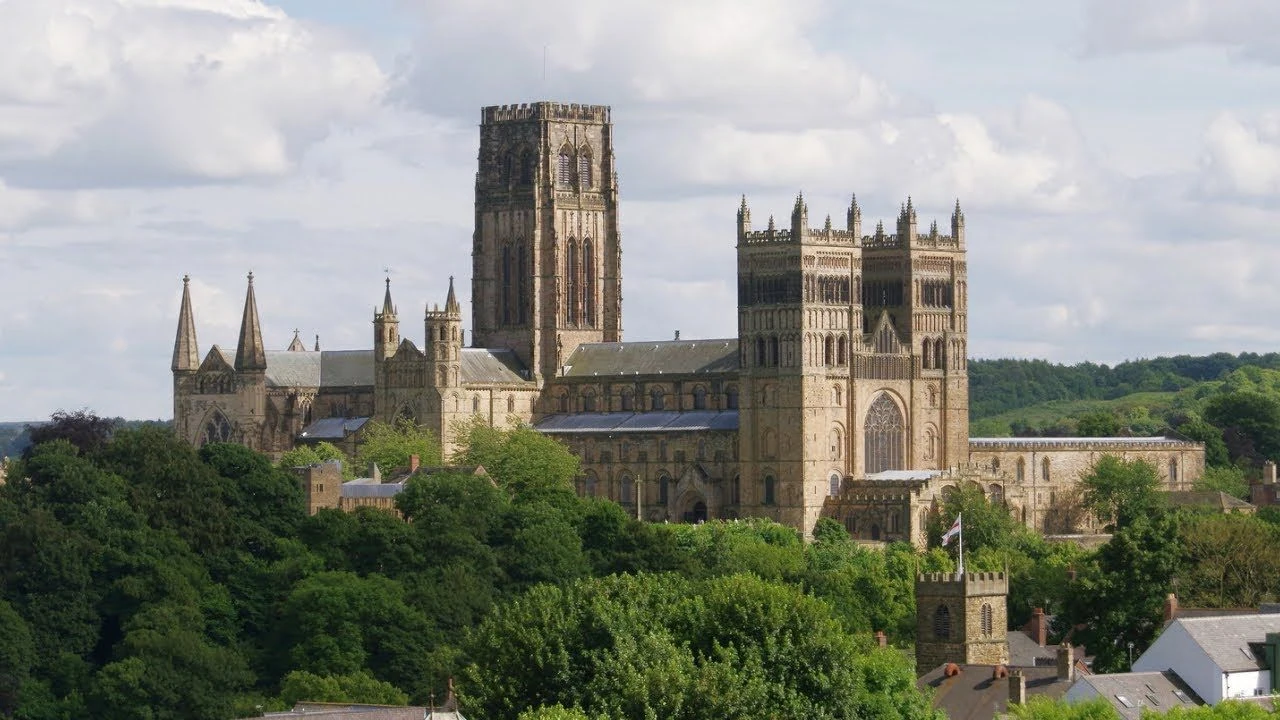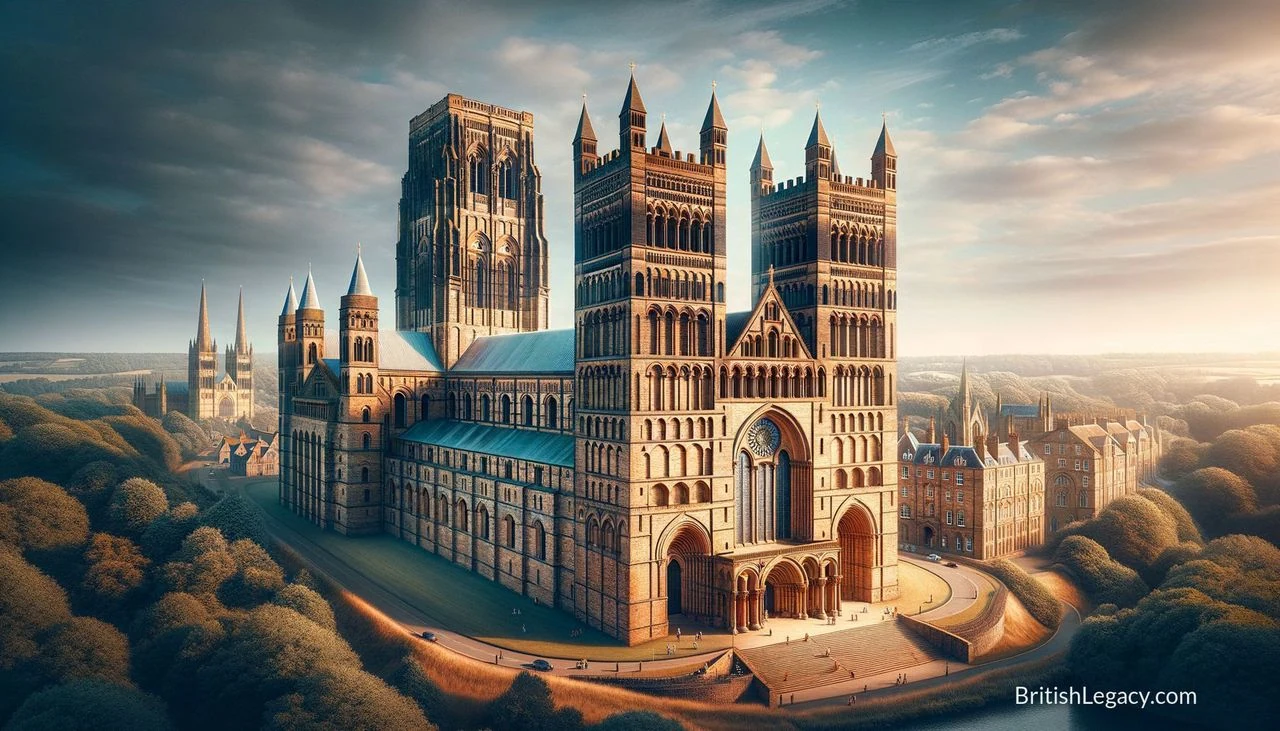
Durham Cathedral rises above a bend in the River Wear, its massive Norman piers and ribbed vaults giving the building a forceful presence. Construction began in 1093, but the cathedral is not simply a monument to one medieval building campaign: additions and changes continued over centuries. Its importance rests on several histories held together in one place: the cult of St Cuthbert, the memory of the Venerable Bede, the development of English architecture and the continuing life of a Church of England cathedral.
A church built for Cuthbert
The cathedral’s formal name is the Cathedral Church of Christ, Blessed Mary the Virgin and St Cuthbert of Durham. Its story reaches back to the community that carried Cuthbert’s relics from Lindisfarne after Viking raids. The monks settled at Chester-le-Street before moving to Durham in 995. A wooden church and then a stone church known as the White Church housed the relics before the present cathedral replaced the Anglo-Saxon building.
In 1083 Bishop William of St-Calais founded a Benedictine priory at Durham. Ten years later, on 11 August 1093, he and Prior Turgot laid the foundation stone of the new cathedral. The project was intended in large part to provide a setting for the bodies of St Cuthbert and the Venerable Bede. Cuthbert’s remains were transferred to the new shrine in 1104. The church thus began as both a major work of construction and a destination for pilgrims drawn to the saint’s shrine.
The cathedral was part of a monastic community until the priory was dissolved in 1540. Its last prior, Hugh Whitehead, became the first dean of the secular chapter. During the English Reformation, Cuthbert’s shrine was destroyed on Henry VIII’s orders; his remains were reburied beneath a plain stone slab. The cathedral changed from a Benedictine monastery to an Anglican place of worship, while the site’s religious life continued in a new institutional form.
Stonework that changed the scale of a church
The greater part of the building remains Norman, although the work did not stop in 1133. The choir was completed early in the campaign; the nave walls were finished by 1128 and its high vault by 1135. Later additions include the Galilee Chapel, built at the western end in the 1170s, and the Chapel of the Nine Altars, constructed at the east end in the thirteenth century. The central tower was rebuilt in two stages during the fifteenth century. This sequence is clearer than treating the cathedral as a structure completed in a single year.
Inside, alternating massive drum columns and more slender composite piers carry the nave’s ribbed vault. The pointed arches and vaulting are among the building’s most important architectural features. They made it possible to cover a complex space and are often described as an early landmark in the development of Gothic construction, although the cathedral as a whole is Romanesque. Its design brings structural experiment and monumental scale together: the vault is not merely an ornamental ceiling but a defining element of the building.
The Galilee Chapel, added by Bishop Hugh de Puiset, occupies the west end and holds the remains of Bede. At the opposite end, the shrine of St Cuthbert remains a place of pilgrimage. Other layers of the building’s history are visible in its furnishings: the medieval Neville screen, Prior Castell’s Clock, and choir stalls and a font cover associated with Bishop John Cosin’s seventeenth-century restoration. The cathedral’s material history is not confined to its original Norman fabric.
War, restoration and remembrance
After the Battle of Dunbar in 1650, Parliamentarian forces used the cathedral as a prison for Scottish prisoners of war. Up to 3,000 men were held there in harsh conditions, and an estimated 1,700 died. Many of the building’s wooden fittings were broken up for firewood. The episode is a stark counterpoint to the cathedral’s role as a sanctuary and pilgrimage church, and it forms part of the site’s history rather than a marginal footnote.
Bishop Cosin, whose tenure began after the Restoration, undertook repairs and refurnished parts of the interior, including the choir stalls. Later work altered the building again. In the late eighteenth century, stonework was smoothed and much of the Chapter House demolished; proposed plans to remove the Galilee Chapel were not carried out. In the nineteenth century, architects including George Gilbert Scott worked on the tower, choir screen and other parts of the cathedral. These interventions shaped the building visitors encounter, alongside the medieval structure.
Memory of the prisoners has also been marked within the modern site. A plaque commemorates the Scottish soldiers who died in the cathedral after Dunbar, and remains of some prisoners were identified in a mass grave found near Palace Green during building works in 2013. The story connects the cathedral’s architectural and religious history to the political violence of the seventeenth century.
A World Heritage site and a working cathedral
Durham Cathedral and nearby Durham Castle were inscribed together as a UNESCO World Heritage Site in 1986. The recognition reflects more than the cathedral’s appearance: the site brings together architecture, religious continuity, the history of the priory and the setting of the cathedral and castle above the Wear. The building is also Grade I listed. Its historic status does not make it a museum alone; daily Church of England services continue there.
The cathedral’s relationship with learning is also rooted in local history. Bishop William Van Mildert, whose memorial stands in the building, was a driving force behind the foundation of Durham University. The cathedral’s own library contains significant collections, including manuscripts held by the former priory. Work to digitise manuscripts from the sixth to the sixteenth centuries has involved both the cathedral and the university.
Visitors can encounter the site’s history through its surviving monastic buildings as well as the church. The Open Treasure exhibition opened in former monastic buildings around the cloister in 2016, displaying aspects of the cathedral’s history and possessions. In 2017, a new exhibition area included St Cuthbert’s coffin and relics; a later display, Mapping the World, presented geographical material from the cathedral archive. Such exhibitions give the precinct a public role alongside worship, conservation and study.
The cathedral has also been used in film and television, including the first two Harry Potter films. Its distinctive architecture makes it an identifiable setting on screen, but its cultural presence is not limited to filming. Writers and artists have responded to Durham’s cathedral and its dramatic position. The building and the surrounding city form a closely connected historic landscape, with the castle and cathedral occupying the peninsula above the river.
Why Durham Cathedral deserves a place in British Legacy
Durham Cathedral deserves a place in British Legacy because its significance can be explained through specific, enduring achievements. Its Norman builders created a vast church whose ribbed vaulting and pointed arches helped demonstrate new ways of spanning and organising architectural space. The result is not only a celebrated example of Romanesque design: it is a building in which the history of construction remains visible, from the early Norman core to the Galilee Chapel, the eastern chapels and later restorations.
The cathedral also preserves a deep record of religious and civic life in northern England. It was built to house the shrine of St Cuthbert and the remains of Bede, became a monastic institution, and continued as an Anglican cathedral after the Reformation. Its history includes pilgrimage and daily worship, but also the deaths of Scottish prisoners held there after Dunbar. Commemorating that episode gives the site a responsibility to preserve difficult history as well as architectural achievement.
Its value continues through the work of worship, conservation, scholarship and public interpretation. The library’s collections, collaboration with Durham University, and exhibitions in former monastic buildings connect the cathedral’s past with people studying and visiting it now. World Heritage recognition acknowledges this exceptional combination of architecture, setting and historical continuity. Durham Cathedral belongs in a British legacy not as a symbol offered without explanation, but as a particular place where craftsmanship, faith, learning and the consequences of political power can be encountered together.
Sources
Durham Cathedral — Wikipedia revision 1378473470
Adapted in part from Durham Cathedral by Wikipedia contributors, under CC BY-SA 4.0. Text has been edited and combined with the existing article; this adapted text is shared under the same licence. Contributor history.