Durham University’s story began with an Act of Parliament in 1832, but its identity has never rested on age alone. It grew from a university closely tied to the Church of England into a collegiate institution whose teaching, research and student life are spread across a historic northern city and, for a time, a second campus in Stockton-on-Tees. Its colleges and buildings give Durham a distinctive shape; its history also records change in who could study there, what the university was for and how it related to the region around it.
Founded in the city, opened to students
The Durham University Act received royal assent on 4 July 1832. The university opened on 28 October 1833 and was incorporated by royal charter on 1 June 1837. The distinction matters: the Act enabled the institution, while the opening and charter marked later steps in its establishment. Durham became the first recognised university to open in England for more than 600 years after Oxford and Cambridge, and historians identify it as England’s third-oldest university.
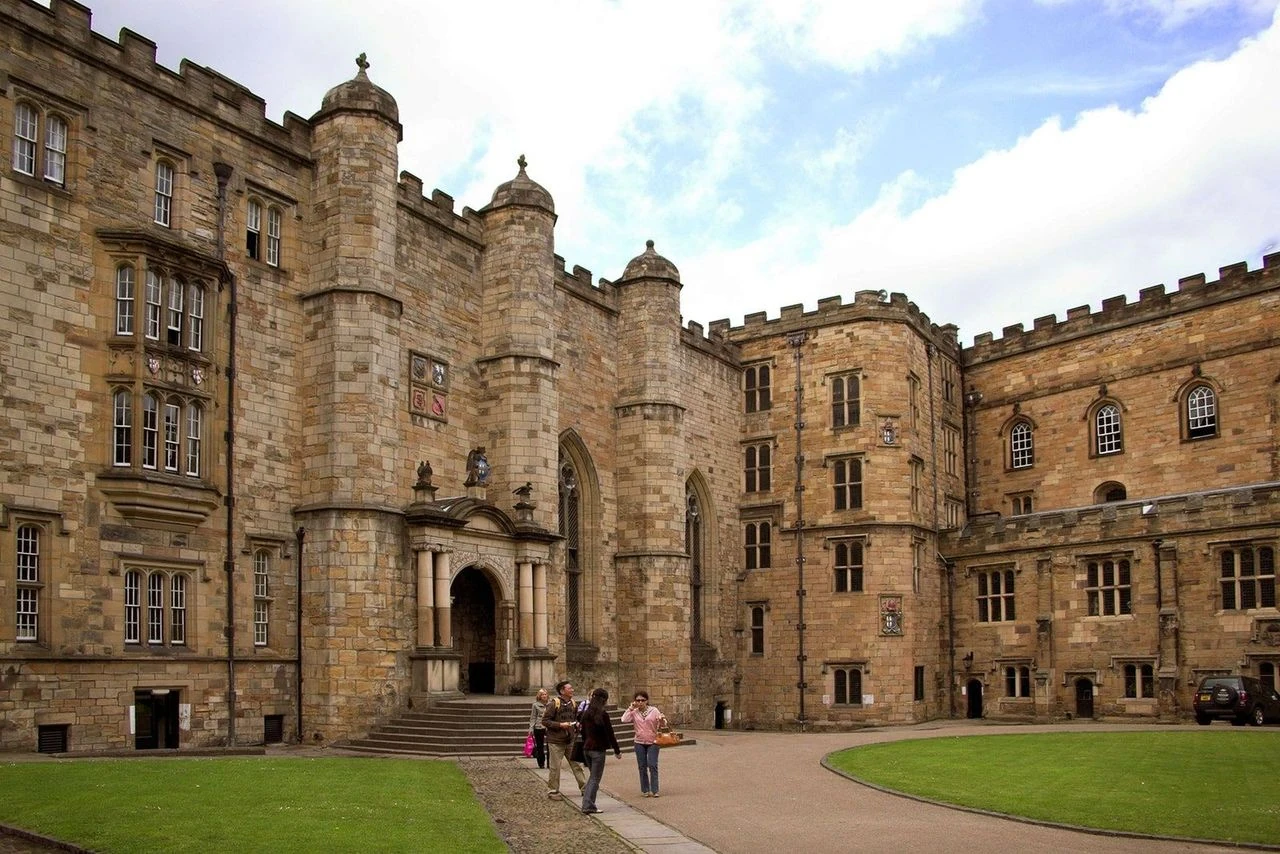
Its early life was closely connected to Durham Cathedral. The Act enabled the Dean and Chapter to devote part of the church’s property to establishing a university, and the university initially operated under their governance. Durham Castle, formerly a bishop’s palace, became available for university accommodation in 1837. The university remains closely associated with the Castle and Cathedral setting, but they are not interchangeable institutions: the university owns and manages parts of the Durham World Heritage Site in partnership with the cathedral, including Durham Castle and Palace Green.
The university’s beginnings also reflected the religious limits of nineteenth-century higher education. Early statutes restricted degrees to members of the Church of England. The rules were revised in 1865, and the Universities Tests Act 1871 removed the requirement for university staff and members of Convocation to belong to the established church. A supplemental charter in 1895 allowed women to receive degrees; the first women’s hostel, later St Mary’s College, was founded in 1899. Women graduated from Durham from 1898 through St Hild’s, which had been associated with the university.
A collegiate university, not a set of teaching colleges
Durham’s collegiate system divides the university’s main functions between academic departments and colleges. Departments provide teaching and carry out research; colleges are responsible for students’ domestic arrangements and welfare. The university has 17 colleges, but they are not simply small versions of academic departments. Their responsibilities and legal arrangements vary, and, unlike at Oxford and Cambridge, formal teaching does not generally take place in Durham’s colleges.
The college idea has deep roots in the institution’s history. Bishop Hatfield’s Hall, founded in 1846, offered affordable accommodation with communal, catered meals. At the time, students at University College were expected to bring servants to cook and clean for them. The model at Hatfield provided an alternative and was later endorsed by a Royal Commission; comparable arrangements spread to other universities. Durham’s colleges have since developed different identities and facilities, while continuing to provide residential, pastoral and social settings for students.
The university also changed substantially as it grew. In 1852, the medical school in Newcastle became part of Durham, followed by the College of Physical Sciences in 1871. The Newcastle division expanded until the institution became a federal university. In 1963, Newcastle’s King’s College became the University of Newcastle upon Tyne, leaving Durham University based in Durham. Subsequent growth included new colleges on Elvet Hill and, from the 1990s, university activity in Stockton-on-Tees. The colleges and academic departments at Stockton were relocated to Durham between 2017 and 2018, and the former campus became an International Study Centre.
Buildings, collections and a city setting
The university’s physical setting makes its history visible. Its estate includes buildings ranging from Durham Castle, dating from the eleventh century, to the 1960s students’ union. Durham Castle and Durham Cathedral form a UNESCO World Heritage Site, designated in 1986; the university owns and manages part of the site with the cathedral. The university’s buildings and grounds also include listed buildings and other heritage assets, so its development takes place amid structures with civic and historical significance.
Its collections extend that role beyond classrooms and residences. Durham University Library began in 1833 with 160 volumes donated by Bishop William Van Mildert. Its holdings now include special and heritage collections at Palace Green Library. In 2012, Durham University, the British Library and Durham Cathedral jointly purchased the St Cuthbert Gospel for the nation. The university’s museums include the Museum of Archaeology, which focuses on the heritage of North East England as well as wider periods and places, and the Oriental Museum, whose collections cover Asia and the Levant. These institutions give local residents and visitors ways to encounter the university’s resources outside formal study.
Research, access and public life
Durham is a member of the Russell Group and the north-of-England N8 Research Partnership. Its work spans the sciences, arts and humanities, social sciences and business. Research institutes cover fields including energy, computational cosmology, data science, medical humanities and particle physics. The university also hosts part of the UK’s DiRAC supercomputing facility and the N8 Bede supercomputer. This breadth connects research based in Durham with collaborations across the region and beyond.
Research and study are only part of the university’s public role. Durham runs widening-access provision for mature students without traditional entry qualifications, including foundation-year courses, and has worked with the Sutton Trust on summer schools for pupils from under-represented backgrounds. Its student volunteering programme, formed in 1989, coordinates projects in Durham and nearby communities; it received the Queen’s Award for Voluntary Service in 2020. Such programmes offer practical routes between university resources and people who might otherwise have less access to them.
Student life also reaches into the city’s cultural calendar. Durham Students’ Union supports more than 300 clubs and organisations, while the independently run student newspaper Palatinate has been published continuously since 1948. Students take part in rowing and other sports, and the university’s musical and theatrical groups perform in college and city venues. The university has not always expanded without disagreement: plans for growth have prompted local opposition. Its place in Durham is therefore not only architectural. It is also a continuing relationship between a large institution, its students and the community around it.
Why Durham University deserves a place in British Legacy
Durham University’s significance lies in the way its institutional history reflects wider changes in British higher education. Established through an Act of Parliament and opened in the nineteenth century, it developed from a university governed by the cathedral’s Dean and Chapter into a modern research institution. Its early religious restrictions, later changes to those rules and the gradual admission of women are part of that history, as is its expansion into Newcastle and the eventual separation that created the University of Newcastle upon Tyne. The chronology shows an institution being reshaped by decisions about governance, access and educational purpose.
Its contribution is also visible in places and services that reach beyond its degree programmes. The colleges organise residential and welfare life; its museums and libraries preserve collections and welcome public audiences; and research partnerships connect Durham to regional and international work. Jointly purchasing the St Cuthbert Gospel with the British Library and Durham Cathedral placed a significant historic book in public stewardship. Volunteering and widening-access programmes create further links between the university and people beyond its student body. These are specific ways in which Durham’s academic resources, heritage and civic responsibilities meet. That combination—distinctive collegiate life, sustained research, public collections and an evolving relationship with the North East—gives Durham a well-founded place in British Legacy.
Sources
Durham University — Wikipedia revision 1378796832
Adapted in part from Durham University by Wikipedia contributors, under CC BY-SA 4.0. Text has been edited and combined with the existing article; this adapted text is shared under the same licence. Contributor history.