Edmund Cartwright’s first power loom was not a finished industrial success. It was a proof of concept: a primitive machine that showed weaving, one of the most intricate manual trades of its time, could be attempted mechanically. Cartwright spent years trying to make that idea work in practice. Others solved problems his designs could not, and his own manufacturing ventures brought financial loss. Yet the step he took in the 1780s helped turn powered weaving from a possibility into an engineering challenge.
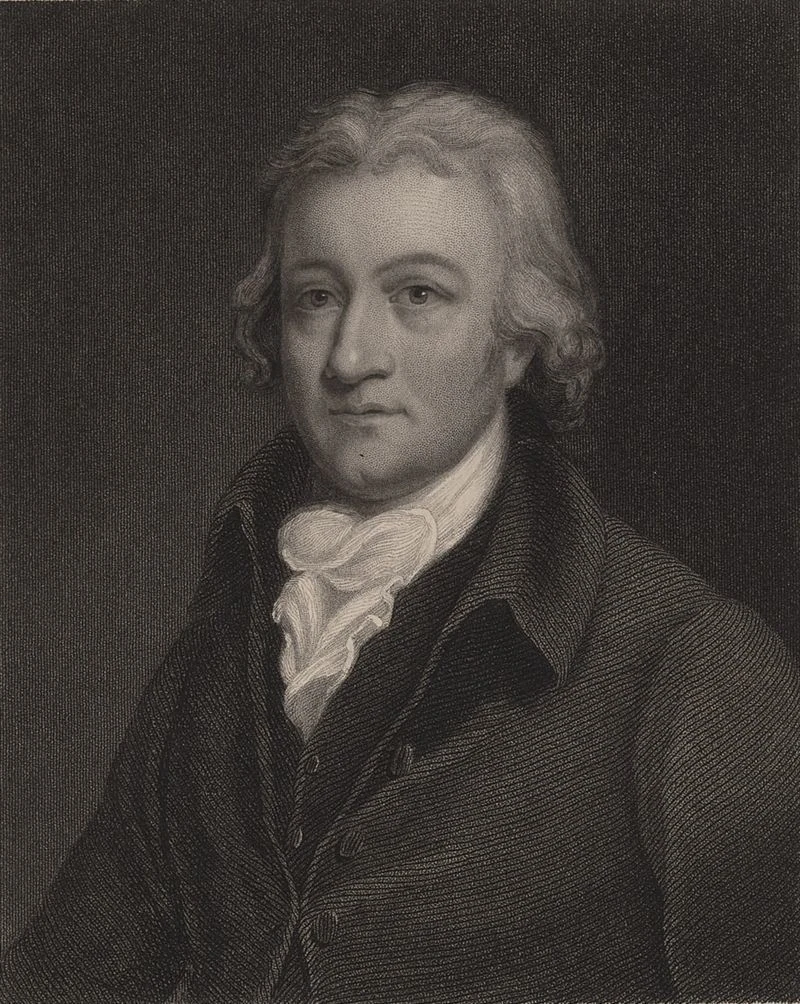
Born in Nottinghamshire in 1743, Cartwright was an Oxford-educated clergyman and published poet before he became an inventor. His life brought together religious, literary and mechanical interests. His story is not one of instant triumph, but of an imperfect invention, the efforts of those who improved it, and the industrial changes that followed. To understand his contribution is to distinguish the first machine from the later systems that made powered weaving practical.
A clergyman turns to mechanics
Cartwright was born at Marnham, Nottinghamshire, on 24 April 1743. He attended Queen Elizabeth Grammar School in Wakefield before studying at Oxford. He matriculated in 1760, graduated in 1764 and became a Fellow of Magdalen College. He entered the Church of England, becoming a deacon in 1765 and a priest in 1767. His appointments included the rectorship of Goadby Marwood in Leicestershire and a prebend at Lincoln Cathedral.
Alongside his church career, Cartwright wrote poetry. Armine and Elvira appeared in 1770, followed by The Prince of Peace in 1779. These pursuits differed from textile engineering, but his later work shows that he did not confine his curiosity to one occupation. The power loom became his best-known achievement; it was not the only machinery he designed, or the only subject that occupied him.
Biographical accounts associate Cartwright’s interest in mechanised weaving with a visit to Matlock in 1784 and conversations with men connected to Manchester’s textile trade. As the story is commonly told, he heard that spinning had been mechanised but weaving remained too complicated to automate. The conversation is part of the reported origin story, rather than a detail that needs to carry the weight of his achievement. The underlying technical challenge is clear: a loom had to coordinate several actions, repeatedly and in the right order.
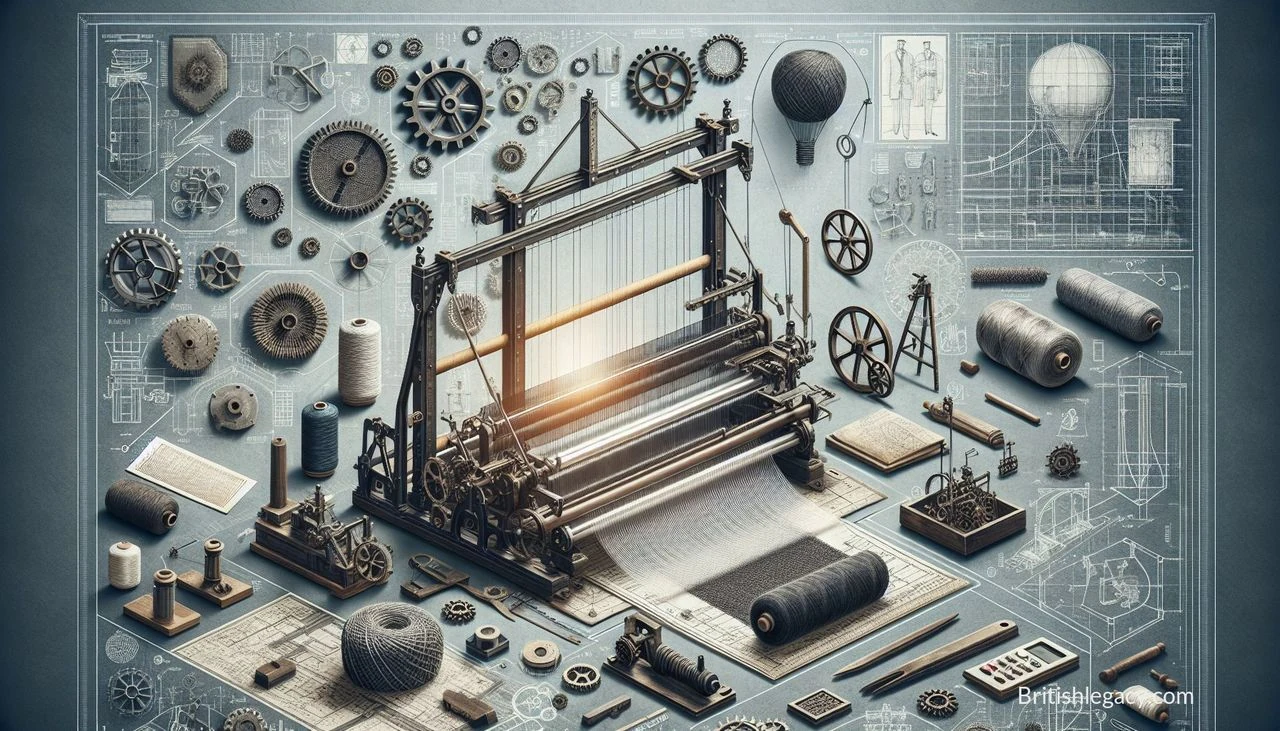
It had to separate the lengthwise warp threads, pass the weft across them with a shuttle, and beat the new thread into the cloth. A powered machine needed to perform these movements while keeping the threads and shuttle under control. Cartwright set out to address the process as a whole. Merely supplying power to a handloom would not be enough if threads broke, the shuttle failed to travel correctly or the equipment required constant attention.
That distinction helps explain both the promise and the limits of his early work. Weaving was not one movement that could simply be made faster. Its actions had to be coordinated, and small failures could interrupt the production of cloth. Cartwright’s ambition was to organise those actions mechanically. His experiments therefore posed a problem that later inventors could continue to tackle, even when his own solutions proved inadequate.
From patent to working mill
Cartwright designed his first power loom in 1784 and patented it in 1785. The significance of the early design lay less in its performance than in demonstrating that powered weaving could be attempted. Its importance should not be mistaken for proof that it was already commercially dependable. Cartwright’s patents mark stages in a difficult process, not a single moment when the problems of factory weaving were solved.
In 1785, after his family inherited property at Doncaster, Cartwright established a power-loom mill and worked with skilled mechanics. Accounts of the early undertaking describe twenty looms initially driven by a bull, before steam power replaced that arrangement in 1788 and 1789. It is an unusually tangible detail in the history of invention: a new mechanical system was being tested with an improvised source of power before steam took over. The mill was an experiment as much as a manufacturing venture.
Cartwright kept revising the loom. His 1789 patent included further improvements, and his 1792 patent added multiple shuttle boxes, which allowed the machine to weave checks and cross-stripes. He also worked on mechanisms to control the warp and stop the loom when a thread or shuttle went wrong. These were not merely refinements for their own sake. A loom had to produce cloth reliably, not simply move through its motions. Breakdowns could waste material, spoil the fabric or require intervention.
Cartwright began manufacturing fabrics at Doncaster, where practical use exposed shortcomings in the designs. A machine might demonstrate that powered weaving was possible while still failing to provide a reliable, commercially workable process. Preparing and sizing the warp remained a particular difficulty. Cartwright attempted to address the problem, but his manufacturing venture did not become secure. In 1793, his mill was repossessed by creditors.
The gap between invention and commercial success is central to Cartwright’s career. His loom was historically important, but that did not make it an immediate source of profit. The factory, machinery and production process all had to work together. In his case, the difficulties revealed by use outweighed the prospect of a successful business. The eventual practical power loom would depend on further work, including improvements made by people other than Cartwright.
Setbacks, resistance and recognition
Cartwright’s financial difficulties were one cost of trying to turn a machine into a business. A separate attempt to establish a larger weaving operation also ended abruptly. In 1790, Robert Grimshaw set up a factory at Knott Mill in Manchester, intending to install 500 of Cartwright’s power looms. Only 30 had been installed when the building burned down. The fire was thought at the time to have been arson inspired by handloom weavers’ fears, but the supplied account does not establish its cause as certain. The factory was not rebuilt.
The episode belongs to a larger conflict over mechanisation. Powered production offered the prospect of making cloth in greater quantities, but it also challenged the working practices and livelihoods of people who wove by hand. The move towards mills changed where work took place and how labour was organised. It would be misleading to describe that transition only as a story of technical improvement: the machinery altered the conditions of work as well as the processes of production.
Cartwright’s commercial failure did not prevent Parliament from recognising the importance attributed to his work. In 1809 it granted him £10,000. That award should not be confused with a successful return from manufacturing. He had suffered losses, and the loom’s development still depended on improvements beyond his own. The parliamentary grant recognised the value of his contribution to manufacturing even though his ventures had not brought lasting commercial success.
The parliamentary debate referred to services to British manufactures, including cotton weaving and sailcloth for the Navy. This gives the award a specific industrial context: Cartwright’s work was regarded as relevant to production beyond the fabrics made in his own mill. The recognition came after the difficult early attempts, not as evidence that those attempts had already succeeded as a business.
Other inventors helped overcome obstacles that had held back powered weaving. William Radcliffe and his assistant Thomas Johnson developed the beam warper and dressing-sizing machine, addressing problems in preparing the warp. Later improvements associated with Richard Roberts in the 1820s helped make power weaving more practical in the cotton trade. Cartwright’s place in the sequence is therefore significant but specific. He did not deliver the final successful loom on his own; his early designs demonstrated a possibility and helped establish a problem that others worked to solve.
More than one invention
The power loom can eclipse Cartwright’s other work. He patented a wool-combing machine in 1789 and a cordelier—a machine for making rope—in 1792. He also designed a steam engine that used alcohol instead of water. These projects show that his interest in invention extended across different materials and processes. The loom was his defining contribution, but it was part of a broader record of mechanical experimentation.
His intellectual interests continued in later life. Cartwright was elected a Fellow of the Royal Society in 1821. In 1822 he submitted an unpublished paper proposing electromagnetic principles as an explanation for planetary motion. The paper did not establish a new account of astronomy, but it records an inventor still exploring ideas outside his principal field.
Cartwright died in Sussex on 30 October 1823. He had moved through several distinct roles: scholar, clergyman, poet and inventor. The power loom remained an unfinished achievement in his own hands, but the principle he had tried to establish continued to matter as others developed machinery suited to commercial production. His importance rests not on having solved every difficulty, but on the combination of a serious attempt, practical trials and later influence.
Why Edmund Cartwright deserves a place in British Legacy
Edmund Cartwright deserves a place in British Legacy because his contribution was consequential without being simple. He did not perfect the power loom, nor did his manufacturing ventures make him a commercial success. He did take on a difficult process that depended on the coordinated movement of threads and shuttle, patent a machine for powered weaving and persist in testing and revising it. Remembering that distinction gives him credit for the first step without taking credit away from the inventors who solved problems his machines left unresolved.
His work also belongs to a defining change in British industry. As powered weaving matured, cloth production increasingly took place in mills rather than in the dispersed settings of handloom work. That transition increased the scope for factory production, while disrupting established skills and livelihoods. Cartwright’s story is useful precisely because it connects engineering to the human consequences of changing how work is done. His early loom was not the finished machinery of a later industrial age; it was part of the route towards it.
From his experiments at Doncaster to the later development of factory looms, Cartwright’s career helps explain how an idea can outlive the machine that first expressed it. His achievement was to make powered weaving a practical question for engineers, rather than an impossibility to be set aside. British Legacy can remember him as an English inventor whose work helped shape the country’s textile history, while keeping the limits and consequences of mechanisation in view. That is a more accurate legacy than either a tale of solitary triumph or a dismissal of an imperfect first attempt.
Sources
Edmund Cartwright — Wikipedia, revision 1368931550
Adapted in part from Edmund Cartwright by Wikipedia contributors, under CC BY-SA 4.0. Text has been edited and combined with the existing article; this adapted text is shared under the same licence. Contributor history.