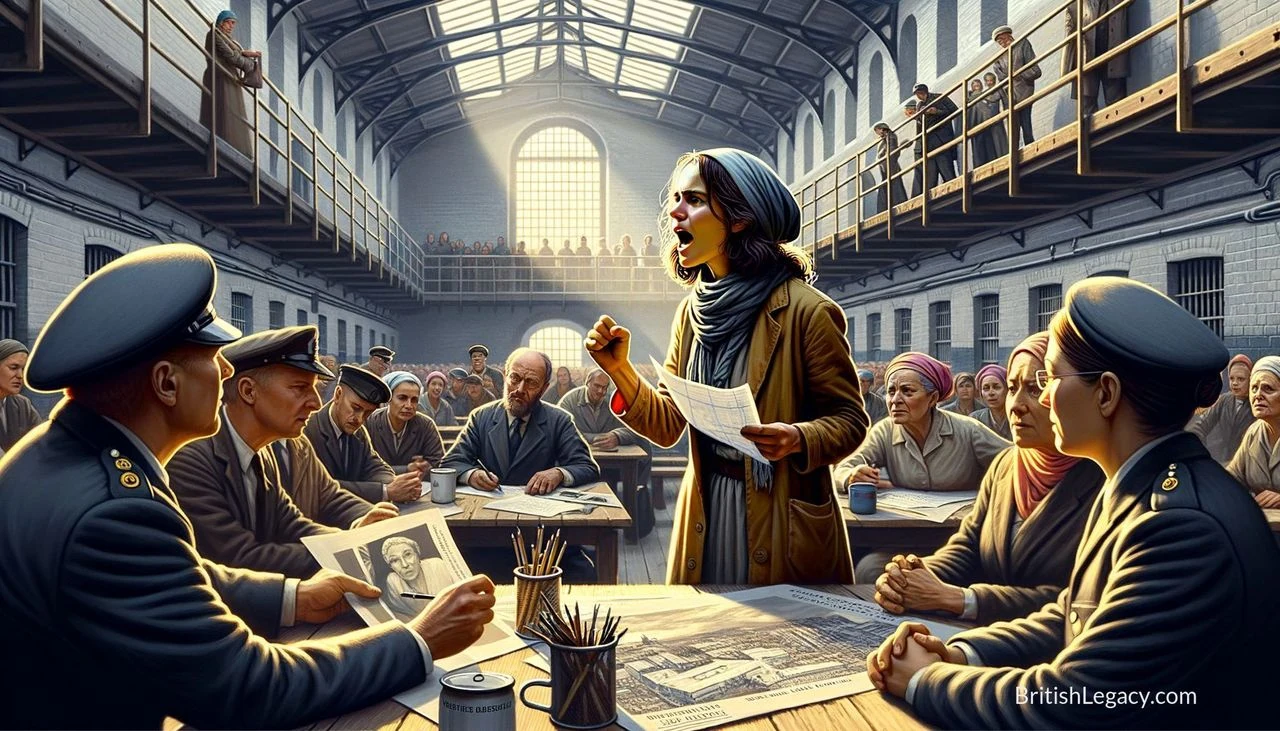
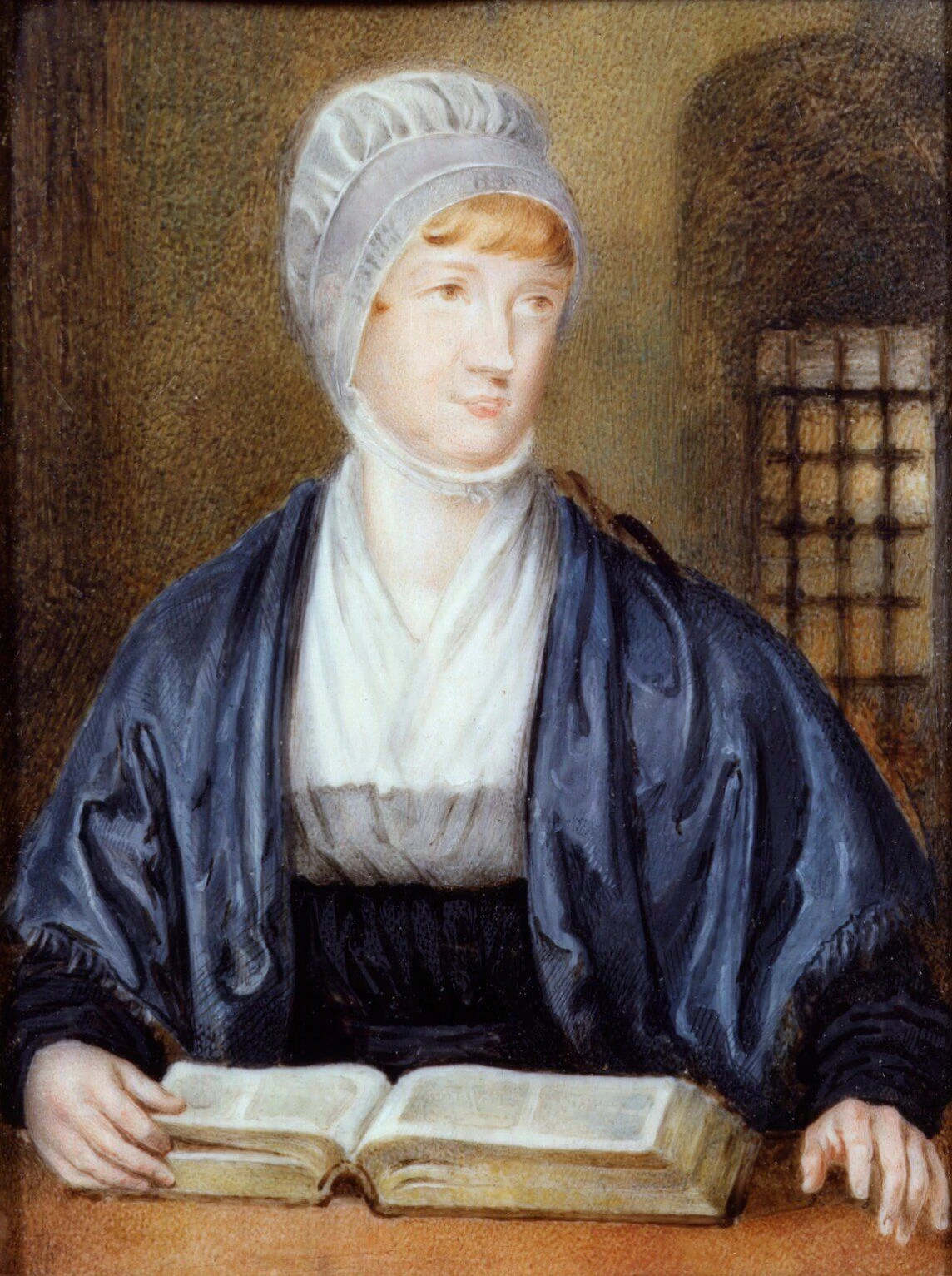
When Elizabeth Fry visited Newgate Prison in 1813, she found women and children crowded into small cells, sleeping on straw and left to cook and wash where they lived. The visit prompted a life of practical campaigning: she organised help inside the prison, pressed authorities to improve conditions and worked to make rehabilitation, education and useful employment part of the response to imprisonment. Her influence reached beyond Newgate, but her work was not a simple story of legislation transforming prisons overnight. Fry understood that rules could be ignored, and continued to argue for change.
A Quaker upbringing and a public vocation
Born Elizabeth Gurney in Norwich on 21 May 1780, Fry grew up in a prominent Quaker family. Her father, John Gurney, was a partner in Gurney’s Bank; her mother, Catherine, belonged to the Barclay family. When her mother died, Elizabeth was twelve. As one of the older girls in a large family, she took some responsibility for the younger children, including her brother Joseph John Gurney, later an evangelical leader and philanthropist.
She met Joseph Fry, a Quaker banker, when she was 20. They married in Norwich on 19 August 1800 and had eleven children. The family first lived in the City of London, then at Plashet House in East Ham, and later at The Cedars in West Ham. In 1811, Elizabeth was recorded as a minister of the Religious Society of Friends. Her concern for prison conditions grew from religious conviction, but she put that conviction to work through visits, organisation and sustained dealings with institutions.
Priscilla Hannah Gurney, Deborah Darby and William Savery were among the preachers whose words affected her. A visit to Newgate, prompted by the Quaker Stephen Grellet, made the issue immediate. Fry encountered women and children held in severe overcrowding, including people who had not yet received a trial. She returned the next day with food and clothing. Family difficulties meant that she could not pursue the work continuously for nearly four years.
Newgate: order, education and work
Fry returned to her project in 1816 and helped fund a prison school for children held with their mothers. Rather than simply impose rules, she proposed them and asked the women to vote. This approach treated prisoners as people capable of taking part in the organisation of their lives, even within the limits of confinement.
In 1817, she helped found the Association for the Reformation of the Female Prisoners in Newgate. It supplied materials for sewing and other needlework, offering women a way to practise skills that could later help them earn a living. Fry also promoted education and employment, and pressed for improvements in hygiene and basic provision. The association’s work helped inspire the British Ladies’ Society for Promoting the Reformation of Female Prisoners, established in 1821. The organisation’s methods were copied elsewhere.
Her work attracted public attention, but she also addressed Parliament. In 1818, Fry gave evidence to a House of Commons committee examining prisons. She is believed to have been the first woman called to give evidence to a select committee of the Houses of Parliament. Her testimony brought a woman’s direct observations of prison life into a forum where lawmakers considered the conditions they were being asked to change.
Legislation, transportation and the limits of reform
Fry’s campaigning helped shape the Gaols Act of 1823. The Act required male and female prisoners to be separated and provided for female warders for women prisoners, a safeguard against sexual exploitation. Yet legislation did not by itself ensure humane conditions. The Act had limited effect and no mechanism to make institutions comply with all its provisions. Some places, including town gaols and debtors’ prisons, were not covered. In 1835 Fry told a House of Lords committee that many prisons remained in a deplorable state, with too little instruction, employment or classification. A further Prisons Act in 1835 brought the appointment of inspectors and central control over gaols and prisons.
Fry also worked with women sentenced to transportation to Australia. She sought commutation of death sentences and campaigned for better treatment on the journey. Women were sometimes taken to ships in open carts, in chains and exposed to abuse from crowds. Fry persuaded the Newgate governor to use closed carriages and accompanied transports to the docks with other members of the Ladies’ Society. On prison ships, she pressed captains to provide women and children with food and water. She arranged packages of cloth and sewing tools so that women could make quilts during the voyage and have useful skills after arrival.
She visited 106 transport ships and saw 12,000 convicts, and campaigned for better conditions for women already transported to New South Wales and Van Diemen’s Land. Transportation was officially abolished in 1868; Fry continued visiting transport ships until 1843. Her work formed part of a broader movement against transportation, as well as an effort to protect the welfare and prospects of the women subjected to it.
From prison visiting to wider welfare
Fry’s methods travelled beyond Newgate. She wrote about prison visiting and supervision, visited prisons in Scotland and northern England, and encouraged people of influence to see conditions for themselves. She visited women’s prisons and places of female confinement in Ireland in 1827, encouraging women in Belfast to organise a committee to improve the local women’s poorhouse. In 1838, she travelled to France with her husband and other reformers; despite the language barrier, she and Lydia Irving visited French prisons.
Her concern for hardship outside prison led to further work. After seeing the body of a young boy in winter, she helped establish a nightly shelter for homeless people in London in 1819–20. In Brighton, she founded a district visiting society in 1824. Volunteers visited poor households to offer practical help and comfort, and the model was adopted in other towns and districts. She also supported maternity care for poor women.
In 1840, Fry opened a training school for nurses at Guy’s Hospital, known as the Institution of Nursing Sisters. Her training programme influenced Florence Nightingale, who took a team of Fry’s nurses to help wounded soldiers in the Crimean War. Fry was also active in campaigns against slavery in European colonies, including Danish and Dutch colonies. These activities shared an emphasis on organised care: identify a need, build a group around it and equip people to provide sustained help.
Death and commemoration
Fry died of a stroke in Ramsgate, Kent, on 12 October 1845, aged 65. She was buried in the Friends’ burial ground at Barking. At her funeral, more than a thousand people stood in silence; Ramsgate Coast Guard flew its flag at half mast, an honour described as previously reserved for the death of a ruling monarch.
Commemoration took several forms. A refuge for young women discharged from metropolitan gaols or police offices opened in London in 1849, providing temporary shelter and training. The institution later moved to Reading, where it remains. Plaques and other memorials mark places associated with Fry, while buildings and institutions have also taken her name. The Church of England remembers her on 12 October.
Fry appeared on Bank of England £5 notes from 2002 until May 2017. The design showed her reading to prisoners at Newgate and included a key, representing the key to the prison awarded in recognition of her work. This corrected chronology places the notes’ circulation later than the 2001–2016 dates sometimes given. Her image was replaced by that of Winston Churchill in 2016. The banknote made a prison reformer part of everyday currency, while the details of her work reveal a legacy grounded in persistent campaigning rather than symbolism alone.
Why Elizabeth Fry deserves a place in British Legacy
Elizabeth Fry deserves a place in British Legacy because she made the treatment of prisoners a public question and helped turn observation into organised reform. At Newgate, she worked with women and children in conditions of acute overcrowding, supported education and practical skills, and helped establish an association that could sustain improvements. Her evidence to a parliamentary committee brought her experience into a national debate about prisons. The Gaols Act of 1823 reflected some of the changes she had pressed for, including separation by sex and female warders for women. Just as importantly, Fry recognised the distance between legislation and practice: her later evidence described prisons where instruction, work and classification were still lacking.
Her British legacy also lies in the reach of her methods. She campaigned for humane treatment during transportation, helped create a London shelter for homeless people, organised visiting support for poor households and established nurse training at Guy’s Hospital. The influence of that training on Florence Nightingale connects Fry’s reforming work with a later, widely recognised history of nursing. Across these causes, she combined religious commitment with practical organisation and sustained advocacy. Her career shows how reform depended not only on good intentions or a new law, but on people building institutions, challenging failures and maintaining pressure for better treatment. That is a specific and enduring contribution to Britain’s history of social reform.
Sources
Elizabeth Fry — Wikipedia, revision 1368167916 · Elizabeth Fry — Wikipedia
Adapted in part from Elizabeth Fry by Wikipedia contributors, under CC BY-SA 4.0. Text has been edited and combined with the existing article; this adapted text is shared under the same licence. Contributor history.