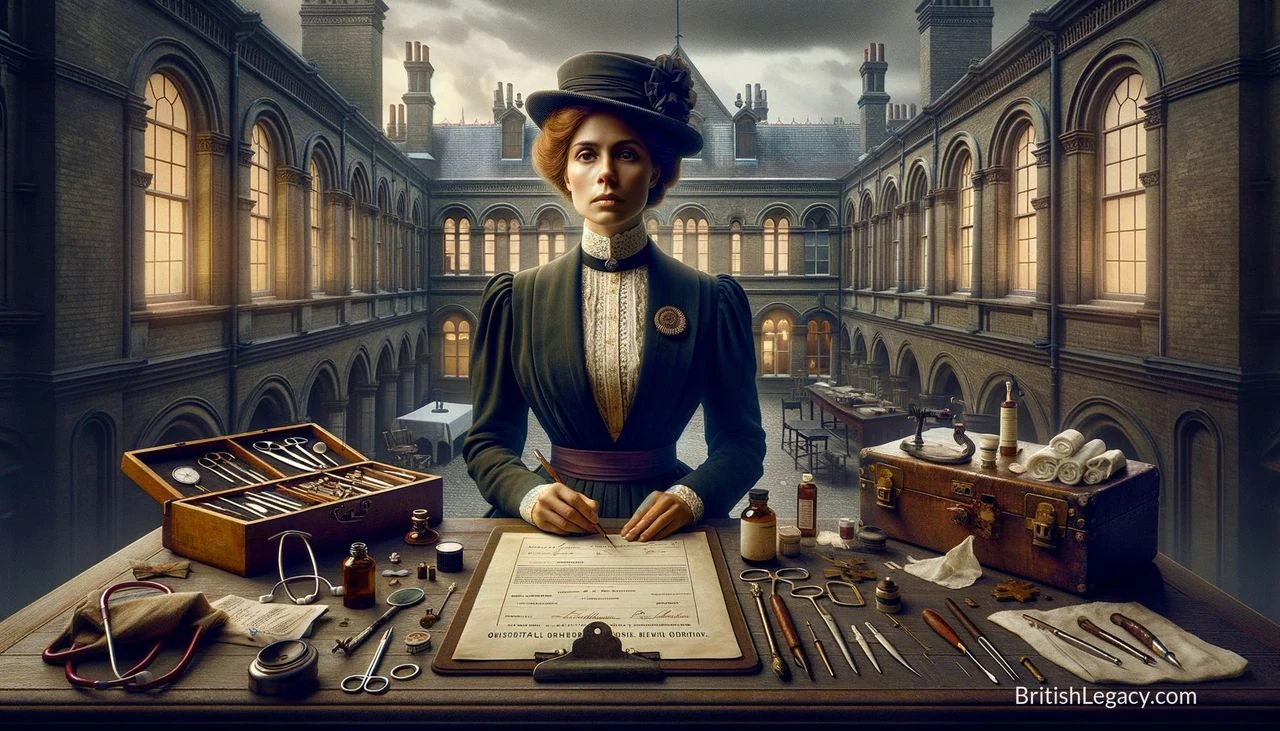
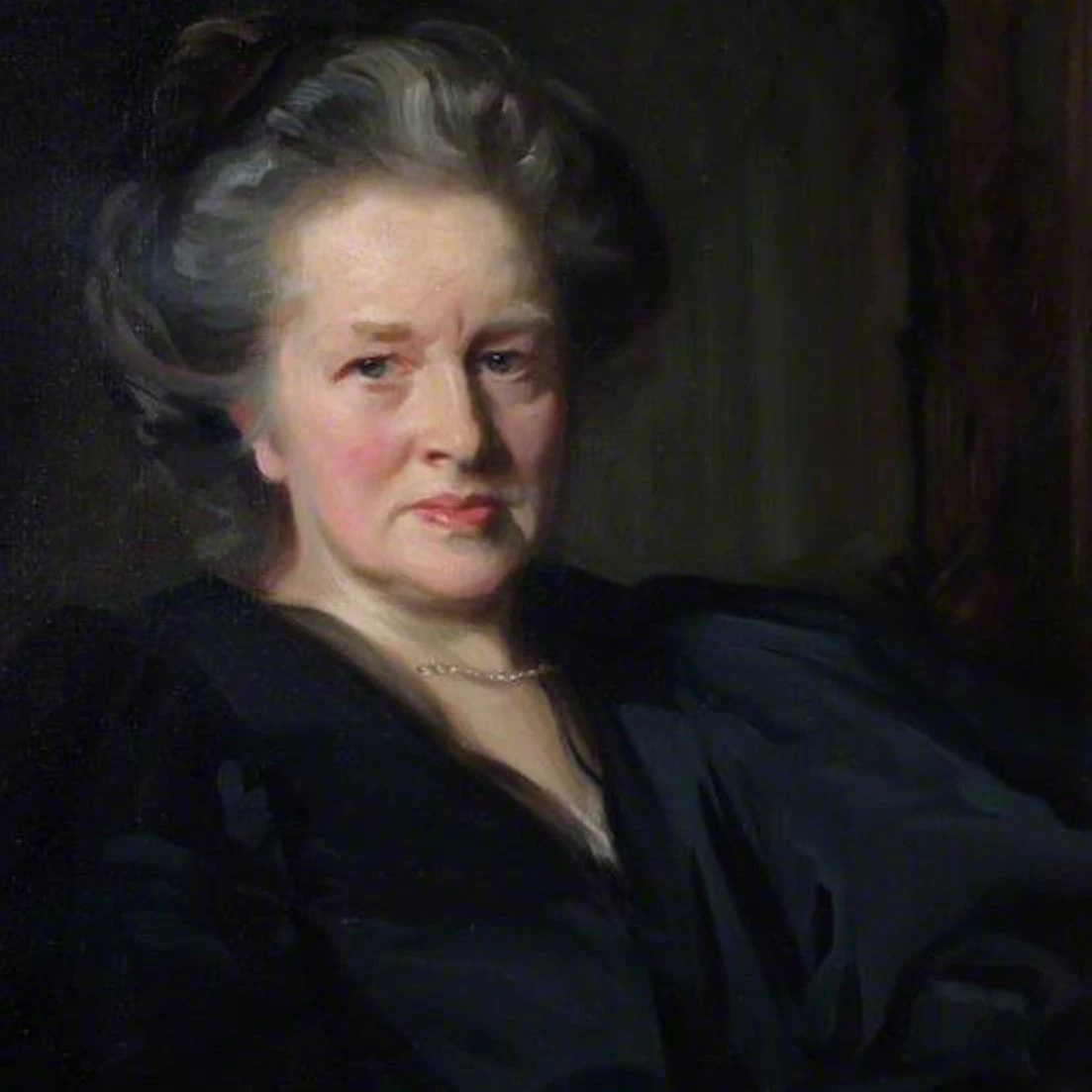
Elizabeth Garrett Anderson did not enter medicine through a medical school. When the established institutions refused to admit her, she pursued private tuition and found a route to qualification through the Society of Apothecaries. In 1865, she became the first woman to qualify in Britain as a physician and surgeon. She then turned an individual breakthrough into lasting institutions: a dispensary and hospital for women and children, and a medical school that trained women to become doctors.
A childhood between London and Suffolk
Garrett Anderson was born Elizabeth Garrett in Whitechapel, London, on 9 June 1836. She was the second of eleven children of Newson Garrett and Louisa Dunnell. Her father’s business took the family to Suffolk, where they lived in Aldeburgh and he later developed a successful malting business. The household encouraged its children to take an interest in public life, but Elizabeth’s education did not follow a straightforward school route.
She learnt reading, writing and arithmetic from her mother before a governess was employed. At 13, she and her sister Louisa went to a private school in Blackheath. Garrett later recalled its shortcomings, particularly the lack of science and mathematics. After leaving, she spent several years on domestic duties while continuing to study and read. A visit to Gateshead in 1854 brought her into contact with Emily Davies, who became a lifelong friend and fellow campaigner for women’s opportunities.
Her decision to pursue medicine took shape after she learnt of Elizabeth Blackwell, the American doctor, and attended Blackwell’s London lectures in 1859. Garrett joined the Society for Promoting the Employment of Women, which arranged a private meeting between the two. Her father initially opposed the prospect of a medical career, but later agreed to support her. The ambition was exceptional in a society where medical education and professional practice were largely closed to women.
Finding a route into medicine
In August 1860, Garrett began work as a surgery nurse at Middlesex Hospital in London. She was allowed to attend the outpatients’ clinic and later an operation, but the hospital’s medical school would not enrol her. Instead, she arranged private instruction in subjects including Latin, Greek and pharmacology, and studied anatomy and physiology with a tutor. She was eventually permitted to attend some lectures and work in the dissecting room. Opposition from male students helped force her departure, although she left with an honours certificate in chemistry and materia medica.
Applications to medical schools and other institutions, including Oxford, Cambridge, Glasgow, Edinburgh, St Andrews and the Royal College of Surgeons, failed. Garrett continued studying privately and obtained the certificates in anatomy and physiology required to sit the Society of Apothecaries’ examination. The Society could not exclude her under its charter. In 1865, she passed the examination and received its licence to practise medicine, with the highest marks among the candidates who passed.
The Society promptly changed its rules to prevent other privately educated women from using the same route. Garrett’s qualification opened a door for her, not a settled path for those who followed. Women could not obtain medical licences from British authorities on equal terms until the Medical Act of 1876 allowed qualified applicants to be licensed regardless of sex.
Creating places to treat and train women
Garrett opened a private practice at 20 Upper Berkeley Street in London in late 1865. Patients came slowly at first. In 1866, she opened St Mary’s Dispensary for Women and Children in Seymour Place, providing care from a qualified woman doctor. Its first year brought 3,000 new patients and 9,300 outpatient visits. In 1872, the dispensary became the New Hospital for Women and Children; it moved to new premises in Marylebone Street in 1874 and was for many years staffed entirely by women.
Her work extended beyond private practice and the dispensary. In 1870, Garrett received a medical degree from the University of Paris. That year she was elected to the first London School Board, the first woman elected to a school board in Britain, and appointed visiting physician to the East London Hospital for Children—the first woman in Britain appointed to a medical post. She resigned from those roles by 1873, as their demands competed with her practice, hospital work and responsibilities as a new mother.
In 1874, Garrett co-founded the London School of Medicine for Women with Sophia Jex-Blake. It offered women a route to formal medical training in Britain, and Garrett taught there. She served as dean from 1883 to 1902. The school prepared students for a medical degree at the University of London, which had opened its degree to women in 1877. The New Hospital and the school made her achievement more than a personal exception: they helped build practical settings in which women could receive medical care and train as practitioners.
Garrett joined the British Medical Association in 1873. After her election, a motion to exclude women was proposed in 1878; the association did not readmit women until 1892, following a campaign in which Garrett, Sarah Gray and Eliza Walker Dunbar took part. Garrett later became president of the BMA’s East Anglian branch in 1897. Her experience showed how an initial admission could be followed by attempts to close the institution to other women.
Family, suffrage and public office
Garrett married James George Skelton Anderson in 1871 and continued her medical work. They had three children: Louisa, who became a doctor and feminist activist; Margaret, who died of meningitis in infancy; and Alan. After her husband’s death in 1907, Garrett became more active in the suffrage movement. She had earlier joined the first British Women’s Suffrage Committee and, in 1889, the central committee of the National Society for Women’s Suffrage. She later withdrew from the movement as its militant activity increased.
Her public service also included local government. On 9 November 1908, she was elected mayor of Aldeburgh, becoming the first female mayor in Britain. She used her position to speak in favour of women’s suffrage. The office extended a life spent challenging exclusions from public and professional institutions, though her work in medicine remained the defining achievement of her career.
Garrett and her husband retired to Aldeburgh in 1902. She died there on 17 December 1917, aged 81, and was buried in the churchyard of St Peter and St Paul’s Church. In 1918, the New Hospital for Women was renamed the Elizabeth Garrett Anderson Hospital. The former hospital building is now part of the headquarters of the public service trade union UNISON and houses a gallery about Garrett Anderson, the hospital and women’s struggle for equality in medicine. Her name also lives on in the Garrett Anderson Centre at Ipswich Hospital and in a school in Islington.
Why Elizabeth Garrett Anderson deserves a place in British Legacy
Garrett Anderson’s place in British history rests on more than being first. In 1865, she found a way to qualify when medical schools barred her, but the Society of Apothecaries then changed its rules to prevent other women from following. Her response was not simply to defend her own professional standing. She built organisations that could serve patients and educate future doctors: St Mary’s Dispensary, the New Hospital for Women and Children, and the London School of Medicine for Women. These institutions addressed two connected barriers, women’s access to medical care and women’s access to the training required to provide it.
Her career also shows the uneven nature of institutional progress. Garrett gained a place in the British Medical Association, yet women faced a renewed exclusion before their readmission in 1892. Her medical degree, teaching, leadership and campaigning formed part of a sustained effort to make professional access less dependent on an individual exception. Outside medicine, her election as mayor of Aldeburgh made her the first woman to hold that office in Britain; in London, she was the first woman elected to a school board. These are specific contributions to British public life, not simply symbols of perseverance. The hospital and educational legacy associated with her name offers a concrete record of how her work created opportunities for women as patients, students and practitioners.
Sources
Elizabeth Garrett Anderson — Wikipedia, revision 1362023373
Adapted in part from Elizabeth Garrett Anderson by Wikipedia contributors, under CC BY-SA 4.0. Text has been edited and combined with the existing article; this adapted text is shared under the same licence. Contributor history.