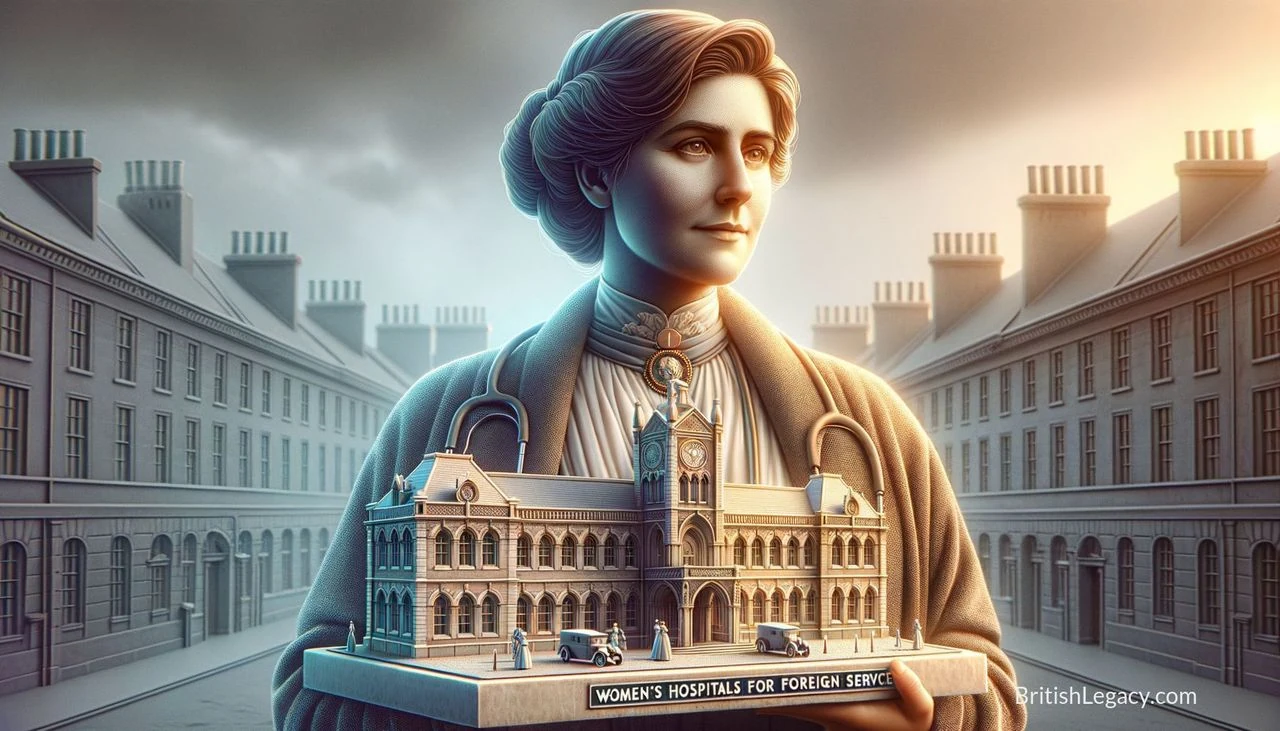
When the War Office rejected Elsie Inglis’s offer of a medical unit staffed by qualified women, it told her to “go home and sit still”. Inglis did not. She drew on the women’s suffrage movement to establish the Scottish Women’s Hospitals for Foreign Service, an organisation that sent medical teams to serve the Allied war effort. Its work in France, Serbia and Russia grew from a career in which practical care for women and children had always been closely connected to public advocacy.
Training as a doctor in Edinburgh and Glasgow
Eliza Maud Inglis, known as Elsie, was born on 16 August 1864 in Naini Tal, in British India. Her father, John Forbes David Inglis, served in the Indian Civil Service and ended his career as Chief Commissioner of Oudh. Her mother was Harriet Lowes Thompson. The family later moved to Edinburgh, where Inglis received a private education. Her decision to study medicine was delayed by her mother’s illness and death in 1885, and by her sense of responsibility to her father.
In 1886 Inglis began studying at the Edinburgh School of Medicine for Women, founded by Sophia Jex-Blake. She later moved to the Edinburgh College of Medicine for Women, established in response to disagreements over Jex-Blake’s methods. Her clinical training included work under William MacEwen at Glasgow Royal Infirmary. In 1892 she gained the Triple Qualification, becoming licentiate of the Royal Colleges of Physicians and Surgeons of Edinburgh and the Faculty of Physicians and Surgeons of Glasgow. After women were admitted to degrees at the University of Edinburgh, she completed her MBChM there in 1899.
Inglis worked at Elizabeth Garrett Anderson’s New Hospital for Women in London and at the Rotunda, a maternity hospital in Dublin. Returning to Edinburgh in 1894, she established a practice with fellow doctor Jessie MacLaren MacGregor and lectured in gynaecology at the Medical College for Women. She and MacGregor opened the Hospice in George Square to provide maternity care for poorer women and to train midwives. The service expanded to include an accident and general department, an operating theatre and eight beds in premises on the Royal Mile. It merged with nearby Bruntsfield Hospital in 1910.
Inglis was concerned about the poor provision of medical care for women and children. She often waived patients’ fees and paid for some to recover by the seaside; she was particularly concerned about children with polio. A visit to Michigan in 1913 allowed her to study a new type of maternity hospital. These practical efforts sat alongside her work for women’s political rights: she served as secretary of the Edinburgh National Society for Women’s Suffrage and, from 1906, as honorary secretary of the Scottish Federation of Women’s Suffrage Societies. She also worked with Millicent Fawcett and spoke at suffrage meetings around the country.
Building the Scottish Women’s Hospitals
At the outbreak of the First World War, Inglis proposed a medical unit of qualified women to the Royal Army Medical Corps. The War Office turned her down. The Scottish Red Cross also refused support, with its head, George Beatson, saying he could have “nothing to say to a hospital staffed by women”. Inglis answered the refusals with organisation rather than retreat. She established the Scottish Women’s Hospitals for Foreign Service Committee and began the fund with £100 of her own money.
The suffrage movement supplied a network through which she could seek donations and volunteers. Millicent Fawcett helped bring the proposal to a London audience; the fundraising goal was £50,000. Inglis wanted the organisation’s name to be neutral enough to attract support beyond the suffrage movement, but the movement’s connections were crucial to getting it started. The teams included women doctors and technical staff, alongside volunteer nurses and transport workers. Ultimately, 14 teams served in Belgium, France, Serbia and Russia.
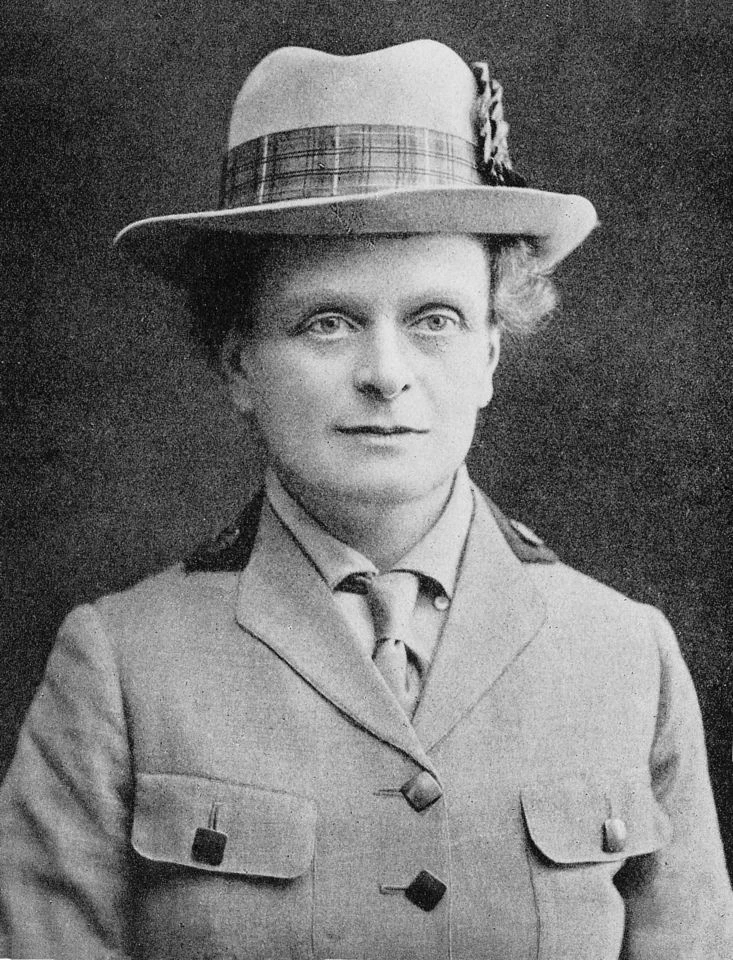
It was the French government, rather than the British Army, that accepted the offer of a hospital unit. Based at the Abbey of Royaumont, the hospital was run by Frances Ivens from January 1915 to March 1919. Initially planned for 100 beds, it expanded to 600 as it treated casualties from battles including the Somme. Inglis was involved in the organisation’s details, including the design of its uniform: hodden grey with Gordon tartan facings.
Service in Serbia and Russia
Inglis led a team to Serbia, where the SWH worked to improve hygiene and reduce typhus and other epidemics. Four units were established in the country. The work was dangerous: typhus affected the hospital staff and killed four SWH members, including Louisa Jordan. Inglis remained with others to help repatriate wounded people when Austro-Hungarian and German forces took control of the region. She was captured at the hospital in Kruševac and repatriated through neutral Switzerland in February 1916.
Back in Scotland, she turned quickly to raising money for a team in Russia. In August 1916 she travelled with it to Odessa, accompanied by administrator Mary H. J. Henderson and commandant Evelina Haverfield. As the military situation deteriorated, the teams were caught up in a chaotic retreat. Inglis and her colleagues travelled through Dobruja to Brăila, on the Danube. There, with only six other doctors and one surgeon, they treated 11,000 wounded soldiers and sailors. A letter written in the name of Russian citizen soldiers thanked Inglis and her staff for their tireless care.
Inglis continued working in Russia through another summer, but her health failed. She was suffering from bowel cancer and returned to Britain in poor condition. She died in Newcastle upon Tyne on 26 November 1917, the day after arriving back in Britain, with her sisters at her bedside in the Station Hotel. Her death came after years of medical work, suffrage campaigning and wartime service, rather than at the Edinburgh funeral described in the earlier account: her funeral was held at St Giles’ Cathedral on 29 November.
Honours and remembrance
In April 1916, the Serbian Crown Prince Alexander awarded Inglis the Order of the White Eagle, First Class, making her the first woman to receive it. She had earlier received the Order of Saint Sava, Third Class. Her wartime leadership also attracted public recognition in Britain. At her Edinburgh funeral, attended by British and Serbian royalty, her coffin was carried through streets lined with people before she was buried in Dean Cemetery. Winston Churchill wrote that Inglis and her nurses would “shine in history”.
Commemorations have connected her name to both medicine and the suffrage campaign. Edinburgh’s Elsie Inglis Memorial Maternity Hospital opened in 1925 and continued operating until 1988; many children were born there. In 2017, the University of Edinburgh named a medical-school courtyard in her honour. Her name also appears on the plinth of the Millicent Fawcett statue in Parliament Square, unveiled in 2018, alongside those of other women who supported suffrage. In 2009, her portrait appeared on a new Clydesdale Bank £50 note. Serbia has also commemorated her work, including by naming the British Residence in Belgrade Elsie Inglis House in 2015.
Why Elsie Inglis deserves a place in British Legacy
Elsie Inglis deserves a place in British Legacy because she joined medical practice to the campaign for women’s rights, and made both forms of work concrete. In Edinburgh, she helped create maternity and general services for women who had limited access to care, trained midwives and supported patients who could not afford treatment. Her work was not simply a matter of individual professional success: it addressed gaps in provision for women and children and helped establish facilities that served the city for decades. Her suffrage activity, including years as an organiser and speaker, made political equality part of that same concern for women’s lives.
The Scottish Women’s Hospitals extended this record beyond Britain. Inglis built an organisation able to raise funds, recruit women and deliver medical care in a war zone, despite rejection by British authorities. Its teams served across several countries; in Serbia, they worked against epidemics as well as treating the wounded, and in Russia Inglis’s small medical team faced an immense caseload. The hospitals demonstrated women’s capacity to undertake demanding professional and logistical responsibilities under wartime conditions. Her legacy therefore rests not on vague claims of inspiration, but on institutions, services and organised action: better maternity care in Edinburgh, a route into wartime medical service for women, and a sustained challenge to the assumption that women should be kept out of medicine and public life.
Sources
Elsie Inglis — Wikipedia revision 1379836713
Adapted in part from Elsie Inglis by Wikipedia contributors, under CC BY-SA 4.0. Text has been edited and combined with the existing article; this adapted text is shared under the same licence. Contributor history.