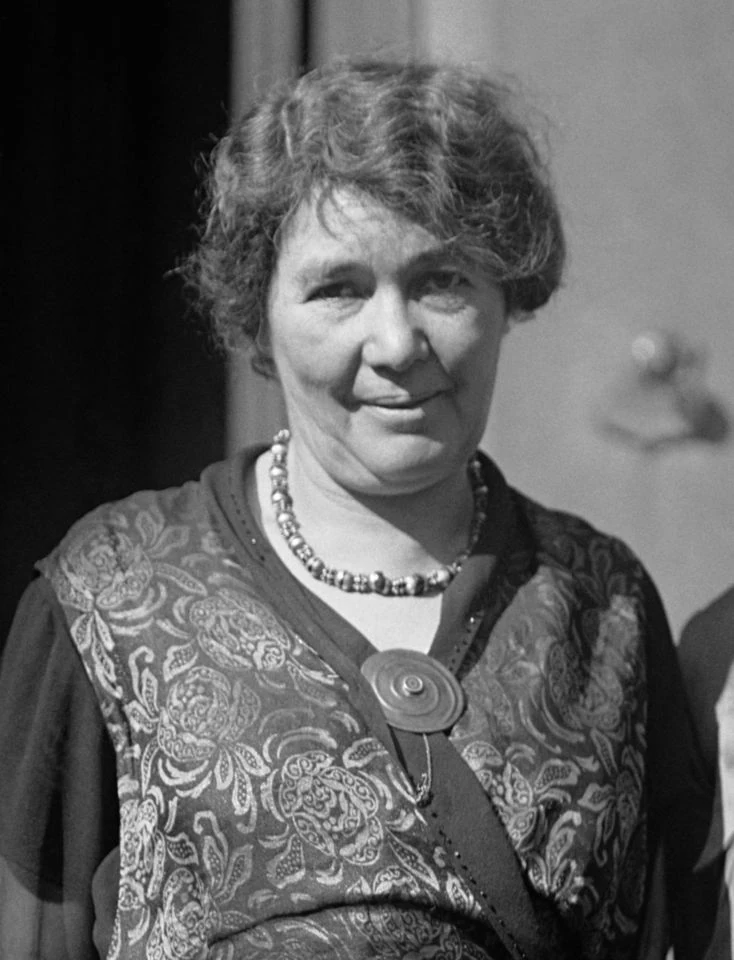
Emmeline Pethick-Lawrence’s work for women’s rights began well before she became a leading figure in the suffrage campaign. In London, she organised social and educational work for girls and young women, helped create a dressmaking cooperative with improved working conditions, and later became a principal fundraiser and organiser for the Women’s Social and Political Union (WSPU). She also helped establish its public identity through the colours purple, white and green. Her political life did not end with the WSPU: after opposing its increasingly militant tactics, she helped form a broader suffrage organisation and became an advocate for peace.
Social work, clubs and a cooperative
Born Emmeline Pethick in Clifton, Bristol, on 21 October 1867, she was the daughter of businessman Henry Pethick. She attended Greystone House boarding school in Devizes from the age of eight, and was later educated at private schools in England, France and Germany. Her younger sister Dorothy also became a suffragist.
From 1891 to 1895, Pethick worked at the West London Methodist Mission in Cleveland Hall as a “sister of the people”. She ran a girls’ club there with Mary Neal; the two women became friends and lived together. In 1895 they left the mission to found the Espérance Club, a place for young women and girls that could offer dance and drama without the constraints of the mission.
Pethick also set up Maison Espérance, a dressmaking cooperative that offered a minimum wage, an eight-hour working day and a holiday scheme. Her social work included founding a settlement for girls from London’s East End. These projects made practical conditions part of her reforming work: support for women meant not only arguing for political rights, but also creating organisations in which they could learn, work and take part in cultural life.
A partnership in life and political work
Pethick met the barrister Frederick William Lawrence in 1899 at Mansfield House settlement in Canning Town. She worried that a conventional marriage might curtail her independence and her social work, and initially declined his proposal. They married at Canning Town Hall on 2 October 1901, taking the joint surname Pethick-Lawrence. The hyphenated name expressed their commitment to equality; they also kept separate bank accounts.
The couple shared homes in Surrey and London. From 1906, their house at Holmwood, near Dorking, became a meeting place for suffrage leaders and a refuge for women recovering after forcible feeding. Their resources and connections helped support the movement, but Emmeline’s own work was central: she organised, spoke, raised funds and helped give the campaign a public platform.
Building the WSPU campaign
After reading about Christabel Pankhurst and Annie Kenney’s protest at Manchester Free Trade Hall in 1905, Pethick-Lawrence joined the suffrage campaign. Keir Hardie introduced her to Emmeline Pankhurst in 1906, and she became treasurer of the WSPU, the organisation Pankhurst had founded in 1903. Over six years, Pethick-Lawrence raised £134,000 for the union. She also insisted that the WSPU’s finances be audited, appointing her friend, chartered accountant Alfred Sayers, to the task.
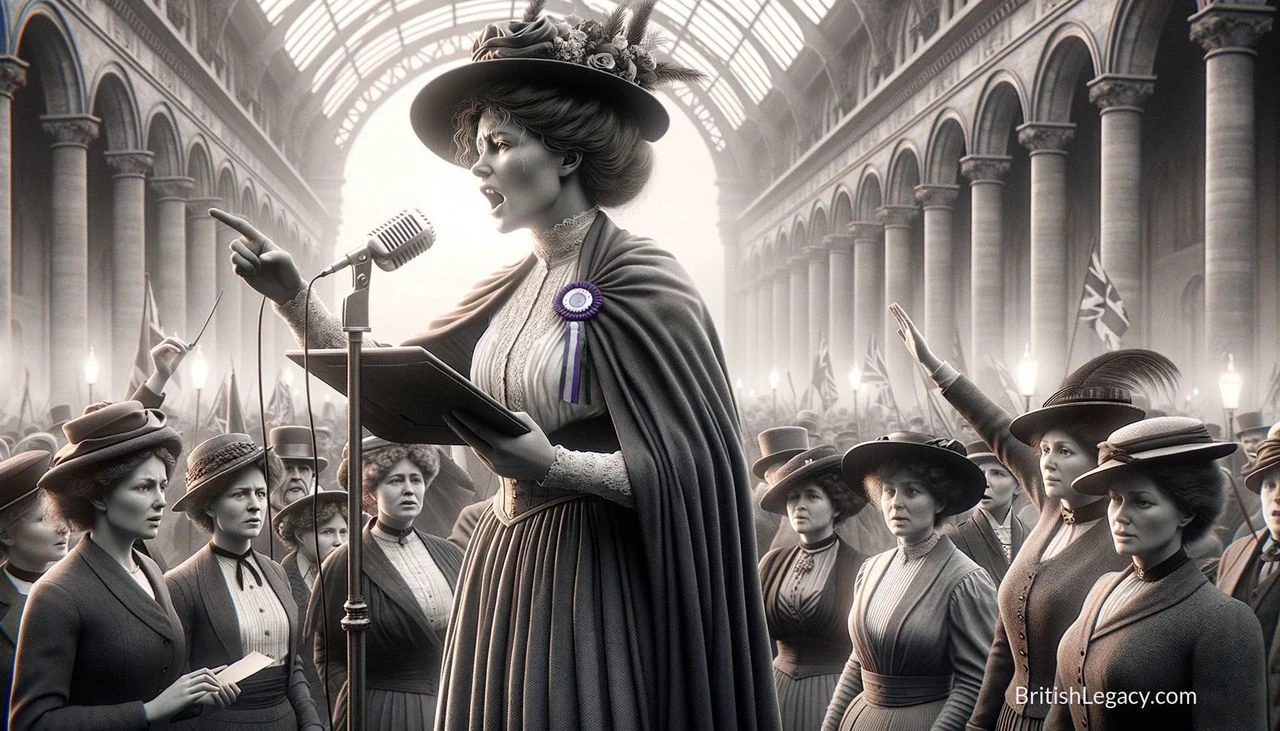
Fundraising was one part of a wider organising effort. In 1908, Pethick-Lawrence, Beatrice Sanders and Mrs Knight organised the WSPU’s first Week of Self-Denial, asking supporters to go without some necessities for a week and donate the money saved. She selected the movement’s colours—purple, white and green—which made the campaign recognisable and gave supporters a shared visual identity.
She also helped bring the movement’s case to audiences across the country. Pethick-Lawrence spoke at the large Women’s Sunday gathering in Hyde Park on 21 June 1908 and at the Royal Albert Hall in 1909. She founded and edited Votes for Women with her husband from 1907. The WSPU adopted it as its official newspaper, giving organisers a regular means of communicating their arguments and campaign news.
Her activism brought repeated arrests. In October 1906, she was imprisoned at Holloway after refusing to pay a fine for causing a disturbance outside the House of Commons. She was arrested again in 1911. In 1912, the Pethick-Lawrences were prosecuted for conspiracy following demonstrations involving window-breaking, although they opposed that form of action. They were imprisoned, and Emmeline was force-fed. The distinction matters: her imprisonment followed a prosecution for conspiracy; the account does not support the older claim that she received a two-month sentence of hard labour for the window-smashing campaign.
Breaking with militancy, campaigning for peace
Disagreement over increasingly militant tactics brought the Pethick-Lawrences into conflict with Emmeline and Christabel Pankhurst. They were expelled from the WSPU. Rather than abandon the campaign, they joined Agnes Harben and others in founding the United Suffragists, an organisation open to women and men, and to both militant and non-militant supporters. It took over Votes for Women.
Pethick-Lawrence’s political activity extended beyond suffrage. During the First World War she became a pacifist, speaking in the United States in 1914 about the war’s effects on women and the case for feminist pacifism. She attended the 1915 International Congress of Women at The Hague, where the Women’s International League for Peace and Freedom was formed, and became one of its members. Back in England, she led a campaign against the naval blockade of Germany and later deplored the terms of the Treaty of Versailles.
In 1919, the first year women could stand for Parliament, she contested the Manchester constituency of Rusholme as a Labour candidate. Her programme called for better housing and food, pure milk, public health provision, midwives and pensions for widowed mothers. She was not elected, receiving a sixth of the vote. Her campaign shows how she connected women’s political participation with wider questions of health, housing and social provision.
Later work and public remembrance
Pethick-Lawrence continued to work for women’s organisations after the vote was extended. She was president of the Women’s Freedom League from 1926 to 1935 and was later elected its president in honour. She helped establish the Suffragette Fellowship, which documented the movement, and was involved in campaigns for birth control for working-class women. In 1938 she published her memoir, My Part in a Changing World, reflecting on the radicalisation of the suffrage movement and its connections with the peace movement.
The Representation of the People Act 1918 gave the vote to women aged over 30 who met property qualifications. The Representation of the People (Equal Franchise) Act 1928 brought women’s voting rights into line with men’s, ending the unequal age threshold. Pethick-Lawrence and her husband attended a celebratory breakfast after the 1928 Act became law; she paid tribute there to suffrage activists who had died before equal voting rights were achieved.
Her husband was made a baron in 1945, making her Lady Pethick-Lawrence. A serious accident in 1950 ended her campaigning. She died at her home in Gomshall, Surrey, on 11 March 1954, aged 86. Her name and image were later included on the plinth of the Millicent Fawcett statue in Parliament Square, unveiled in 2018. That year, the London School of Economics also named a campus building in her honour. In 2020, a blue plaque was unveiled at Lewisham House in Weston-super-Mare, the house known as Trewartha where she had lived as a child.
Why Emmeline Pethick-Lawrence deserves a place in British Legacy
Pethick-Lawrence’s place in British history rests on more than her association with a famous campaign. She helped build the infrastructure that allowed suffrage activism to operate: raising substantial funds for the WSPU, pressing for financial oversight, organising the Week of Self-Denial and co-founding a newspaper that became the union’s official voice. Her choice of purple, white and green gave supporters a shared emblem. These were practical contributions to political organising, as well as visible expressions of a movement seeking to make women’s claims heard across Britain.
Her record also shows that women’s rights activism encompassed more than the parliamentary vote. The clubs and cooperative she established offered opportunities for girls and working women; her later election campaign linked political representation to housing, food, health care and support for widowed mothers. When she rejected the WSPU’s militant direction, she continued through the United Suffragists, and her pacifist work carried her concerns into international politics. The vote was secured through the actions of many people, not one individual, but Pethick-Lawrence’s combination of social organisation, fundraising, publishing and political advocacy helped sustain that collective effort. Her work remains part of Britain’s history of democratic reform and organised campaigns for social change.
Sources
Emmeline Pethick-Lawrence — Wikipedia revision 1362818581
Adapted in part from Emmeline Pethick-Lawrence by Wikipedia contributors, under CC BY-SA 4.0. Text has been edited and combined with the existing article; this adapted text is shared under the same licence. Contributor history.