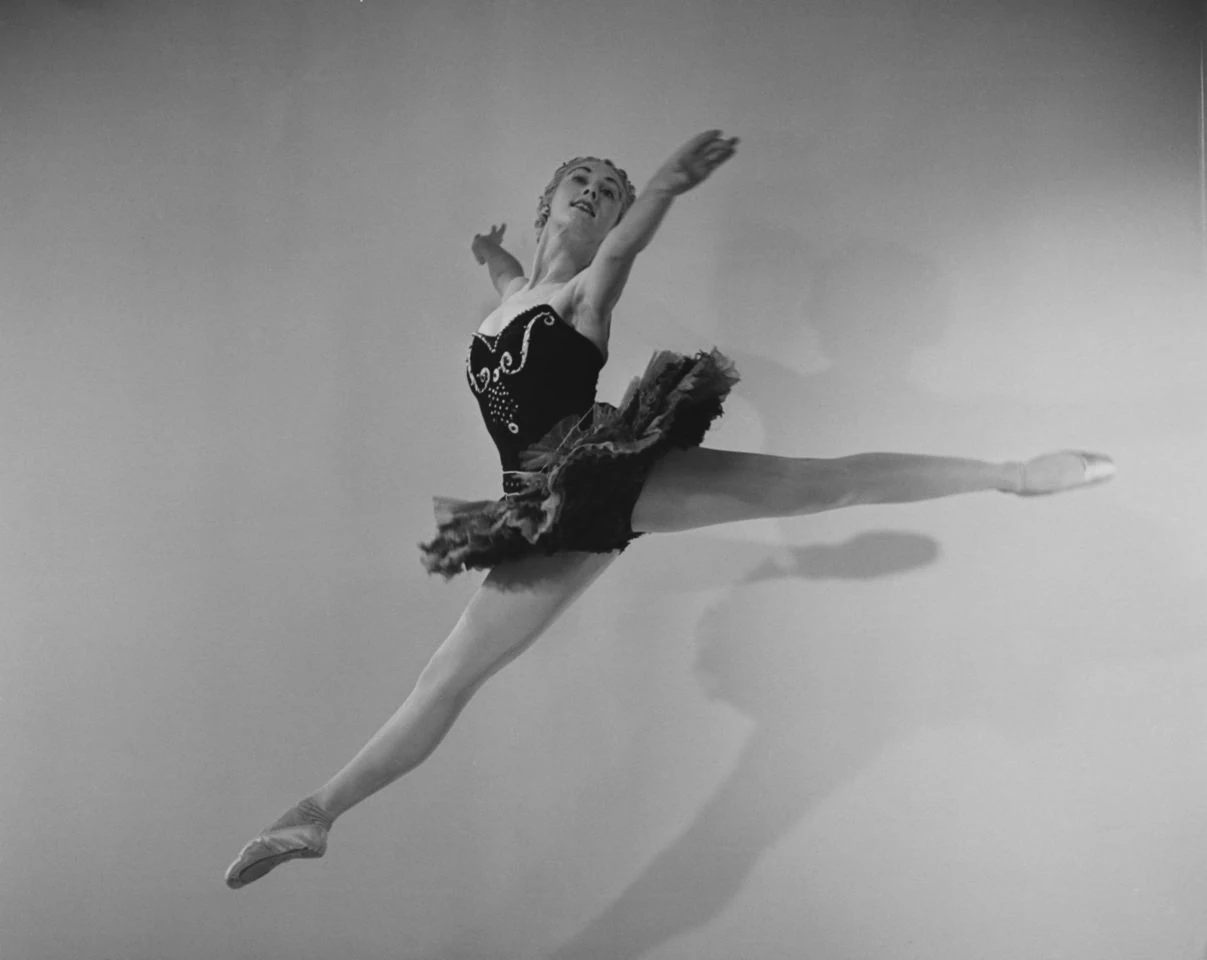
Gillian Lynne’s work helped define how dance could tell a story on the musical-theatre stage. Her choreography for Cats and The Phantom of the Opera became part of two internationally recognised productions, but those shows were only a portion of a career that also took in ballet, opera, Shakespeare, film and television. Lynne began as a dancer, developed into a choreographer and director, and remained active in theatre into her eighties.
A dancer from the beginning
Born Gillian Barbara Pyrke in Bromley, Kent, on 20 February 1926, Lynne showed an early aptitude for dance. Her mother took her to a doctor after concerns about her fidgeting and lack of concentration at school. The doctor turned on the radio and left the room; seeing Lynne dance, he suggested that she should attend dance school. It was an early recognition of an ability that would become the foundation of her professional life.
Lynne danced with Molly Lake’s Ballet Guild before Ninette de Valois invited her to join Sadler’s Wells Ballet during the Second World War. The company later became the Royal Ballet. Lynne was a leading soloist from 1944 to 1951, and, after the Royal Opera House reopened after the war, received her first major solo in The Sleeping Beauty on her twentieth birthday. Among her notable roles were the Black Queen in de Valois’s Checkmate and the Queen of the Wilis in Giselle, as well as parts created for her by Frederick Ashton and Robert Helpmann.
Leaving the company in 1951, she became a star dancer at the London Palladium, then appeared in West End productions including Can-Can at the Coliseum. She also acted in film and appeared on early British television as both dancer and actress. That experience across different kinds of performance would inform her later work as a choreographer and director.
From performer to maker
Lynne’s career in choreography and direction ranged well beyond one theatrical style. She worked on productions for the Royal Opera House, the Royal Shakespeare Company and English National Opera, as well as for West End and Broadway stages. In 1970 she choreographed and directed Love on the Dole at Nottingham Playhouse, a musical adaptation of Walter Greenwood’s novel. In 1975 she created The Fool on the Hill, the Australian Ballet’s first work commissioned expressly for television.
Television became a substantial strand of her work. Lynne choreographed and directed for programmes including The Muppet Show. Her direction and choreography for A Simple Man, starring Moira Shearer, won the 1987 BAFTA Huw Wheldon Award. The work brought dance to viewers beyond the theatre, while giving Lynne room to combine movement, performance and the possibilities of the screen.
Her stage credits also ranged from Shakespeare to new musicals. She choreographed the Royal Shakespeare Company’s production of The Secret Garden, which played at Stratford in 2000 before transferring to the Aldwych Theatre in 2001. In 2002 she staged and choreographed Chitty Chitty Bang Bang in London; the production later went to Broadway. The London run brought her back to the Palladium, where she had first found success as a dancer.
Movement in Cats and Phantom
Lynne is particularly associated with Andrew Lloyd Webber’s Cats (1981), The Phantom of the Opera (1986) and Aspects of Love (1990). In Cats, adapted from T. S. Eliot’s Old Possum’s Book of Practical Cats, choreography helped distinguish the characters through their movement. Dance was not simply an interlude between songs: it gave the cats an individual physical presence and helped shape the world of the show.
For The Phantom of the Opera, Lynne worked as musical stager and choreographer. She later choreographed its 90-minute Las Vegas production, which opened in 2006, and the Royal Albert Hall production marking the show’s 25th anniversary in 2011. These versions show the continuing place of her work within the production’s life after its original staging.
Her association with these celebrated musicals should not eclipse the breadth of her work. She choreographed productions ranging from The Roar of the Greasepaint – The Smell of the Crowd to My Fair Lady, directed as well as choreographed several projects, and continued working into the 2010s. In 2013 she directed and choreographed Dear World at Charing Cross Theatre, starring Betty Buckley.
Honours and remembrance
Lynne received the Olivier Award for Outstanding Achievement of the Year in Musicals in 1981 for Cats, and was nominated for Tony Awards for the choreography of both Cats and The Phantom of the Opera. Her other honours included the Queen Elizabeth II Coronation Award from the Royal Academy of Dance in 2001 and a special award at the 2013 Olivier Awards.
She was appointed a Commander of the Order of the British Empire in the 1997 Birthday Honours for services to dance and musical theatre, and a Dame Commander in the 2014 New Year Honours. In 2018, the New London Theatre, where the original West End production of Cats had played, was renamed the Gillian Lynne Theatre. The naming made her the first non-royal woman to have a West End theatre named after her.
Lynne died in a London hospital on 1 July 2018, aged 92, from pneumonia. Her life in dance had moved from ballet company and variety-stage performance to musical theatre, television and direction. The theatre bearing her name provides a visible memorial in the West End, while her work remains present in the productions for which she choreographed.
Why Gillian Lynne deserves a place in British Legacy
Gillian Lynne’s place in British Legacy rests on the scale and range of her contribution to performance in Britain. She began as a dancer with Sadler’s Wells Ballet, became a leading soloist, then carried her understanding of performers’ bodies into choreography and direction. Her work crossed ballet, opera, Shakespeare, film, television and musical theatre. That breadth matters: it shows how a career in dance could develop beyond the stage role of performer and shape the form, pace and storytelling of entire productions.
Her best-known work offers a specific example of that contribution. In Cats, distinctive movement helped audiences read character; in The Phantom of the Opera, choreography became part of the production’s dramatic world. Lynne’s television work, including the BAFTA-winning A Simple Man, also took dance beyond theatre audiences. The Gillian Lynne Theatre gives her name a lasting place in London’s West End, the setting of much of her work. Together, these achievements connect an individual artist’s long career to British institutions and audiences: ballet companies, playhouses, television, the West End and the honours recognising services to dance and musical theatre.
Sources
Adapted in part from Gillian Lynne by Wikipedia contributors, under CC BY-SA 4.0. Text has been edited and combined with the existing article; this adapted text is shared under the same licence. Contributor history.