In Peter Shaffer’s Equus, a psychiatrist tries to understand why a 17-year-old boy has blinded six horses. But the case unsettles the doctor as much as it occupies him: Martin Dysart begins to question whether treatment will help Alan Strang or merely return him to a life stripped of intensity and devotion. First staged at the National Theatre in London in 1973, the play makes that conflict its dramatic engine, joining a crime story to questions about belief, desire and the meaning of an ordinary life.
A case that unsettles the psychiatrist
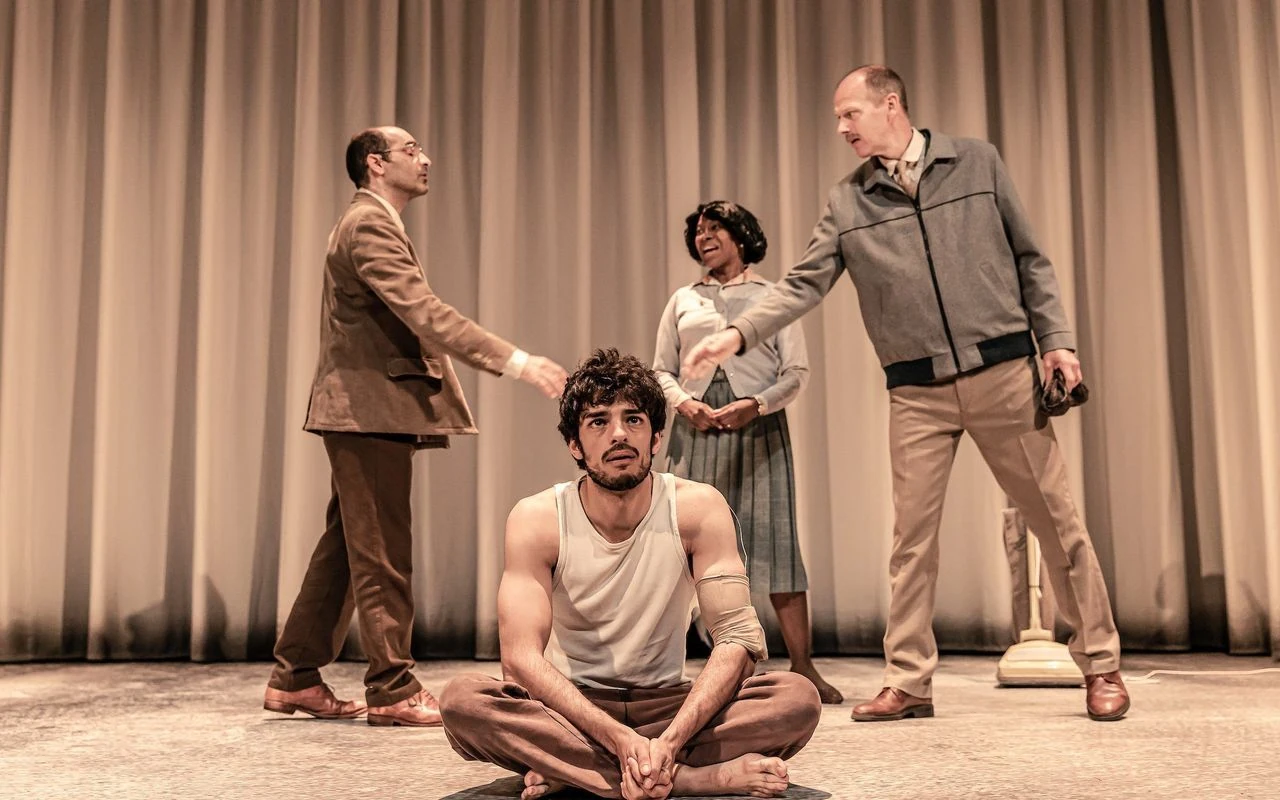
Alan is admitted to a psychiatric hospital after blinding six horses with a spike. Dysart, his psychiatrist, is asked by magistrate Hesther Saloman to help him come to terms with what he has done. At first, Alan evades questioning by singing advertising jingles. Dysart gradually draws him into conversation through a game in which they take turns asking questions and must answer honestly.
The account of Alan’s childhood reveals competing influences. His mother, Dora, is a devout Christian who reads him Bible stories; his father, Frank, is a non-believer and objects to Alan’s interest in violent religious imagery. Alan’s early fascination with horses also grows from stories, films and an encounter with a horse on a beach. Shaffer makes these details part of a fictional explanation, not a clinical diagnosis offered as a final answer.
As Dysart learns more, Alan describes a private religious world centred on the horses and a godhead he calls Equus. He has taken a job at a stable, where he tends to a horse named Nugget and secretly rides him at night. His relationship with the animal combines worship, physical desire and imagined power. The play’s account does not reduce his actions to one cause; instead, the different strands of family, belief and sexuality make the case harder for Dysart to resolve.
Dysart, meanwhile, has his own crisis. He doubts the purpose of a profession that, as he sees it, adjusts young people to a supposedly normal life. He fears that helping Alan might mean suppressing the passion that gives the boy’s life meaning, even though that passion has become destructive. The drama therefore turns its attention from the question of what Alan has done to the doctor’s uncertainty about the ethics and consequences of treatment.
Shaffer’s stage language
Shaffer was inspired by news of a real crime involving a 17-year-old boy who blinded 26 horses in a town in northern England. He did not know the details of that case; he set out to imagine what might have caused such an act and to create an atmosphere of mystery. The play’s Alan and the six horses in his case belong to Shaffer’s fictional construction, rather than being a direct account of the reported incident.
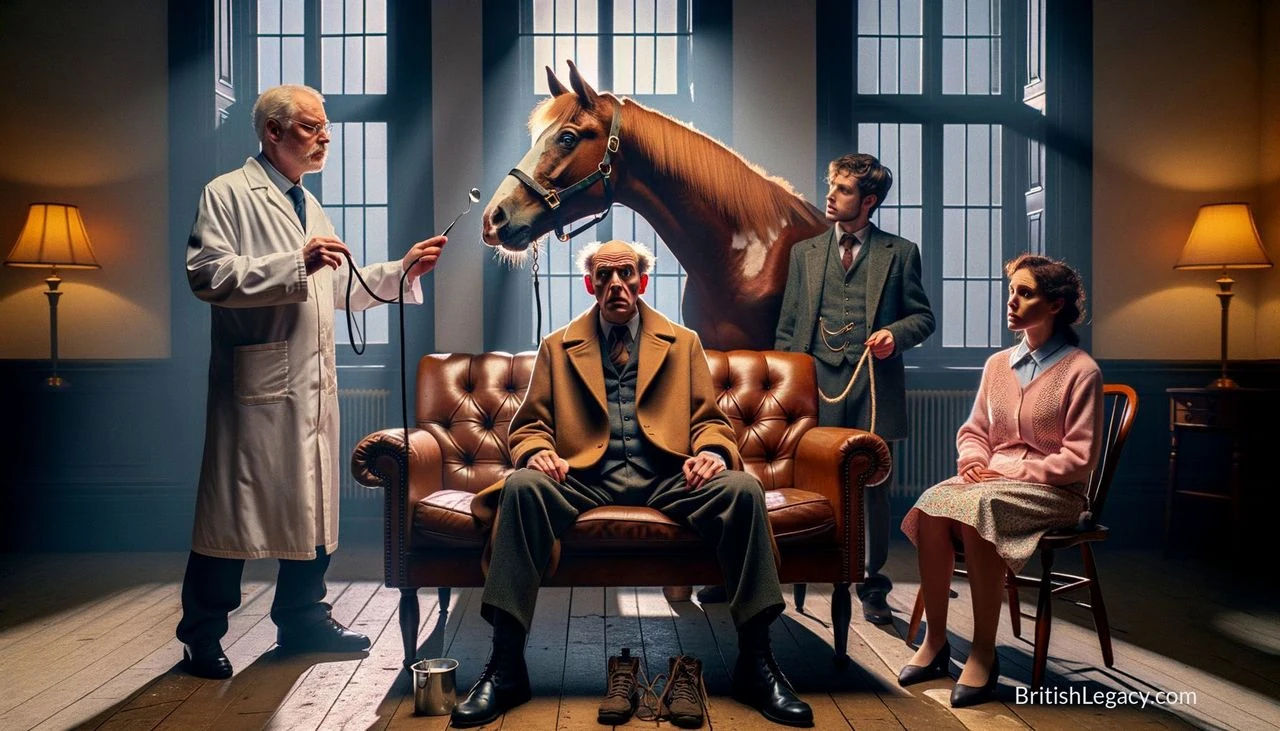
The horses are represented on stage by human actors, often wearing stylised headpieces rather than realistic costumes. This theatrical convention makes the animals visible without attempting to reproduce them naturalistically. It also places the audience close to the play’s central tension: the horses are both physical presences in Alan’s life and figures within his intense private belief. The staging gives the story an abstract, ritual quality, while keeping the relationships between Alan, the horses and Dysart in view.
That formal choice sits alongside the play’s use of direct address, recollection and re-enactment. Alan’s experiences emerge through conversations with Dysart, while the psychiatrist’s own monologues expose the doubts he cannot settle through the case. The structure lets Shaffer place the audience between two perspectives: Alan’s fervent world and Dysart’s increasingly troubled professional judgement.
From the National Theatre to Broadway
Directed by John Dexter, the original production opened at London’s National Theatre in 1973, with Alec McCowen as Dysart and Peter Firth as Alan. It ran there from 1973 to 1975. The production then reached Broadway, where the first staging starred Anthony Hopkins as Dysart and Firth as Alan. When Firth left the London production for Broadway, Dai Bradley took over the role opposite Michael Jayston. The Broadway run continued for 1,209 performances, with Richard Burton, Leonard Nimoy and Anthony Perkins among the actors who later played Dysart, and Tom Hulce later taking over as Alan.
The Broadway production received major awards recognition in 1975. It won the Tony Award for Best Play and the Drama Desk Award for Outstanding Play; Dexter won the Tony for direction and the Drama Desk Award for directing. Hopkins won the Drama Desk Award for Outstanding Actor in a Play. Peter Firth received a Theatre World Award, while the New York Drama Critics’ Circle named Equus Best Play.
Shaffer adapted the play for a 1977 film directed by Sidney Lumet, starring Richard Burton and Peter Firth. The film used real horses, unlike stage productions, where human performers embody the animals. That change also altered the work’s visual language: the theatrical convention makes the horses part of an expressly stylised stage world, while the film presents them more literally.
Renewed attention and reinterpretation
A 2007 West End revival directed by Thea Sharrock starred Richard Griffiths as Dysart, Daniel Radcliffe as Alan and Joanna Christie. Its casting attracted attention, particularly because Radcliffe was 17 and the role required him to appear nude on stage. Radcliffe said the scene was not gratuitous and that he should portray the character as the script called for. The production later transferred to Broadway, where Radcliffe and Griffiths reprised their roles; Radcliffe was nominated for a Drama Desk Award for Outstanding Actor in a Play.
The play has also appeared in other forms and settings. A BBC Radio 4 audio adaptation, starring Peter Barkworth as Dysart and Ian Sharrock as Alan, was broadcast in 1980, with sound effects by the BBC Radiophonic Workshop. In 2009, the Old Stile Press published an illustrated edition of the play text, with images and an afterword by British artist Clive Hicks-Jenkins. These different presentations underline how much the work’s effect depends on choices about what the audience sees and hears.
Why Equus deserves a place in British Legacy
Equus belongs in British Legacy because its history is closely tied to British theatre: it began at the National Theatre in London, ran there for two years and developed a distinctive stage vocabulary for presenting its central figures. The human performers who represent the horses are not simply a practical substitute for animals. They make theatrical artifice part of the drama, allowing the horses to appear both as bodies in a stable and as objects of Alan’s religious imagination. Shaffer’s choice gives directors and audiences a particular problem to interpret, rather than a naturalistic solution that closes it down.
The play’s achievement also lies in its refusal to make the psychiatrist’s authority the final word. Dysart is meant to treat Alan, yet the case forces him to question the assumptions behind treatment and the value of conformity. That conflict has helped the work travel: its long Broadway run, later productions and film adaptation show that its concerns could be encountered in more than one theatrical culture. The British connection is not a general claim about national character, but a specific record of a play made for and first staged in London, whose formal choices and questions about care, belief and social expectations have continued to invite new performances.
Sources
Equus (play) — revision 1378800825
Adapted in part from Equus (play) by Wikipedia contributors, under CC BY-SA 4.0. Text has been edited and combined with the existing article; this adapted text is shared under the same licence. Contributor history.