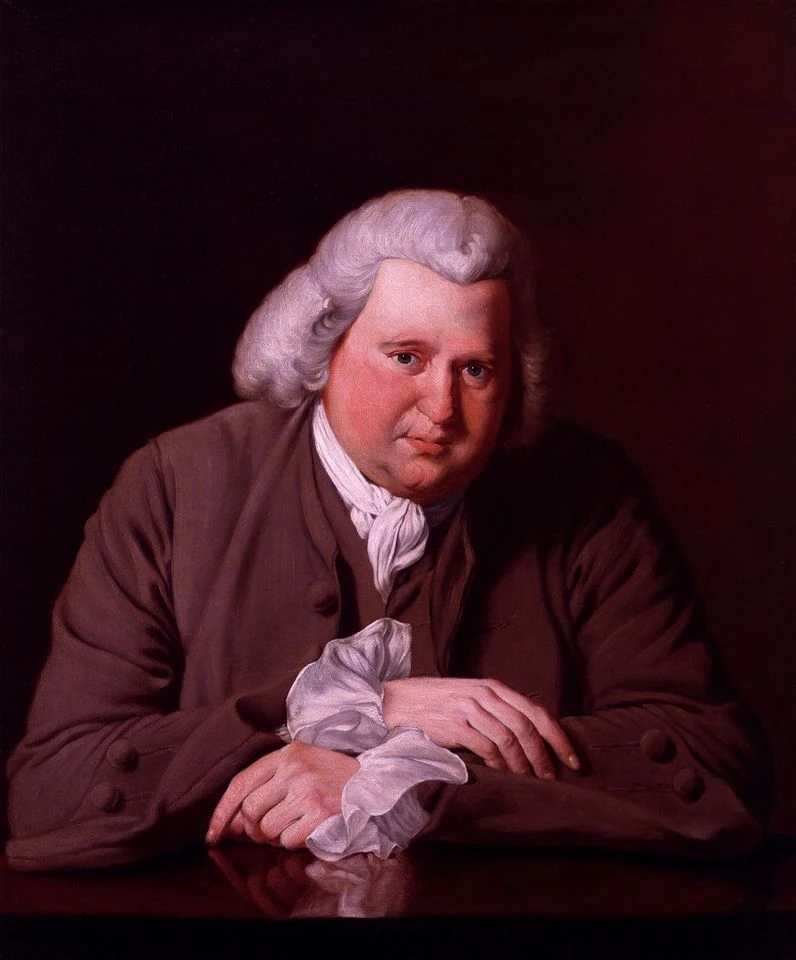
Erasmus Darwin is often introduced as Charles Darwin’s grandfather. The relationship is true, but it can obscure the scale of his own work. A successful Midlands physician, a founder of the Lunar Society, a poet who wrote about science and a designer of mechanical devices, he moved between medicine, natural history, literature and engineering. He also considered whether living forms changed over time, decades before his grandson’s work. His career belongs to an age when intellectual life was not yet divided into today’s professional compartments, and when scientific ideas could travel through a doctor’s practice, a poem, a translation or a drawing in a notebook.
A physician in the Midlands
Darwin was born at Elston Hall in Nottinghamshire on 12 December 1731. He studied at St John’s College, Cambridge, and Edinburgh Medical School, then established himself as a physician. His early work in Nottingham was not an immediate success. In 1757 he moved to Lichfield, where he built a practice serving patients across the Midlands and sustained his medical career for decades.
Medicine gave Darwin a practical starting point for wider enquiries. He was interested in how bodies worked, how illnesses could be described and classified, and how air, movement and environment affected health. He also considered whether mechanical ideas might relieve suffering. His ambitions extended beyond treating individual patients: he wanted medicine to become more systematic and explanatory. Not every theory he advanced endured, but the breadth of his effort reflects a belief that close observation and reasoning could improve understanding of the body.
His standing was recognised in 1761, when he was elected a Fellow of the Royal Society. He also declined an invitation from George III to become royal physician. Those details place him well beyond the category of an ingenious amateur. He was a prominent figure in the scientific life of his time, based not in London but in the Midlands, where professional practice and intellectual exchange could reinforce one another.
Darwin’s medical interests were part of a wider habit of enquiry. Questions about the body, the natural world and useful mechanisms did not sit in separate compartments for him. The same instinct to explain processes appears in his writing about physiology, his botanical work and the devices he sketched. His career therefore offers more than a list of occupations: it shows how an eighteenth-century physician might use one field of knowledge to provoke questions in another.
The Lunar Society and a culture of improvement
Darwin was one of the founders of the Lunar Society, a circle whose members included the manufacturer Matthew Boulton, the engineer James Watt and the potter Josiah Wedgwood. Its participants brought together interests in manufacturing, natural philosophy, medicine and reform. They were not simply specialists exchanging technical information; their discussions linked observation and theory to industry and practical improvement.
For Darwin, this company offered a setting in which ideas could cross boundaries. His medical interests sat alongside mechanical designs, botanical studies and literary work. The Society’s conversations connected a growing culture of experiment to the commercial and industrial life of the Midlands. Its members brought different expertise and pursuits to their exchanges, making intellectual work sociable and helping place provincial centres within wider debates.
That setting matters to the story of British science. Darwin’s importance did not depend on holding a central London post or working within a single discipline. He practised medicine in Lichfield and Derby, took part in a network that included manufacturers and engineers, and addressed readers through published books and poems. His career shows how ideas could move between towns, workshops, medical practice and print.
The society’s members connected inquiry with the possibility of improvement, but Darwin’s contribution was not simply to echo the work of better-known industrial figures. He brought a physician’s interest in living bodies and health into a circle also concerned with manufacture and mechanical invention. That mixture helps explain why he could move from questions about physiology to a design for a carriage, or from botanical classification to a poem. The company around him provided a forum for such crossings, rather than a single subject to which he had to conform.
Making botany readable
Botany was one of the fields in which Darwin worked both as a translator and a writer. With the group known as the Lichfield Botanical Society, he helped translate works by the Swedish naturalist Carl Linnaeus from Latin into English. The translations appeared as A System of Vegetables and The Families of Plants. English versions made botanical classification more accessible to readers who did not know Latin, widening the language in which natural history could be studied. The supplied historical account also credits Darwin with coining English names for numerous plants.
Translation was an act of access as well as scholarship. Scientific works written in Latin could be difficult to approach for readers without a classical education. Bringing Linnaeus into English made his system available to a broader reading public and gave English readers terms with which to discuss plants. Darwin’s work in this area therefore connected specialist classification with a language in which more people could take part.
He went further by making botanical learning the subject of poetry. The Loves of the Plants and The Botanic Garden brought Linnaean ideas into verse, combining scientific material with literary forms. The choice was unusual, but it reflected an understanding that knowledge could circulate through works of imagination as well as technical books. His poems made natural history part of a broader reading culture and offered readers a route into scientific subjects they might not otherwise encounter.
Darwin’s poetry is a reminder that science and literature were not necessarily rival pursuits. His writing carried themes of growth, classification, energy and interdependence beyond specialist discussion. The poems did not replace scientific treatises; they gave scientific ideas another form and another audience. In this way, his work helped make the discussion of nature more public and demonstrated that literary style could serve the communication of scientific knowledge.
Zoonomia and the history of life
Darwin’s major medical work, Zoonomia, was published in parts between 1794 and 1796. Its central concerns included physiology and pathology, but its chapter on generation has attracted particular attention. There Darwin considered common descent and the gradual transformation of living forms, including the possibility that all warm-blooded animals had arisen from “one living filament”. It was a speculative proposal, not a finished modern theory, but it challenged readers to think of life as changing through time.
Care is needed when comparing Erasmus Darwin with his grandson. Erasmus did not formulate Charles Darwin’s later theory of natural selection in its mature nineteenth-century form. His contribution was earlier: he considered questions of inheritance, adaptation, competition and change, helping make the transformation of species a subject for argument. His writing points towards later evolutionary debate without resolving it in the way Charles Darwin’s work would.
That distinction does not reduce Erasmus to a footnote in someone else’s biography. His significance lies in his own attempt to explain the natural world through connections between medicine, biology and philosophy. He was willing to ask whether life had a history, rather than treating the variety of living things as fixed and beyond inquiry. The questions he raised show an intellectually adventurous side of British Enlightenment thought.
Zoonomia also belongs to the medical side of Darwin’s work, rather than being treated as an evolutionary treatise in the modern sense. Its interest in physiology and pathology reflects his desire to organise explanations of living bodies. The chapter on generation gives the book a wider place in histories of ideas about life, but its claims need to be kept in their own context: exploratory and speculative, not a substitute for the later theory associated with Charles Darwin.
Machines, models and practical imagination
Darwin’s interest in mechanism extended well beyond the human body. His surviving designs and accounts include a horizontal windmill made for Wedgwood, a carriage intended to be more stable, a steering arrangement associated with later vehicle-steering geometry, a copying machine, weather-monitoring devices and a proposed canal lift for barges. The range is striking, though the status of individual schemes varied: some remained designs or demonstrations rather than widely adopted technologies.
Among the best-known was a speaking machine made from wood, silk and leather. It attempted to reproduce human speech mechanically. The device was not an industrial breakthrough on the scale of Watt’s engine, but it reveals Darwin’s interest in the processes behind ordinary human abilities. He approached the voice as something that could be analysed and imitated through a mechanism, just as he considered how motion might be redirected or how writing could be copied.
The speaking machine also illustrates the difference between a revealing experiment and a technology with a lasting practical use. Its historical interest lies in the question it posed and the mechanical construction it attempted, not in a claim that it established modern speech technology. Similarly, Darwin’s designs for transport and machinery should not all be presented as completed inventions that transformed daily life. Some were proposals or demonstrations; their value here is in showing the range of problems he thought worth tackling.
The supplied account says Darwin avoided patenting his devices because he believed patents might damage his standing as a physician. His inventive activity was therefore not a story of commercial expansion. It was part of a wider habit of asking how a problem might be understood and whether a contrivance could address it. Some ideas did not progress beyond plans, but they still show the breadth of his curiosity and the traffic between mechanical thought and scientific enquiry.
That traffic was characteristic of Darwin’s wider work. A mechanism could be a practical proposal, but it could also be a way of thinking about how a process operated. His interest in the voice, movement, copying and the measurement of weather shows a mind drawn to systems that could be observed and analysed. The record does not require every design to have succeeded in order for this inventive habit to matter.
Education and the moral questions of his age
Darwin’s interests also reached into education. In 1797 he published A Plan for the Conduct of Female Education, which argued that girls should study subjects including botany, chemistry, mineralogy and languages, and learn about handling money. The book remained shaped by the social assumptions of its period and should not be mistaken for a modern programme of equality. Even so, it proposed a wider intellectual education for women than many contemporaries considered necessary.
His writing also addressed slavery. In his poetry, he called on Britain’s legislators to act against oppression. This part of his work places questions of knowledge and improvement alongside questions of moral responsibility. The commercial and intellectual world around the Lunar Society had its own contradictions, but Darwin’s anti-slavery writing shows that he used his public voice to challenge an injustice.
Medicine, mechanical invention, education and poetry might seem like separate chapters. In Darwin’s life they reflected a recurring interest in how knowledge could be extended and put to use. He wanted to understand bodies and living systems, make scientific subjects accessible, and imagine better ways of doing practical tasks. His record is not a catalogue of unqualified successes; it is the history of a mind that repeatedly crossed between disciplines.
That breadth should not be mistaken for a claim that every subject received the same treatment or achieved the same result. Darwin’s books, designs and reforming arguments belong to different contexts and have different limits. His education proposal remained framed by its period, his evolutionary thinking did not amount to natural selection, and many mechanical schemes did not become widely adopted technologies. A clear account of his achievement can acknowledge those limits while still recognising how unusually wide his enquiries were.
Why Erasmus Darwin deserves a place in British Legacy
Erasmus Darwin deserves a place in British Legacy because he exemplifies a consequential strand of the country’s intellectual history: scientific work rooted in regional life, yet connected to international ideas and practical change. In Lichfield and across the Midlands, he treated patients, pursued questions about the body, joined conversations with manufacturers and engineers, translated botanical works and wrote for a reading public. His membership of the Lunar Society linked him to people such as Boulton, Watt and Wedgwood, while his medical practice gave his enquiries a direct connection to human needs.
His achievements matter in their own right, not simply because he was related to Charles Darwin. Zoonomia made a bold early case for considering change in the history of life; his translations brought botanical learning into English; and his poems carried scientific subjects into literary culture. His mechanical designs, from the speaking machine to proposals for safer transport and practical devices, show the pleasure he took in turning questions into possible mechanisms. They do not all need to have become commercial successes to be historically revealing.
Darwin’s work in education and his writing against slavery add a moral dimension to that record. His proposal for a broader education for girls and his appeal to legislators against oppression show that his public concerns reached beyond scientific explanation. These positions should be understood in their historical setting, not turned into claims that he anticipated every later movement. They nevertheless demonstrate that he considered the reach and purpose of knowledge part of public life.
Taken together, these strands show a British figure whose curiosity crossed boundaries and whose ideas addressed readers beyond a narrow professional circle. His Midlands career matters because it restores regional medical practice, conversation and experiment to the story of British science. His translations and poems show how scientific knowledge could reach a wider audience; his speculative writing and mechanical designs show a willingness to test explanations and imagine alternatives. Remembering him recognises a life in which medicine, invention, literature and social concern were parts of the same expansive intellectual ambition.