
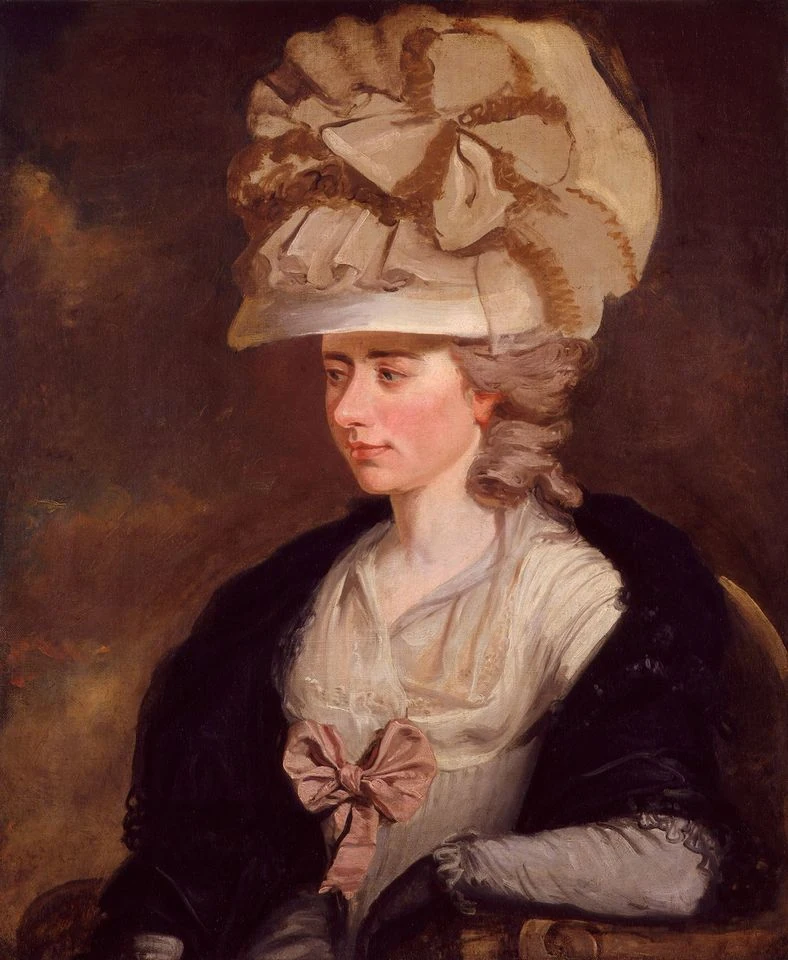
Frances Burney made the shifting rules of social life a subject for comedy, scrutiny and sustained record. In Evelina, a young woman enters London society and has to find her way through its manners and expectations. In the journals Burney kept for much of her life, she recorded the people and events around her, from literary gatherings and royal service to a painful operation performed before anaesthesia. She wrote four novels and plays as well as journals and letters; today, these different forms together reveal the range of her work.
A young writer in a literary family
Burney was born in Lynn Regis, now King's Lynn, on 13 June 1752. Her father, Charles Burney, was a musician and musicologist; her mother, Esther Sleepe Burney, died when Frances was ten. In 1760 the family moved to London, where her father's artistic and social circle brought her into contact with prominent visitors. David Garrick was among those who called at the family home, and Burney met Samuel Johnson there in 1777.
Her education was largely self-directed. She read from the family library and began keeping a journal in 1768, addressing its first entry to “Nobody”. These journals became a form of correspondence with relatives and friends: a record not just of events but of the books she read, the people she met and her responses to them. In 1767, feeling pressure to give up writing as unsuitable, she burnt the manuscript of The History of Caroline Evelyn. She later drew on its material for Evelina, the story of Caroline's daughter.
Burney’s first novel appeared anonymously in 1778. She had reasons to conceal her authorship, including her father’s lack of prior knowledge of the publication. The book quickly attracted attention for its comic account of wealthy society and its vivid portrayal of London speech. Its heroine, a young woman entering the world, allows Burney to examine social pretensions and the constraints placed on women. The epistolary form—letters written by the heroine—also lets the reader encounter events through her developing understanding.
Novels, theatre and public success
Evelina was followed by Cecilia; or, Memoirs of an Heiress in 1782. Its heroine inherits money under a condition that complicates marriage and the question of whose name she will bear. The novel develops Burney’s interest in the pressure that family expectations and social position place on women. A sentence in Cecilia—“The whole of this unfortunate business ... has been the result of pride and prejudice”—is often noted in connection with the title of Jane Austen’s Pride and Prejudice. Austen read and enjoyed Burney’s early novels.
Burney also turned to the theatre. She wrote the comedy The Witlings in 1779, but it was not performed in her lifetime; her father and family friend Samuel Crisp worried that its satire might offend. Her tragic play Edwy and Elgiva was staged at Drury Lane in 1795 and closed after its first performance. Other plays remained unpublished during her life. These setbacks did not end her dramatic writing, but they show how family and contemporary ideas about women’s public work shaped the opportunities available to her.
In 1786 Burney accepted the post of Keeper of the Robes to Queen Charlotte, wife of George III. The position brought a salary and a place at court, where she formed a lasting connection with the queen and princesses. It also left her little time to write and exhausted her. She left in 1790, retaining a yearly pension. Her journals from this period document court life and events beyond it, including the trial of Warren Hastings, whose speeches by Edmund Burke she recorded.
Marriage, France and a life in journals
In 1793 Burney married Alexandre d’Arblay, a French exile and former officer in Lafayette’s service. Their son, Alexander, was born in 1794. The couple’s finances were helped by the publication of Camilla in 1796. Its story of love, hardship and social expectations found readers, and the income allowed them to build a home in Surrey named Camilla Cottage. Burney’s younger sister Susanna, a close correspondent, died in 1800; the loss ended the correspondence that had been one of the main purposes of Burney’s journal-writing.
In 1802 Burney followed her husband to France. The renewal of war between France and England kept the family there for about ten years. In 1811 she underwent a mastectomy while conscious, before the development of anaesthetics. Her account of the operation, written to her sister Esther, is a striking example of the journals’ value as personal testimony. She returned to England with her son in 1812, then went back to France after her father’s death in 1814. When Napoleon returned from Elba in 1815, Burney fled to Belgium; after d’Arblay was wounded, they made their way back to England and settled in Bath. He died in 1818.
Burney published her last novel, The Wanderer; or, Female Difficulties, in 1814. Its heroine tries to earn a living amid social suspicion and restrictions on women’s independence. In 1832 Burney published a three-volume memoir of her father, drawing on her own writings; she died in Bath on 6 January 1840. Her son and husband were buried with her at Walcot cemetery. Her journals and letters began to appear after her death, in editions published from 1842, and have since become central to her reputation as a witness to Georgian life.
Why Frances Burney deserves a place in British Legacy
Burney’s place in British literary history rests on more than the success of a single novel. In Evelina and Cecilia, she made the pressures of courtship, reputation, money and social rank visible through the experience of women negotiating them. Her comic treatment of English society and her use of the letter form gave readers access to a heroine’s uncertainty as well as her wit. Austen’s reading of Burney’s early novels offers a specific connection to a later major novelist, while the shared phrase linking Cecilia with Pride and Prejudice provides a tangible trace of that literary conversation.
Her journals extend that achievement beyond fiction. Kept across 72 years, they record family life, literary circles, royal service, political events and her experience of a mastectomy without anaesthesia. They preserve both the public world and the details of a woman’s changing circumstances, giving later readers and historians a sustained first-person account of the period. Burney’s own life also makes clear that literary work was shaped by material conditions: the demands of court employment, family expectations, the limits placed on women’s drama and the income earned from her novels. Remembering her in British Legacy means recognising both her imaginative writing and the unusually extensive record through which she observed the society around her.
Sources
Frances Burney — Wikipedia revision 1372987847 · Frances Burney — Wikipedia
Adapted in part from Frances Burney by Wikipedia contributors, under CC BY-SA 4.0. Text has been edited and combined with the existing article; this adapted text is shared under the same licence. Contributor history.

_by_Edward_Francisco_Burney.jpg)