Frank Whittle’s route to the jet age began with a question about the limits of the propeller. Could an aircraft be propelled by a turbine-driven stream of exhaust instead? Whittle developed that idea into a working engine, but turning a patent into a machine that could fly took years of calculations, testing, investment and redesign. His achievement was not solitary: it depended on colleagues, engineering firms and industrial capacity, as well as on his persistence through official hesitation and serious personal strain.
On 15 May 1941, the experimental Gloster E.28/39 took off from RAF Cranwell powered by Whittle’s W.1 engine. The flight showed that a turbojet could propel an aeroplane in the air. It did not mark the first turbojet flight in the world: Hans von Ohain’s independently developed Heinkel He 178 had flown in Germany in 1939. Whittle’s work established a successful British route to jet propulsion, helping change military aviation and, in time, civil air travel.
Workshop skills and RAF training
Whittle was born in Coventry on 1 June 1907, the eldest son of Moses Whittle and Sara Alice Garlick. When he was nine, the family moved to nearby Royal Leamington Spa, where his father bought an engineering business. Its lathes, tools and single-cylinder gas engine gave the young Whittle practical experience of machinery. He also spent time reading in the local reference library, including books on engineering, turbines, astronomy and flight. When the family business faltered, there was not enough money for him to continue at the secondary school he had entered on a scholarship; he developed his practical skills in his father’s workshop.
At 15, determined to become a pilot, he applied to join the RAF as an aircraft apprentice. He passed the entrance examination but failed the medical. After a training programme and special diet, he tried again and failed once more. Undeterred, he applied under an assumed name and was accepted at RAF Cranwell in September 1923. He trained as an aircraft mechanic, learning engine theory and working in engineering workshops. The strict discipline was difficult for him, and he considered leaving, but his model aircraft and mathematical ability attracted the attention of his superiors.
In 1926, Whittle was recommended for officer training at Cranwell. He learned to fly, excelled in his studies and graduated in 1928. His thesis, Future Developments in Aircraft Design, examined the possibility of high-speed, long-range flight. He argued that flying at great altitude could reduce air resistance and that conventional piston engines and propellers would struggle to meet the demands of such aircraft. The thesis formed an important early stage in his thinking; it was not yet the complete turbojet design he would develop later.
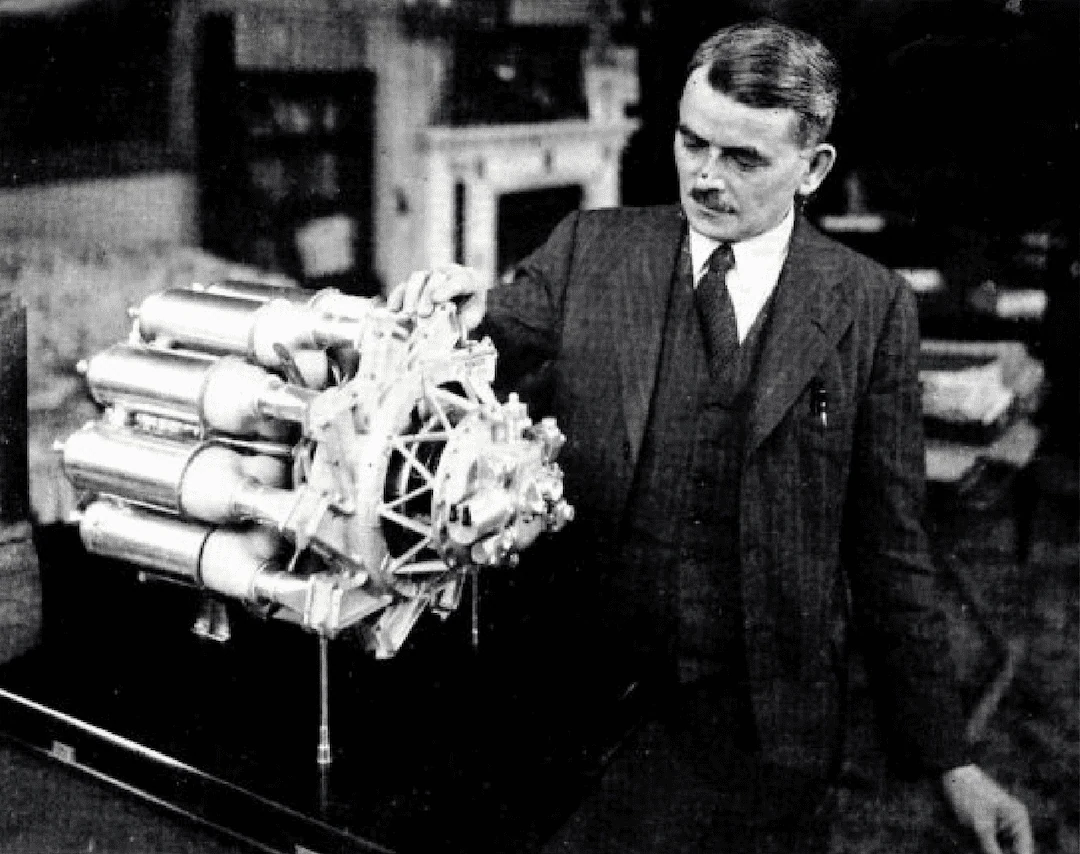
Whittle continued to work through the problem. He first considered a motorjet arrangement, then asked whether a turbine could replace the piston engine driving the compressor. In the turbojet he developed, a compressor forces air into the engine, fuel burns in the compressed air, and a turbine extracts some energy from the exhaust to keep the compressor turning. The remaining hot gas leaves at high speed, producing thrust. Whittle patented his design in January 1930. The principle was clear, but making it reliable with the materials and manufacturing techniques then available remained a formidable task.
From patent to Power Jets
The Air Ministry did not immediately support Whittle’s proposal. Influential critics considered it impractical, while potential industrial partners had doubts about its feasibility, the size of the equipment and its ability to withstand high temperatures. In 1935, Whittle could not afford the fee to renew his patent, and it lapsed. The loss of patent protection did not end the project. Former RAF colleagues Rolf Dudley-Williams and James Collingwood Tinling helped him seek private backing and find a way to develop the design.
An independent technical assessment helped persuade the investment firm O. T. Falk & Partners to provide finance. Power Jets Ltd was formed in 1936, and British Thomson-Houston agreed to help build an experimental engine facility at its works in Rugby. Whittle was still an RAF officer and had been studying at Cambridge; special arrangements allowed him to work on the project alongside his service commitments. He graduated from Peterhouse, Cambridge, with a First in the Mechanical Sciences Tripos in 1936.
The first Power Jets Whittle Unit began ground testing on 12 April 1937. Early trials revealed serious problems, including unstable running, combustion difficulties and limitations in compressor performance. The engine needed repeated reconstruction and improvement; a successful initial run did not mean a dependable aircraft powerplant was ready. But the test established that Whittle’s central idea could be made to work in hardware. Further demonstrations eventually convinced officials of the project’s potential, and the Air Ministry commissioned development of an engine suitable for flight.
Making the design practical required more than the original calculations. The team had to manage fuel and combustion, improve the compressor and build components capable of withstanding sustained heat and stress. British Thomson-Houston’s facilities and the work of Whittle’s colleagues were essential. In 1938, much of the development moved from Rugby to a foundry at Lutterworth. The successive tests, failures and redesigns explain why the 1930 patent did not lead quickly to an aircraft in the air.
The E.28/39 takes to the air
Gloster built the single-seat E.28/39 as an experimental aircraft to test the new engine, not as an operational fighter. A test engine assembled from available parts powered taxi tests and short hops in April 1941. The definitive W.1 engine then made a full flight possible. On the evening of 15 May, Gloster test pilot Gerry Sayer took the aircraft off from RAF Cranwell. The flight lasted 17 minutes. The supplied accounts give different figures for its speed on that first flight: the detailed Wikipedia text records about 340 miles an hour, while the saved article gives around 370 miles an hour at 25,000 feet. The latter figure is also described in Wikipedia as reached within days, so this feature does not assign it to the first flight.
The flight answered the practical question that had driven the development: could a turbojet power an aeroplane in the air, rather than merely run on a test stand? It also demonstrated the potential of the technology. Whittle’s work and the wider British jet programme contributed to aircraft including the Gloster Meteor, which entered RAF service in 1944. The E.28/39 was a test aircraft, not the first operational aircraft powered by Whittle’s engine.
That distinction matters in the wider history of jet propulsion. Von Ohain’s Heinkel He 178 flew before the E.28/39, following independent German development. Whittle’s contribution was not the first turbojet flight anywhere, but a successful British programme that helped establish the technology in British aircraft and industry. The jet age grew through parallel work, engineering collaboration and the conversion of experimental designs into engines that could be produced and used.
Wartime production and a heavy personal cost
As war increased the urgency of development, Power Jets faced the challenge of moving from experimental engines towards production. Relations with Rover, which was involved in development and production, deteriorated. Rolls-Royce became increasingly important after taking over Rover’s jet-engine work. The change brought the industrial resources needed to advance the engines, but it also changed Whittle’s position in the programme he had worked to establish.
Power Jets was nationalised in 1944. Whittle had argued for nationalisation, partly because he believed it could address production problems and provide a fair settlement for the people who had backed development. He nevertheless objected to the process and its terms. The years of technical responsibility, financial pressure and wartime urgency had already taken a toll: he suffered serious ill health and nervous breakdowns. He resigned from Power Jets in 1946. This was not a simple story of an inventor thwarted by industry, or of a smooth progression from prototype to triumph. Large-scale production required resources beyond a small development company, while the change left Whittle with little control over the programme he had initiated.
Whittle retired from the RAF in 1948 with the rank of air commodore. He then became a technical adviser to BOAC, travelling to observe aviation developments. At Shell he worked on a turbine-driven drilling system that used the flow of drilling fluid to power a cutting head. He later joined Bristol Aero Engines. These projects show that his engineering interests were not confined to aircraft: he continued to apply turbine technology to practical problems.
He also explored ways to improve jet efficiency by turning a fast, low-mass exhaust stream into a slower flow of greater mass. One approach was to use a fan to move additional air around the engine core, a principle associated with the turbofan that became important in later airliners. Whittle’s work did not end with the E.28/39’s flight; he remained concerned with how turbine engines could be adapted and made more effective.
Honours and a continuing engineering legacy
Whittle was elected a Fellow of the Royal Society in 1947, knighted in 1948 and appointed to the Order of Merit in 1986. After emigrating to the United States in 1976, he became NAVAIR Research Professor at the United States Naval Academy, where his research included boundary-layer studies. He died in Maryland in August 1996. The supplied Wikipedia text gives conflicting exact dates for his death, so the day is not stated here. His ashes were interred at RAF Cranwell.
His name remains attached to places where engineering is studied and recognised. The University of Cambridge’s Whittle Laboratory is a research centre associated with turbines and propulsion, and the Royal Academy of Engineering awards the Sir Frank Whittle Medal for sustained engineering achievement. Peterhouse named a building in his honour. In Coventry, a statue beneath the Whittle Arch commemorates him; Rugby and Lutterworth, where important development work took place, also preserve connections to the engine’s history.
Why Frank Whittle deserves a place in British Legacy
Frank Whittle deserves a place in British Legacy because his work joined a far-reaching engineering idea to the practical persistence needed to make it fly. He recognised that improving piston engines and propellers would not satisfy every ambition for speed, altitude and range, then developed a different means of propulsion. A patent alone was not enough: turning the principle into a working engine required years of testing, redesign and problem-solving. It also required other people and organisations, from former RAF colleagues and private investors to British Thomson-Houston, Gloster and the manufacturers that took on production. The E.28/39’s flight in 1941 was a decisive demonstration for Britain’s jet programme, while the later Gloster Meteor showed how experimental work could contribute to aircraft entering RAF service.
The British connection is grounded in the places and institutions that shaped the work. Whittle was born in Coventry, trained and served in the RAF, studied at Cambridge and developed engines through work in Rugby and Lutterworth. These were not incidental settings: they formed a path from a young apprentice’s practical skills to an experimental aircraft in flight. The consequences reached beyond one test. Turbojet and later turbofan development transformed military aviation and helped enable long-distance civil jet travel. His story also makes the nature of engineering achievement clearer. Technical progress depended on collective effort and industrial investment, while its originator faced financial uncertainty, institutional disagreement and serious strain. Remembering Whittle means recognising both what his idea made possible and the sustained work required to make it real. That combination of invention, service and lasting influence gives his story a specific place in British Legacy.
Sources
Frank Whittle — Wikipedia revision 1373063792
Adapted in part from Frank Whittle by Wikipedia contributors, under CC BY-SA 4.0. Text has been edited and combined with the existing article; this adapted text is shared under the same licence. Contributor history.