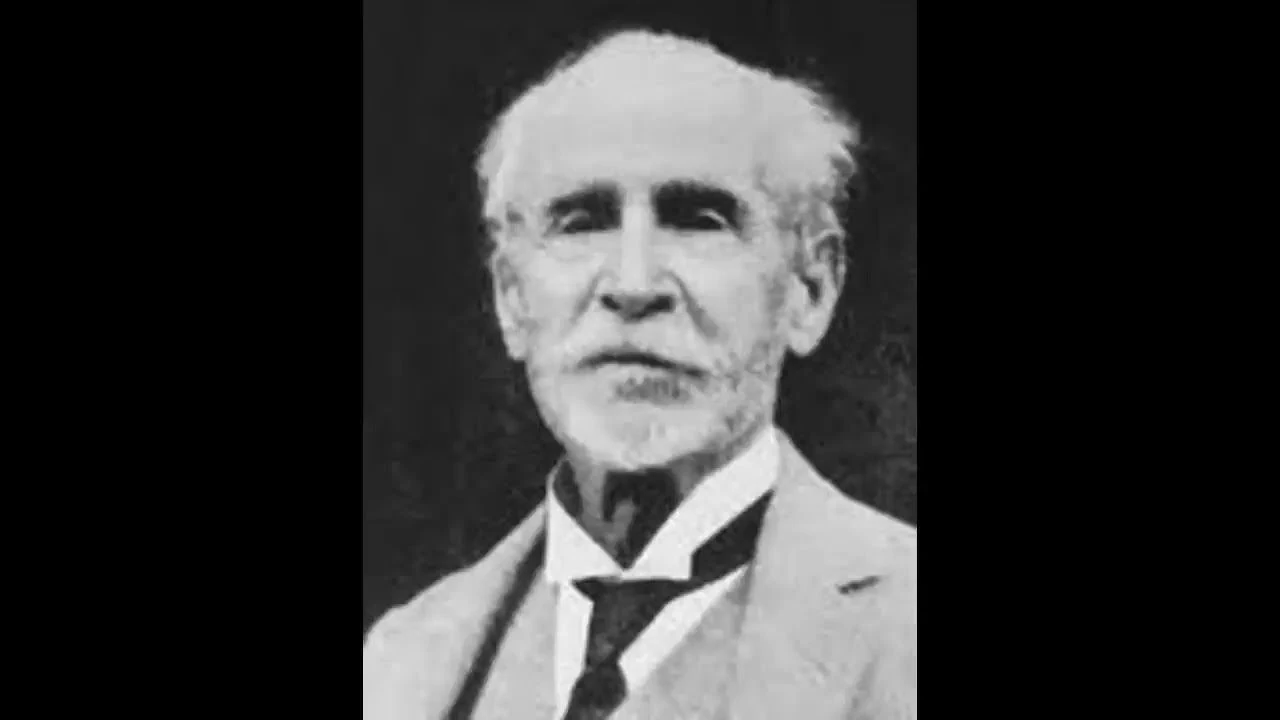
Frederick Walton’s best-known invention became so familiar that its maker could disappear behind the name: linoleum, the hard-wearing floor covering used in homes, workplaces and public buildings. Walton developed it from oxidised linseed oil, cork and colouring agents, then did the less celebrated work of patenting the process, building factories and finding customers. The result was both a practical material for everyday interiors and a British manufacturing enterprise that reached overseas markets. He later applied related ideas to Lincrusta, an embossed wallcovering that brought industrial manufacture into decorative interiors.
Learning through manufacture
Frederick Edward Walton was born on 13 March 1834 near Halifax. He attended Horton School in Bradford and Wakefield Proprietary School. In 1855, he joined his father, James, and brother William in the family wire card-making business at Haughton Dale. The work put him among the machinery and materials of manufacture, and he spent much of his time developing new techniques for the business. This practical setting formed the background to an inventive career that would depend as much on making a process work repeatedly as on recognising a promising material.
His first patent, granted in 1856, was for wire brushes with ornamental backings. It was a modest beginning compared with the invention that made his name, but it shows that Walton was already applying his attention to manufactured goods and their design. In 1857 he found a way to solidify linseed oil, an experiment that opened up a new line of work. His father was unconvinced by the value of that experimentation. Later that year, their partnership was dissolved, and Walton moved to Hammersmith to pursue his work independently.
The chronology matters. In 1860 Walton established an experimental factory in Chiswick, where he worked on the oxidation of linseed oil and received a patent for that process. This was not yet the finished floor covering. He experimented with the oxidised oil as a possible replacement for rubber, and discovered that combining it with cork and colouring agents produced a useful material for floors. In 1863 he patented the new floor covering and named it linoleum, drawing on the Latin words linum, for flax, and oleum, for oil.
A new surface for everyday interiors
Linoleum joined chemical experimentation to a clear practical purpose. Its ingredients included oxidised linseed oil and cork, with colour added to the mixture. Pressed on a fabric backing, the material formed a resilient surface that could be made in sheets and wiped clean. These qualities helped it suit rooms in which floors faced regular use. It was not simply an experimental substance: Walton’s invention had to be manufactured in a form that could stand up to daily life.
That combination helped the material move well beyond a single kind of interior. Linoleum appeared in homes, workrooms and public institutions, including schools and hospitals. It offered a surface that could cope with heavy use while still allowing colour and pattern. Rather than having to choose between utility and appearance, buyers could use a material that served both purposes. Its usefulness in institutional settings also meant that it belonged to the corridors and working spaces of everyday life, not only to more formal domestic rooms.
Walton continued to improve the product after securing the original patent. In 1863 he patented a method for passing sheets of coloured linoleum through rollers to emboss a pattern. In 1882 he patented machinery for making inlaid mosaic floor coverings. These developments extended the design possibilities of the material and show that his work did not stop at the first successful formulation. Manufacture, surface treatment and appearance were connected parts of a product that had to be made consistently and appeal to different uses.
Staines and the growth of a British industry
Walton moved his factory to Staines and formed the Linoleum Manufacturing Company there in 1864. By 1869, the business was exporting to Europe and the United States. In five years, the work had grown from an experimental process into a manufacturing operation with customers abroad. That expansion depended on bringing the material to market, not merely demonstrating that it could be made. A factory had to supply linoleum in quantity, while continuing improvements gave customers choices in colour and finish.
The business also developed beyond Britain. In the 1870s Walton partnered with the carpet manufacturer John Crossley to form the American Linoleum Company. He spent two years in the United States helping to establish a factory at Linoleumville, New York, before returning to the United Kingdom. The overseas venture extended Walton’s manufacturing work across the Atlantic and gave the material a wider commercial reach. It was a substantial step from his early experiments in Chiswick: production was now being established in more than one country.
The name linoleum eventually passed beyond Walton’s exclusive control. Accounts in the supplied feature describe attempts to defend the term and its later treatment by courts as generic rather than proprietary. That outcome was a commercial frustration: the inventor could not keep the word solely for his own product. At the same time, its everyday use reflects how widely the material had become known. The name Walton gave his invention became part of ordinary language, even as the legal protection of the term did not remain exclusive to him.
Lincrusta and the decorative interior
Walton’s inventions were not confined to floors. In 1877 he launched Lincrusta, an embossed wallcovering based on related material ideas and originally patented as Linoleum Muralis. It was promoted as a durable, washable and decorative surface. Its raised patterns could imitate finishes such as leather, wood and relief plasterwork. The product brought a different combination of concerns to manufacture: walls did not face the same wear as floors, but a covering still had to offer durability while enriching a room’s appearance.
Lincrusta also shows how Walton’s approach could extend from an everyday material to ornamental design. Repeated patterns could be manufactured rather than carved individually into a wall, making a decorative effect available through a product that could be produced in quantity. The Lincrusta historical account cited in the supplied feature records use in royal homes, railway carriages and notable buildings, including the White House. Its reported settings suggest a reach beyond practical rooms and into ceremonial and decorative spaces.
For Walton, the wallcovering was a second major product, not a minor footnote to linoleum. Together, the two materials demonstrate different applications of industrial production: a resilient floor surface and a patterned wall finish. Both were intended to be useful, but neither was limited to bare function. Colour, texture and design formed part of the way the products answered the needs of interiors.
Walton’s life beyond the factory
Walton’s later life connected his manufacturing career with rural Wales. In 1868 he moved to the Cwmllecoediog Estate near Aberangell, which had belonged to his father, and built Plas Cwmllecoediog there in 1870. In 1883 he gave land and funds for a school in the village. The donation linked his resources to a local institution, while his move placed part of his story beyond the English industrial centres most closely associated with linoleum.
He also became involved in slate quarrying. From 1886 he partnered with quarry manager Edward Hurst Davies to develop the Maesygamfa slate quarry. They operated together until their partnership was dissolved in 1900. This was separate from his flooring and wallcovering work, but it adds to the record of a businessman whose activities spanned several kinds of enterprise. Walton died on 16 May 1928, aged 94.
His personal interests included collecting art and painting. He married Alice Scruby in 1867, and they had four children. The supplied biography credits him with more than 100 patents over his career. That total places the better-known products within a much longer record of experimentation and invention, although linoleum and Lincrusta remain the achievements most closely associated with his name.
What “lino” leaves behind
The supplied feature also notes a distinction that is often lost in everyday speech: modern vinyl flooring is not the same material as traditional linoleum, despite the loose use of “lino” for vinyl. True linoleum belongs to Walton’s nineteenth-century line of invention and uses a different recipe based on natural ingredients. The two materials should not be conflated simply because a familiar word is used for both.
Linoleum’s place in the history of flooring changed as plastics and newer materials became more prominent. The supplied feature describes plastics as displacing linoleum in much of the market during the mid-twentieth century. That shift did not erase the earlier invention’s influence: linoleum had already become a widely used surface and had helped establish expectations for resilient flooring. Its name and the everyday abbreviation “lino” are part of the way the product outlived the period in which it was dominant.
Why Frederick Walton deserves a place in British Legacy
Frederick Walton deserves a place in British Legacy because his achievement joined invention to the practical work that makes an invention useful. He found a way to solidify linseed oil, developed a floor covering from the oxidised material, and protected different stages of that work through patents in 1860 and 1863. He then moved from experiments to production, established the Linoleum Manufacturing Company in Staines in 1864 and had the business exporting to Europe and the United States by 1869. That route from process to product to international trade makes his contribution more than a story of a clever idea. It shows how British manufacturing could turn a new material into something used in the ordinary spaces of homes and institutions.
His importance also lies in the range of what he made possible. Linoleum offered durability and a cleanable surface, while his continuing work on embossing and inlaid patterns widened its decorative uses. Lincrusta carried related material thinking onto walls, where it could provide a durable patterned finish. Together, the products show manufacturing serving both daily needs and interior design. Walton’s later activities in Wales, including his contribution of land and funds for a village school and his involvement in a slate quarry, further place his life within the wider story of British industry and local communities. His name became less visible than his invention, but the material, the factories and the products that followed remain a specific and lasting part of Britain’s industrial history.
Sources
Frederick Walton — Wikipedia revision · Frederick Walton — Wikipedia
Adapted in part from Frederick Walton by Wikipedia contributors, under CC BY-SA 4.0. Text has been edited and combined with the existing article; this adapted text is shared under the same licence. Contributor history.