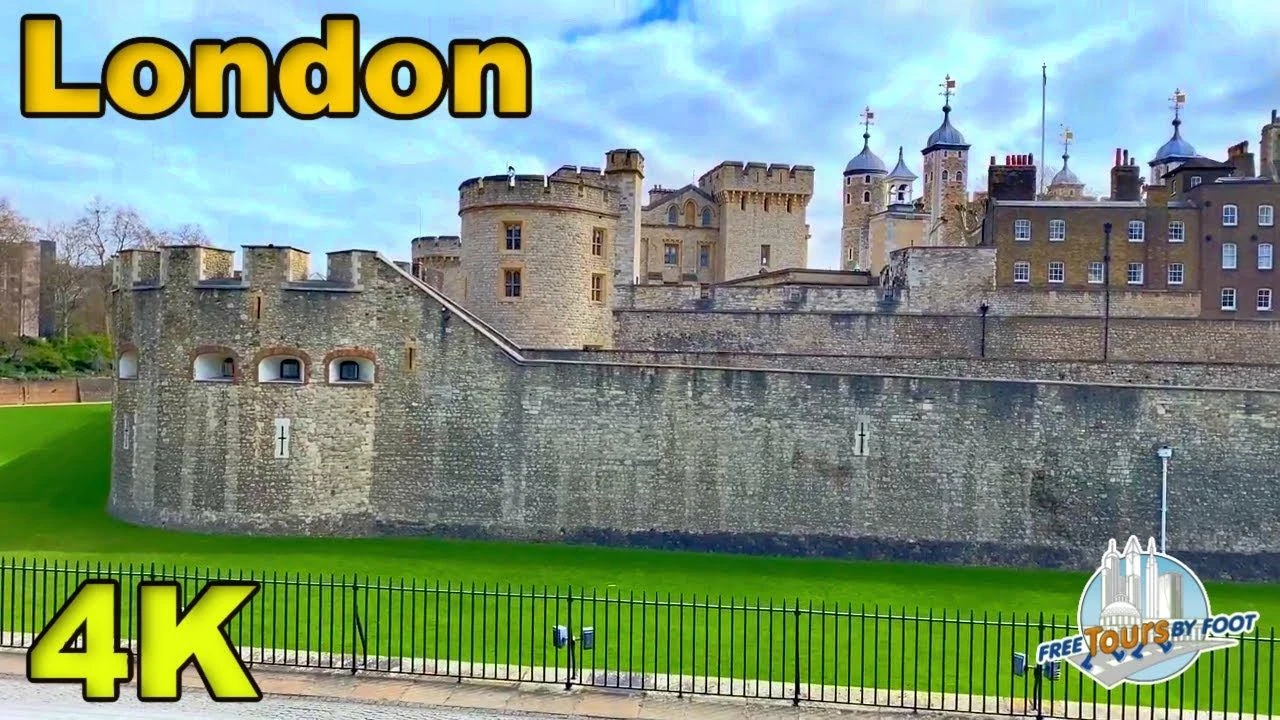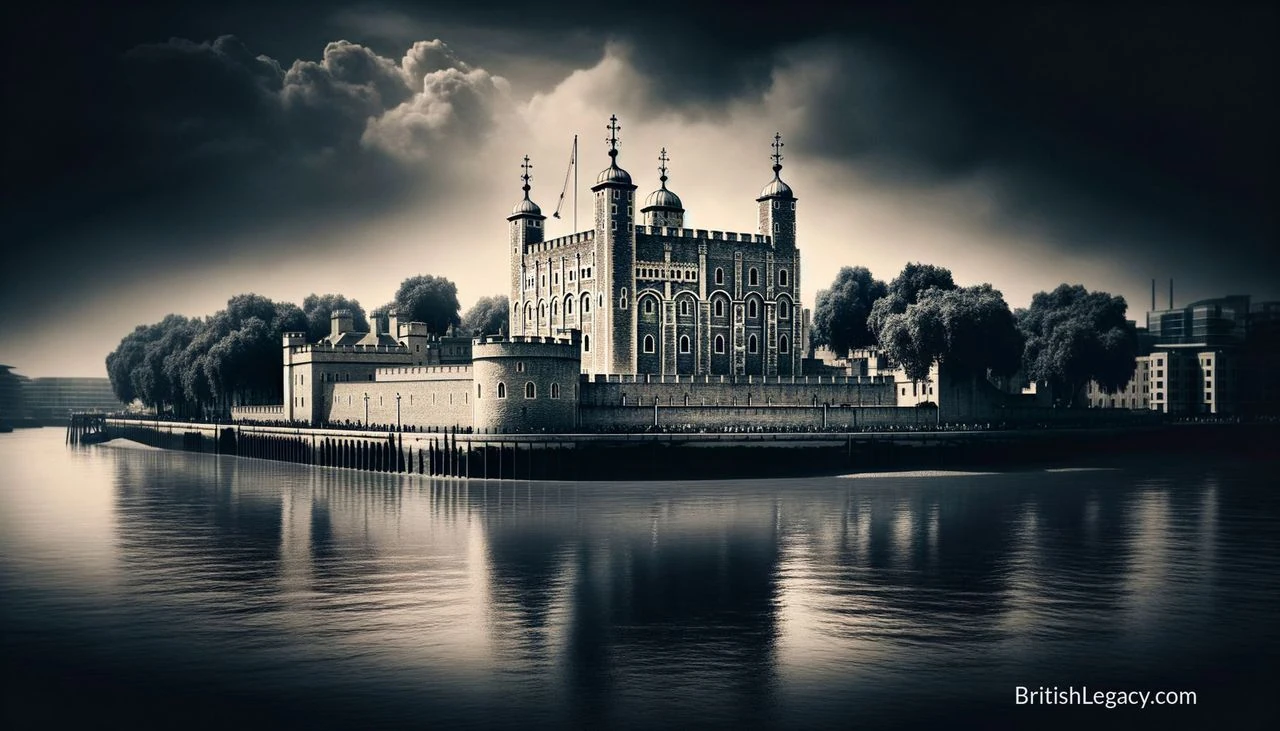
The Tower of London began as a statement of conquest. Founded by William the Conqueror towards the end of 1066, it secured a strategic position beside the Thames and placed a Norman stronghold on the edge of the city. Its oldest great building, the White Tower, was begun in 1078. In the centuries that followed, the castle became a royal residence, fortress, prison, armoury, treasury and menagerie. Its history is not simply a succession of famous prisoners and royal treasures: control of the Tower repeatedly mattered to those competing for power in England.
A Norman stronghold becomes a royal castle
William’s new castle formed part of the Norman effort to establish control over London after the invasion of 1066. The earliest fortification was built against the south-east corner of the Roman city wall, with the Thames adding protection to the south. The White Tower, a stone keep with accommodation for the king, was the most formidable part of the early castle. Its position and scale made it both a defensive structure and a visible reminder of the new ruling power.
The Tower grew in stages rather than according to a single plan. Richard I’s reign saw a moat dug to the west of the original enclosure. Henry III extended the castle to the north and east and developed its palatial buildings; Edward I added another defensive perimeter, a new moat and a more elaborate entrance. By the end of Edward’s rebuilding in 1285, the general layout of the complex had taken shape. Its three wards enclosed successive layers of buildings and defences, and the site covered almost 12 acres.
The castle’s purpose was never purely military. Its royal apartments were expanded and refurbished, and monarchs sometimes stayed there before their coronations. From at least the early 14th century until Charles II’s reign, a monarch traditionally began the coronation journey with a procession from the Tower to Westminster Abbey. The practice reflected the Tower’s place in the rituals of royal authority as well as its practical importance to the Crown.
That importance made possession of the fortress politically valuable. It was besieged during periods of conflict, including the First Barons’ War and the Peasants’ Revolt of 1381. In the latter uprising, rebels entered the castle and looted the Jewel House. During the Wars of the Roses, control of the Tower shifted amid the struggle for the throne. Its walls, garrison and contents made it more than a backdrop to political events: it was a prize that rulers and challengers sought to hold.
From royal household to prison and armoury
Under the Tudors, the Tower was used less often as a royal residence. It remained a stronghold and an administrative centre, while its reputation as a prison grew. People held there were often high-status political or religious prisoners rather than ordinary offenders. The phrase “sent to the Tower” grew from this history, but the familiar image of a purpose-built dungeon for every prisoner is misleading: the castle’s use as a prison developed alongside its other functions, and conditions varied.
Among its most famous prisoners were Anne Boleyn, who was executed in 1536, and Guy Fawkes, brought to the Tower after the Gunpowder Plot in 1605 and tortured there. Elizabeth I was imprisoned there before she became queen. Sir Walter Raleigh was also held within its walls; his rooms were adapted to accommodate his family. The Tower became particularly associated with imprisonment in the 16th and 17th centuries, when political and religious conflicts brought people into royal custody.
The history of executions needs careful distinction between the castle and the ground beyond it. Executions were usually carried out on Tower Hill, north of the Tower. Before the 20th century, seven people were executed within the castle itself, on Tower Green; such private executions were reserved for particular cases. This difference matters because later accounts and fiction often compress imprisonment, torture and execution into a single picture of the Tower.
The site also housed the royal armoury and the Royal Mint, and at different times served as a treasury and public record office. Its institutions changed as the state changed. The Office of Ordnance and the Armoury Office used the castle to manage weapons and military supplies, while the Mint operated there for centuries. As these bodies moved elsewhere during the 19th century, many buildings became vacant and the Tower’s military and administrative roles diminished.
The Crown Jewels, ravens and a changing public image
The association with the Crown Jewels reaches back to the medieval monarchy. The regalia and other royal valuables were kept under close guard, and the Jewel House became part of the Tower’s history as a treasury. In 1649, after Charles I’s execution, the Commonwealth ordered the royal collection to be disposed of: much of the metal was melted down and the crowns broken. New regalia were made for Charles II’s coronation in 1661. The present display includes objects such as St Edward’s Crown, the Imperial State Crown and the Coronation Spoon.
The jewels have not always been safe from theft. In 1671, Colonel Thomas Blood and his accomplices attempted to steal them from Martin Tower, where they were then displayed to paying visitors. They were caught before they could escape with the regalia. The episode belongs to a longer history in which the Tower’s treasures were at once symbols of royal authority, valuable assets and objects of public curiosity.
Animals were another part of the castle’s life. The royal menagerie, recorded from at least the early 13th century, included lions and other exotic animals; a polar bear was kept there in the 13th century. The collection became a public attraction before most of its animals were moved to the newly opened London Zoo in the 1830s. The Tower’s ravens belong to a different tradition. According to legend, the kingdom will fall if they leave. At least six are kept at the Tower, in the care of the Ravenmaster, a Yeoman Warder.
Stories of torture and haunting helped shape the Tower’s popular image, but the history behind them is more complex. The castle acquired a reputation for torture through religious polemic and later romantic writing. The research record notes that the Tower never had a permanent torture chamber, although a rack was used in the White Tower’s basement in later periods. The distinction between an enduring legend and the evidence of how the site was used is part of what makes the Tower’s history worth exploring.
Restoration, conflict and visitors
As government and military institutions left, interest in the Tower’s medieval past grew. Restoration work by Anthony Salvin and John Taylor sought to recover what they understood to be its medieval appearance. Those efforts also reshaped the site, sometimes removing later buildings and decoration in pursuit of that vision. The result is a historic complex whose present appearance reflects not only medieval construction, but also later ideas about how the past should be preserved.
The Tower was not untouched by modern conflict. During the First World War, eleven men were tried in private and shot there for espionage. In the Second World War it again held prisoners, and German spy Josef Jakobs was executed by firing squad in 1941. Bombs damaged buildings during the Blitz; repairs followed the war, and the castle reopened to the public. These episodes connect the ancient fortress to the continuing history of the state and its security.
Tourism, meanwhile, has a long history at the site. Visitors came to see the menagerie and displays of armour, and the Crown Jewels have been on public display since 1669. The Tower was inscribed as a UNESCO World Heritage Site in 1988. Today, its ceremonial life includes the Yeoman Warders, who guard the site and lead tours, and the daily Ceremony of the Keys. Historic Royal Palaces has cared for the Tower since 1990. Wikipedia records 2,817,852 visitors in 2025, placing the castle among the country’s most visited attractions.
Why the Tower of London deserves a place in British Legacy
The Tower of London deserves a place in British Legacy because its buildings make the changing reach of English and British government unusually tangible. Founded as a Norman stronghold after the Conquest, it was enlarged by successive monarchs, used as a royal residence and a centre of military administration, and repeatedly contested during political crises. Its history includes the expansion of royal authority, the imprisonment of political opponents and the management of weapons, records and money. These are not separate stories attached to an old building; they are different uses of the same strategically important site.
Its present value also lies in the way history can be encountered there. Visitors can see the White Tower and the layered defences, explore the history of the Crown Jewels, and learn how the menagerie, Mint, armouries and prison fitted into the life of a working castle. The site’s public role has evolved from royal stronghold to historic attraction, while ceremonies such as the Ceremony of the Keys preserve a link with its continuing institutional life. By distinguishing documented history from legend, the Tower helps audiences understand both the power it once served and the stories later generations built around it. Its preservation and public interpretation make a substantial part of England’s political and architectural past accessible in the heart of London.
Sources
Tower of London · Tower of London
Adapted in part from Tower of London by Wikipedia contributors, under CC BY-SA 4.0. Text has been edited and combined with the existing article; this adapted text is shared under the same licence. Contributor history.