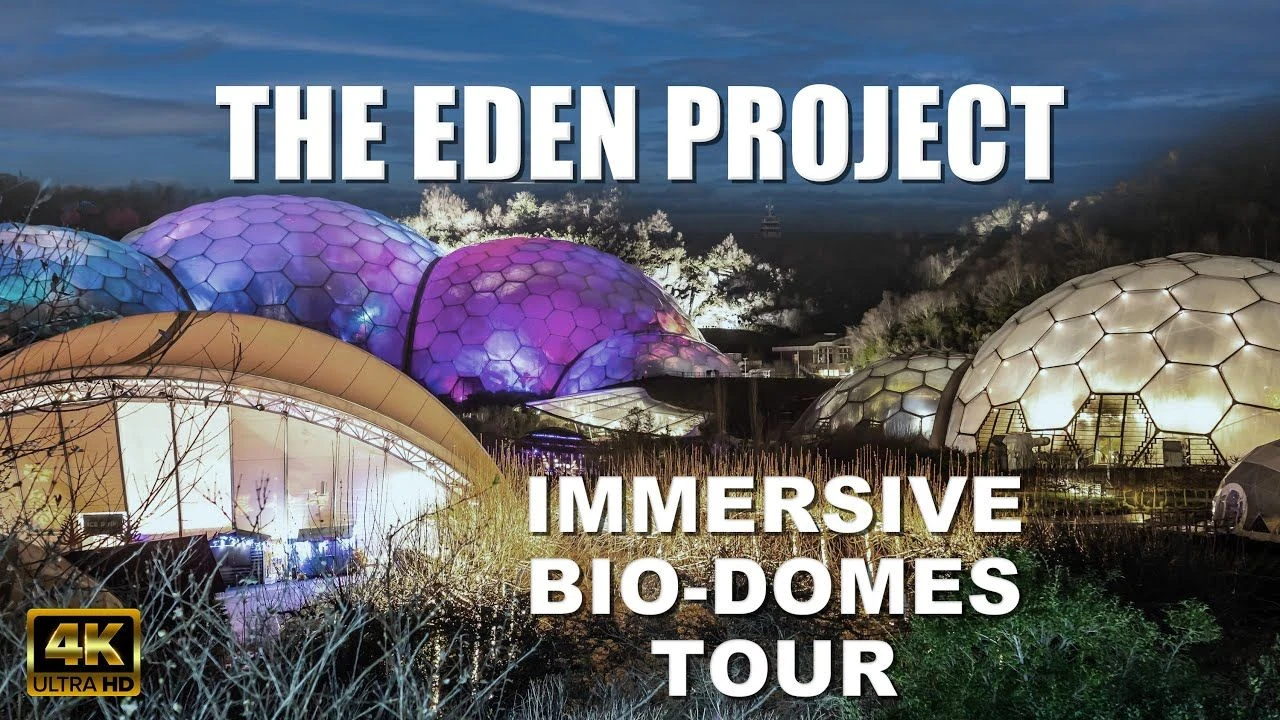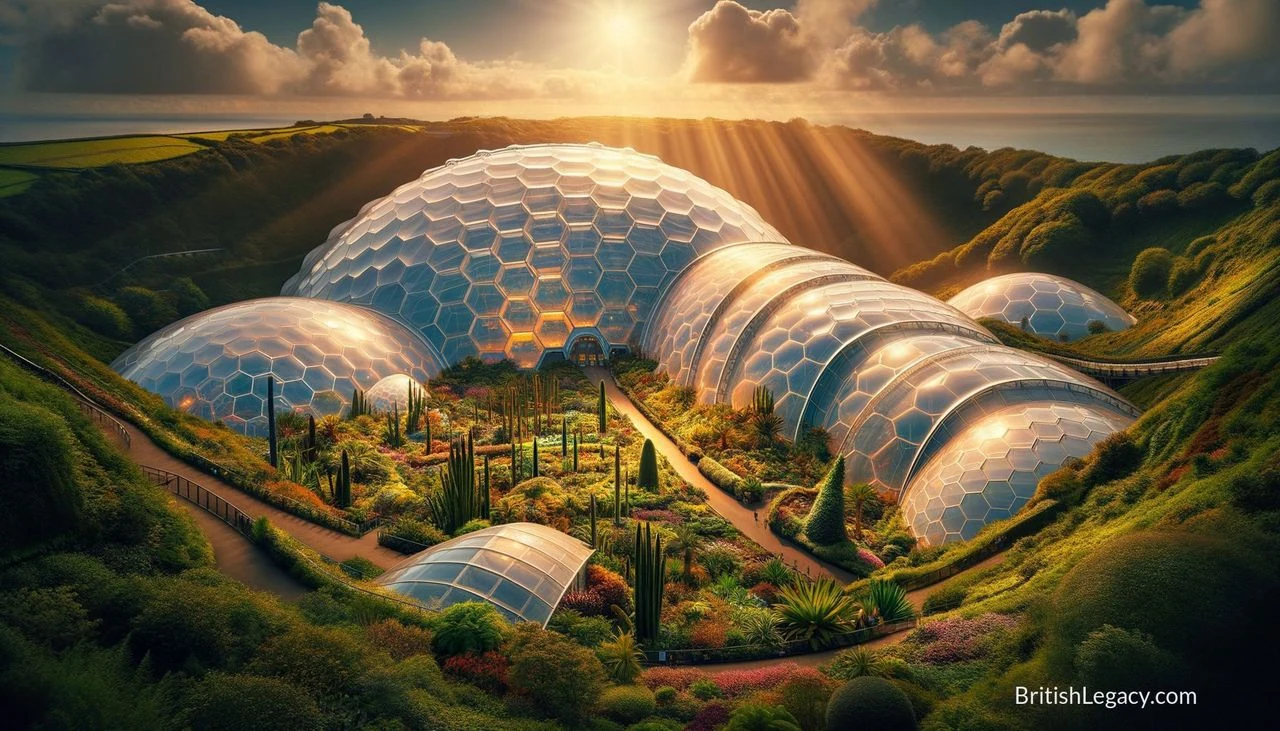
In a former china clay pit in Cornwall, two vast enclosed gardens bring very different climates into view. The Eden Project opened to the public in March 2001. Its biomes, planted with species from around the world, are the most recognisable part of a site that also presents education, sustainability and conservation as part of its purpose.
From clay pit to garden
The project grew from a vision associated with Sir Tim Smit: to transform an abandoned clay pit into an educational garden and show how human life depends on the natural world. The scheme took shape in the late 1990s, with financial backing from the Millennium Commission, the European Union and other funding bodies. What emerged was a large environmental complex in Cornwall, built around the idea that plants and the conditions in which they grow could be experienced directly by visitors.
The setting and the ambition belong together. Rather than presenting plant life in a single outdoor landscape, the Eden Project uses two enclosed biomes to represent contrasting climate conditions. Their steel and thermoplastic structures form large geodesic enclosures; inside, the planting gives visitors a way to encounter environments far removed from the Cornish landscape outside.
Two climates under cover
The Rainforest Biome recreates a humid tropical environment. Visitors can walk among trees and waterfalls and see plants including cocoa, bananas, coffee and rubber. The setting gives the project a way to address subjects associated with rainforests, including deforestation, climate change and biodiversity loss. The plants are not simply a display: their presence helps connect those environmental issues with recognisable products and living ecosystems.
The Mediterranean Biome brings together plants associated with the Mediterranean, South Africa, California and Western Australia. Its warmer, drier conditions support landscapes featuring olive trees, grapevines, citrus orchards and aromatic herbs. The contrast with the rainforest environment is central to the visitor experience: the two biomes make visible how different climates support different plant communities and landscapes.
Together, the enclosures make the Eden Project more than a collection of individual botanical displays. They provide a structure for comparing environments, plants and the ways people use them. The subject matter ranges from familiar crops to the broader ecological questions raised by the loss of habitats and biodiversity.
Learning beyond the biomes
Education is another part of the project’s work. Its programmes for children and adults, along with interactive exhibits, workshops and guided tours, focus on plants, ecosystems, sustainable practices and the connections between human life and nature. This gives visitors routes into the subject beyond walking through the planted spaces: a visit can include activities and interpretation as well as the biomes themselves.
The project also describes sustainability and research as parts of its mission. Its account highlights renewable energy, water conservation and sustainable building materials among its operational approaches. It also refers to work with scientific institutions on plant conservation, climate resilience and sustainable agriculture. These broad ambitions help explain the intended scope of the site, which combines public-facing gardens and learning with environmental themes and research.
A Cornish destination and public venue
The Eden Project has become a visitor attraction and a venue for cultural events and festivals. Its presence has been associated with jobs and tourism in Cornwall, while its international profile brings visitors from beyond the county. The project therefore has a local dimension as well as an environmental one: it gives people a reason to visit this part of Cornwall and provides a setting for public events alongside its gardens and educational activities.
Claims about the scale of its economic effects or its influence on environmental practice require care. The project’s stated aims and activities are clear, but broad descriptions of its impact should not be mistaken for measured outcomes. Its most readily understood contribution is the experience it offers: a visit that places contrasting plant environments, conservation questions and human dependence on nature in one accessible setting.
Why the Eden Project deserves a place in British Legacy
The Eden Project merits a place in British Legacy because it gives a distinctive form to an environmental idea in a specific British landscape. In Cornwall, a former clay pit became the setting for two large climate-controlled gardens, where visitors can encounter tropical rainforest plants and Mediterranean-climate planting under cover. The project’s design makes the contrast between environments part of the experience, while its educational programmes and interpretation connect that experience with biodiversity, climate change and the relationship between people and plants.
Its significance also lies in bringing several purposes together at one public site. The Eden Project combines gardens with workshops, guided visits and cultural events, and it identifies sustainability, conservation and research among its areas of work. That combination gives the public more than a striking pair of structures to visit: it offers ways to learn about ecosystems and the plants people rely on. Its Cornish location, its transformation of a clay-pit setting and its focus on environmental learning make the Eden Project a specific example of how a British visitor attraction can engage audiences with global ecological questions.