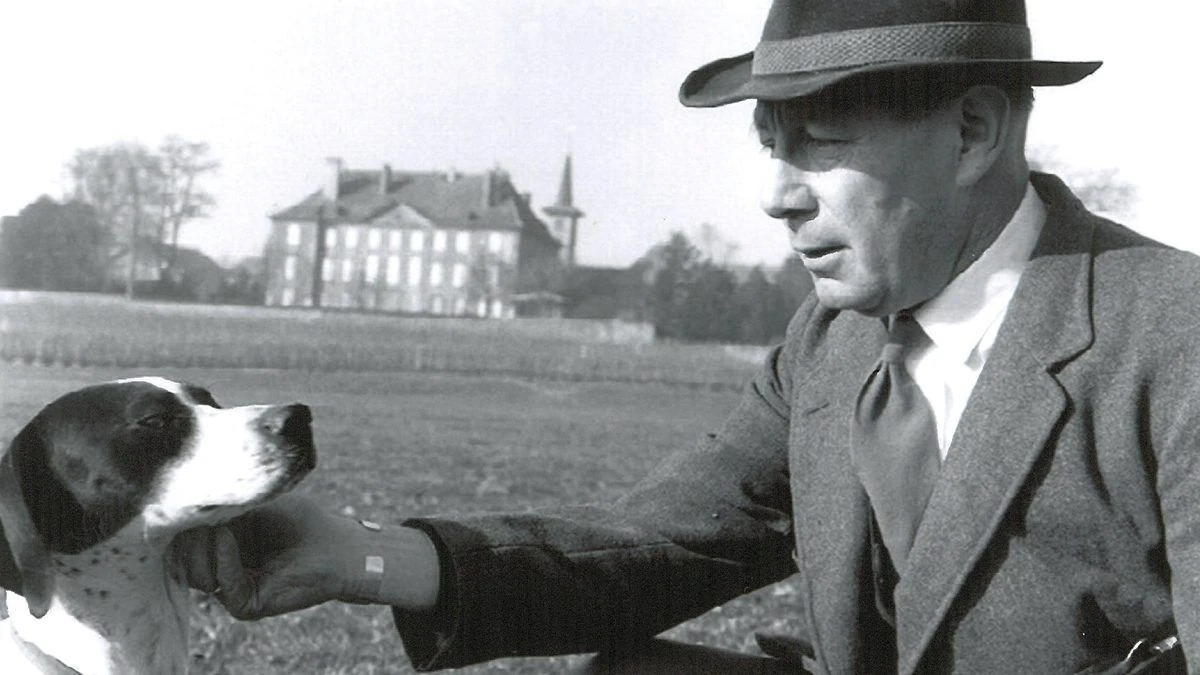
George de Mestral’s hook-and-loop fastener is now so familiar that its ingenuity can be easy to overlook. In Britain, it appears on children’s shoes, sportswear and orthopaedic supports: a practical fastening that holds securely, opens quickly and can be used again. De Mestral was Swiss, and the invention was not British. But he built an international business that included the United Kingdom, and his design has found durable uses in British daily life. Its story begins with a burr, but the invention depended on years of patient engineering.
A small observation with a practical consequence
De Mestral was born near Lausanne, Switzerland, in 1907. His father was an agronomist engineer, and his mother was Marthe de Goumoëns. An early sign of his interest in making things came when, aged 12, he designed and patented a toy aeroplane. He later studied at the École polytechnique fédérale de Lausanne, graduating in 1930, and worked in the machine shop of an engineering company.
The idea that would make his name came later. In 1941, after a hunting trip in the Alps with his dog, de Mestral found burdock burrs caught in his clothes and the animal’s fur. Rather than dismiss them as a nuisance, he examined them under a microscope. He saw that the burrs were covered with tiny hooks that caught on loops in fabric, hair and fur. The mechanism offered a model for joining two surfaces in a way that was firm but reversible.
The insight was not simply that burrs stick. It was that their grip came from a repeatable structure that might be recreated in manufactured materials. One surface could carry hooks and the other loops; pressed together, they would hold, and pulled apart, they would release. De Mestral had identified a useful principle, but making it work reliably in textiles would demand considerably more than copying nature’s shape.
From a working sample to a manufacturing process
De Mestral took the idea to Lyon, a centre of weaving, and found a weaver willing to help make experimental strips. Their first samples used cotton. They demonstrated the principle, but the cotton wore out too quickly for a durable product. De Mestral turned to synthetic fibres and settled on nylon after testing alternatives.
He found that nylon thread could be formed into loops and heat-treated so that the loops retained their shape. The loops then had to be cut accurately to make hooks that could engage with the uncut loops on the other strip. Getting a sample to work was one thing; making the material repeatedly and at industrial scale was another. Mechanising the weaving and trimming process became a long technical challenge.
The work took about ten years. The account in the supplied Wikipedia article describes eight years spent mechanising the weave, followed by another year developing a loom to trim the loops after weaving. That prolonged development is an important part of the invention’s history: de Mestral had to solve problems of material, durability and production before his observation could become a dependable commercial product.
He submitted his idea for a Swiss patent in 1951, and the patent was granted in 1955. He named the fastening Velcro, combining the French words velours, meaning velvet, and crochet, meaning hook. The name was used for both the fastening and the company associated with it. After receiving patents, he opened shops in several countries, including the United Kingdom, as well as Switzerland, Germany, Sweden, Italy, the Netherlands, Belgium and Canada.
A product that had to win people over
A patent did not guarantee an immediate welcome from the textile trade. Early hook-and-loop material could look like leftover scraps of fabric, and clothiers were slow to adopt it. Its strengths were practical rather than decorative: it could be fastened and reopened quickly, used repeatedly and adjusted without the rigid parts of a buckle or the alignment required by a button.
Aerospace provided an early setting in which those qualities mattered more than appearance. The fastening helped astronauts manoeuvre in and out of bulky space suits, while its capacity to keep items in place made it useful in demanding conditions. Skiing, scuba diving and marine equipment followed among the applications noted in the supplied account. These uses helped make the case for a fastening that was plain in appearance but effective in service.
De Mestral’s achievement was not limited to noticing a natural structure. He had to make the idea repeatable: find materials that could endure, create hooks and loops that worked together, and develop machinery to produce them. The distinction matters. A striking observation may prompt an invention, but it is the work of engineering and production that lets other people rely on it.
A Swiss invention in British use
The British connection should be described accurately. The evidence supplied does not establish that British manufacturers or aerospace engineers played a significant part in developing or industrialising de Mestral’s original invention. Instead, it shows a Swiss inventor extending his commercial operation to the United Kingdom, while the fastening later became useful in British products and services. Britain is part of the invention’s history as a market and place of adoption, not its place of origin.
Footwear is one familiar example. Hook-and-loop closures are used where fast and straightforward fastening is valuable, including children’s shoes and some sportswear. The benefit is not merely convenience: a fastening that can be opened, closed and adjusted easily can make a garment or shoe simpler to manage. The same basic design can serve different users without requiring a knot, small button or more complicated hardware.
In healthcare, the current article records the use of hook-and-loop fastening on orthopaedic supports, including knee ankle foot orthoses described by Guy’s and St Thomas’ NHS Foundation Trust. Such a support needs to fit securely while remaining possible to adjust. A closure that can be tightened and refastened has a practical role for both the wearer and the person helping to fit it. Here, a design conceived through close observation of a burr has become part of an ordinary, functional medical item.
The current article also records a continuing commercial presence in Cheshire: Velcro Limited is listed in Sandbach, and the supplied company information describes it as an active textile wholesaler. That detail does not make the invention British, nor does it prove that British industry created the technology. It does help show how the relationship moved beyond an early international market into an established presence, alongside everyday use in footwear, clothing and healthcare.
Recognition and later life
De Mestral continued to make things beyond the hook-and-loop fastener. The supplied biographical account notes that he developed other inventions, including an asparagus peeler that his wife described as “one stupid little thing that sold very well”. The contrast is telling: a prolific inventor’s work need not be uniformly grand to be useful. In this case, the fastener endured because it answered a broad practical need, rather than because every idea associated with its inventor had the same reach.
His personal life included three marriages and three sons. He married Jeanne Schnyder in 1932; they had two sons, Henri and François. His second marriage, to Monique Panchaud de Bottens, followed in 1949, and they had a son, Charles. He later married Helen Mary Dale. When his father died in 1966, de Mestral inherited the family home, Château Saint-Saphorin-sur-Morges.
De Mestral died in Commugny, Switzerland, on 8 February 1990, aged 82, and was buried there. The municipality later named an avenue in his honour. He was inducted into the National Inventors Hall of Fame in 1999 for inventing hook-and-loop fasteners. Other recognition listed in the supplied account includes being made an honorary citizen of Commugny and receiving honours from engineering and progress organisations.
Why George de Mestral deserves a place in British Legacy
George de Mestral deserves a place in British Legacy not because he was born in Britain or invented Velcro here, but because the evidence shows how a Swiss invention entered British commercial and practical life. He opened operations in the United Kingdom as part of an international business, and the fastening is now used in familiar British settings, from children’s footwear and sportswear to orthopaedic supports. In a clinic, an adjustable fastening can help a support fit and be refastened; in a shoe, it can make closing and opening simpler. These are modest acts of design, but their usefulness is repeated every day.
His story also offers a specific example of the persistence behind an invention. De Mestral saw how burr hooks caught on loops, then spent years working through material failures and the machinery needed to produce a durable fastening. The idea became valuable because he stayed with the technical problems that stood between an observation and a usable product. That is a legacy British readers can recognise without overstating Britain’s part in its creation: an international invention, developed through engineering persistence, that found lasting uses here. Its success is measured not only by the name Velcro, but by the ease and adaptability it brought to everyday tasks and practical care.
Sources
George de Mestral — Wikipedia revision 1358340988
Adapted in part from George de Mestral by Wikipedia contributors, under CC BY-SA 4.0. Text has been edited and combined with the existing article; this adapted text is shared under the same licence. Contributor history.