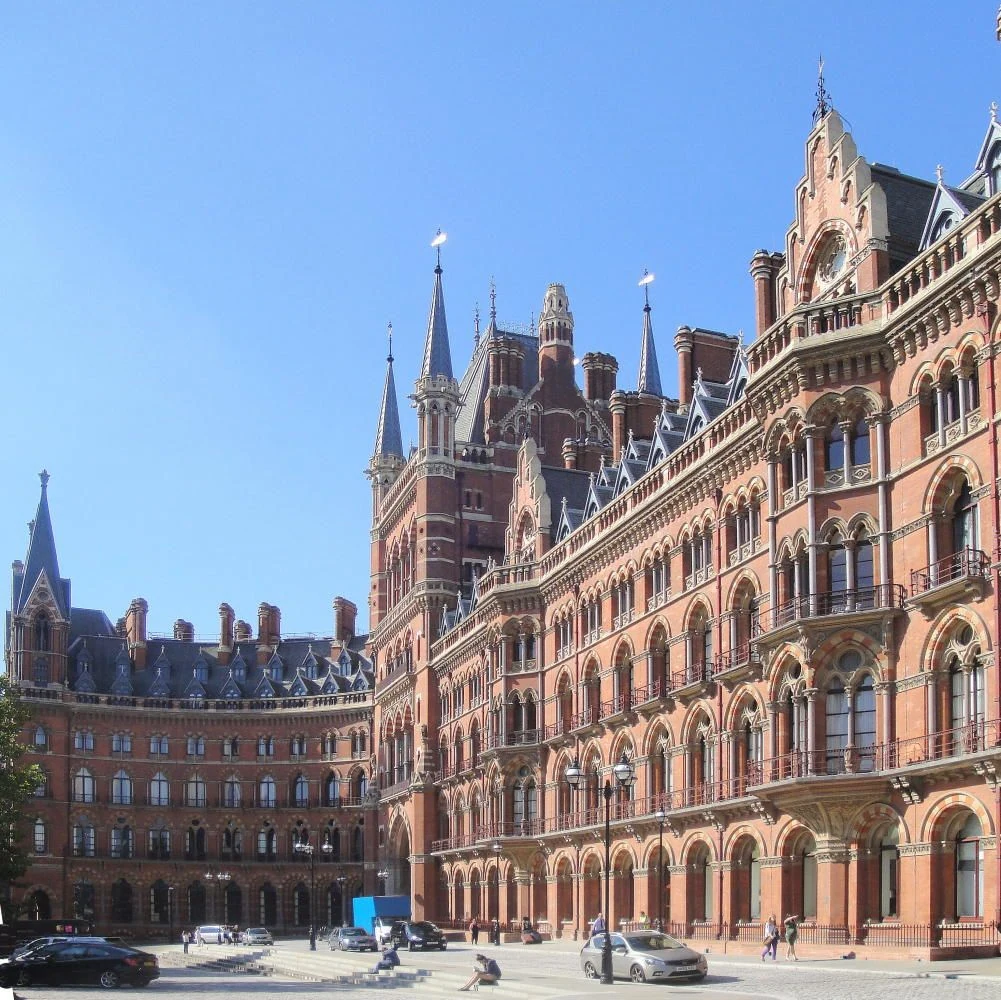
George Gilbert Scott’s buildings ranged from workhouses to cathedrals, from the practical demands of public institutions to the elaborate memorial to Prince Albert in Kensington Gardens. A leading architect of the Gothic Revival, he designed new buildings and altered or restored many older ones. His work at St Pancras, Westminster Abbey and across Britain shows how a Victorian architect could apply medieval forms to modern civic life, religious buildings and national commemoration.
A career begins with workhouses
Scott was born on 13 July 1811 at the parsonage in Gawcott, Buckinghamshire. His father, the Reverend Thomas Scott, was a clergyman; his grandfather was the biblical commentator Thomas Scott. He studied under architect James Edmeston and worked as an assistant to Henry Roberts from 1832 to 1834. He also assisted his friend Sampson Kempthorne, whose practice specialised in workhouses. That experience helped shape Scott’s early independent career.
In about 1835, Scott took on William Bonython Moffatt as an assistant; they became partners from 1838 to 1845. Together they designed more than 40 workhouses in the years following the Poor Law Amendment Act of 1834. The commission list gives a sense of the scale and geographical reach of this work: their projects included buildings in Buckingham, Kettering, Tiverton, Louth and Loughborough. Scott’s first built work, a vicarage for his father at Wappenham in Northamptonshire, dates to 1833.
Churches and other commissions followed. Among Scott and Moffatt’s early church designs were St Mary Magdalene at Flaunden, St Nicholas at Newport in Lincolnshire and St John at Wall in Staffordshire. Scott also worked on Reading Gaol, built in 1841–42 in a castellated style. These projects belong to the same early period as his institutional work, before the Gothic Revival made his name more widely.
Making a Victorian Gothic
Scott was inspired by Augustus Pugin to take part in the Gothic Revival. Two designs helped establish his reputation in the movement: the Martyrs’ Memorial in Oxford, designed in 1841, and St Giles’ Church in Camberwell, designed in 1844. The Oxford memorial commemorated three Protestants burned during the reign of Mary I. Scott’s Gothic work was not confined to churches, however. He argued for Gothic architecture in secular buildings too, rejecting the idea that it belonged exclusively to ecclesiastical settings.
His design for St Nikolai in Hamburg won an international competition in 1844, although the choice followed a reversal of the competition’s initial result. The church, completed in 1863, was Scott’s first major commission beyond Britain. Later, he developed an approach that drew on a wider range of European styles rather than simply copying English medieval Gothic. The red-brick Midland Grand Hotel at St Pancras is one example of that interest in a new Victorian style.
Scott’s practice also reached into national institutions. He became architect to Westminster Abbey in 1849 and designed a Gothic block adjoining the abbey in Broad Sanctuary, built in 1853. His plans for new government buildings in Whitehall, intended to accommodate the Foreign Office and War Office, were not carried out as first designed: after the government changed, Prime Minister Lord Palmerston objected to the Gothic scheme. Scott produced revised plans in a more acceptable style. The episode illustrates both his ambitions for Gothic in public architecture and the limits imposed by political taste.
Memorials, stations and public buildings
Scott’s design for the Albert Memorial was commissioned on Queen Victoria’s behalf in memory of Prince Albert. Construction ran from 1864 to 1876. Its richly ornamented Gothic structure brought together sculpture, allegorical figures and mosaics in a large public tribute to the prince. Among its details is a sculpted image of Scott himself, included in the podium frieze of architects. The memorial is one of his best-known works, but it was part of a broad practice rather than an isolated achievement.
At St Pancras, Scott designed the Midland Grand Hotel and the station’s façade. The hotel’s Gothic exterior and red-brick construction gave a major railway terminus a distinctive architectural identity. The station’s train shed, by contrast, was designed by William Henry Barlow; distinguishing their roles matters to the story of the building. St Pancras brought Scott’s Gothic language into the setting of the railway age, where architecture served a growing system of travel and commerce as well as a visual purpose.
His other public and educational work included the Foreign Office in Whitehall, Leeds General Infirmary, the Old Schools at Cambridge and the main building of the University of Glasgow. He designed the latter in 1870; its spire was added after his death by his son John Oldrid Scott. In London, his commissions included the extension to the library at Lincoln’s Inn and the Vaughan Library at Harrow School. The range of these buildings makes clear that his Gothic architecture could be adapted for government, education, healthcare and transport.
Restoration, influence and family
Scott’s work on existing buildings was as consequential as his new designs. He undertook restoration projects at churches, cathedrals, abbeys and collegiate buildings, including Ely Cathedral, Gloucester Cathedral, Westminster Abbey and Lichfield Cathedral. At Lichfield, his long programme of work on the west front aimed to return the building to what he understood as its medieval form. He used original materials where possible and created imitations where they were unavailable. His approach belongs to a period when restoration could substantially alter the historic fabric it sought to recover; the scale of his intervention is part of his architectural legacy.
Scott’s influence extended through the large number of pupils who passed through his office. Among them were George Edmund Street, Thomas Graham Jackson and his sons George Gilbert Scott Jr and John Oldrid Scott, each of whom became an architect. A grandson, Giles Gilbert Scott, also entered the profession. Scott married Caroline Oldrid in 1838; the family’s connections to architecture continued across generations.
He received the Royal Institute of British Architects’ Royal Gold Medal in 1859 and was knighted in 1872, choosing the style Sir Gilbert Scott. He died on 27 March 1878 at his home in South Kensington and was buried in Westminster Abbey. His posthumously published works included Personal and Professional Recollections and two volumes of Lectures on the Rise and Development of Medieval Architecture. Together with his buildings, these writings record a career that combined design, restoration and sustained argument about the place of Gothic in contemporary architecture.
Why George Gilbert Scott deserves a place in British Legacy
Scott deserves a place in British Legacy because his career is woven into the built history of Victorian Britain. His designs range across public life: workhouses built with William Bonython Moffatt, government offices in Whitehall, educational buildings, a railway hotel and the Albert Memorial. At St Pancras, the Midland Grand Hotel gave a major transport hub a striking architectural face; at the Albert Memorial, Scott created a public monument to Prince Albert. These projects show how Gothic forms were used beyond churches, and how architectural design could express civic purpose, institutional standing and public remembrance.
His legacy also includes the difficult, consequential work of restoring historic buildings. Scott’s interventions at cathedrals and Westminster Abbey reflect a Victorian determination to repair and reinterpret the past, even where restoration could reshape what survived. That tension is part of the value of remembering him: his work invites attention both to the buildings he made and to the choices that shaped older ones. His influence continued through his pupils and architect descendants, while his writing set out ideas about medieval architecture and the future of secular design. Together, these achievements make Scott a defining figure in Britain’s architectural history—not simply for the scale of his output, but for the breadth of the institutions and places his work touched.
Sources
Adapted in part from George Gilbert Scott by Wikipedia contributors, under CC BY-SA 4.0. Text has been edited and combined with the existing article; this adapted text is shared under the same licence. Contributor history.