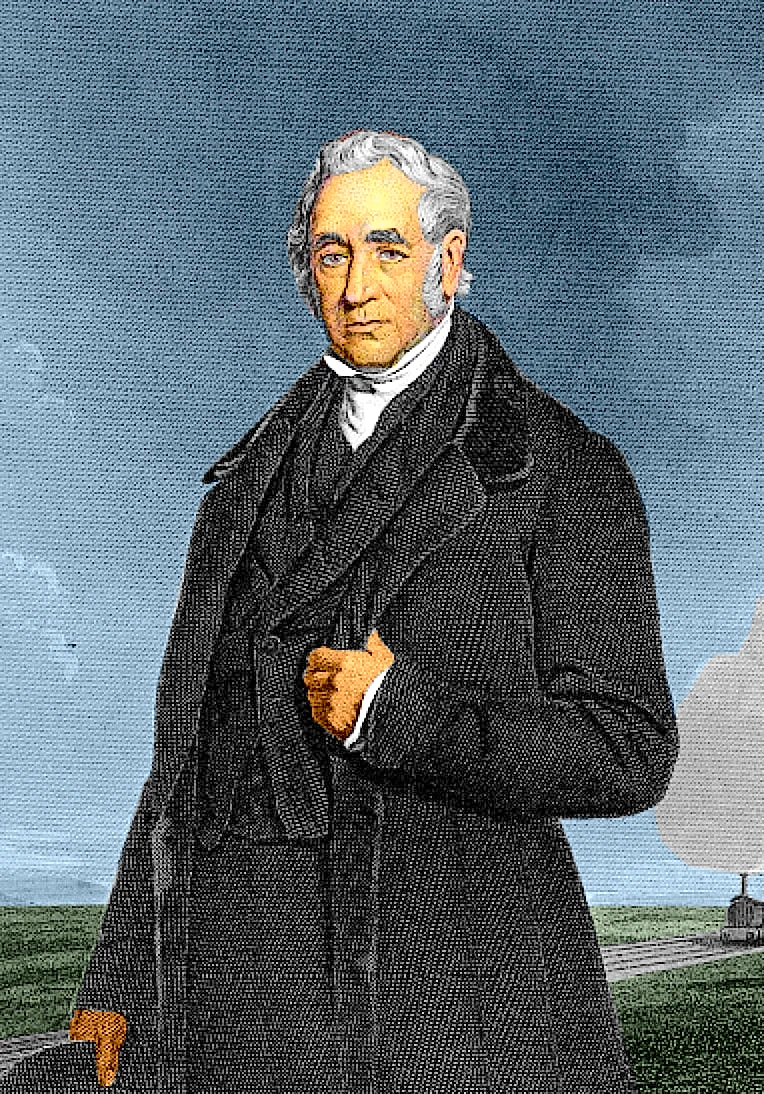
George Stephenson is often called the “Father of Railways”, but his achievement was not the invention of the steam locomotive, nor the work of one man alone. He helped turn engines, rails and colliery wagonways into a dependable transport system that could carry goods and passengers on public lines. The change began in the coal country of Northumberland, where Stephenson was born at Wylam on 9 June 1781, beside a wooden waggonway serving the local mines. His career would connect practical work underground with engineering on a national scale.
Learning through work
Stephenson’s father, Robert, worked as a fireman at the pumping engine at Wylam Colliery. The family had little money, and George received no formal schooling as a child. He went to work in the mines and, as a young man, paid for night lessons in reading, writing and arithmetic. He was still learning these subjects in his late teens, while earning a living around the machinery that would shape his working life.
In 1801 he became a brakesman at Black Callerton Colliery, controlling the winding gear. After marrying Frances Henderson in 1802, he worked at Willington Quay and later at Killingworth, where the couple lived at Dial Cottage. He supplemented his wages by mending clocks and making shoes. Their son, Robert, was born in 1803; their daughter, Frances, died in infancy, and George’s wife died in 1806. For a time he worked in Scotland, then returned to the North-East, where his sister helped care for Robert.
Stephenson’s opportunity to move beyond routine pit work came in 1811, when he offered to repair a pumping engine at High Pit, Killingworth. The repair succeeded, and he was promoted to enginewright for the Killingworth collieries, responsible for maintaining and repairing their engines. The post gave him close experience of steam machinery and the practical problems of keeping equipment working. He built his reputation in a world where a machine had to function under pressure, not merely appear convincing on paper.
A lamp for the mines, a locomotive for the wagonway
Mine safety was one of the first problems Stephenson tackled as an engineer. Firedamp, a flammable gas found in coal mines, could be ignited by an exposed flame. In 1815 he developed a safety lamp in which air entered through small openings designed to prevent the flame from igniting the surrounding gas. At the same time, the scientist Humphry Davy was investigating the same danger and producing a different lamp. Stephenson’s lamp became known as the Geordie lamp and was used in North-Eastern mining districts.
The competing claims to the invention caused a dispute. Stephenson lacked the scientific standing and public authority enjoyed by Davy, and was accused of having taken the idea from him. An inquiry in the North-East supported Stephenson’s claim that he had worked independently; a House of Commons committee later found that he had an equal claim to the invention. The episode is a reminder that early engineering recognition did not rest only on what a design could do. Who was regarded as qualified to make it mattered too.
Stephenson also turned his attention to locomotives. In 1814 he designed Blücher, a locomotive for hauling coal on the Killingworth wagonway. It could pull 30 tons uphill at about four miles an hour. Its flanged wheels gained traction through contact with the rails, a form of adhesion that helped show how a locomotive could haul a useful load without a rack mechanism. The machine was not the first steam locomotive: earlier work by Richard Trevithick had already explored steam-powered vehicles and engines running on rails. Stephenson’s contribution was part of a longer sequence of experiments, and his own work concentrated on making locomotives useful in the conditions of industrial railways.
Those conditions made the track as important as the engine. Early rails could break under the weight of locomotives, while steep gradients used up their power. Stephenson worked on rail design and the distribution of a locomotive’s weight, and developed the view that routes should be kept as level as possible. The Hetton colliery railway, which opened in 1822, brought these considerations together. Stephenson used locomotives on level and rising sections and gravity on downward inclines. The line operated without animal power and demonstrated that railway planning involved the movement of trains over a route, not simply the construction of a powerful engine.
Stockton and Darlington: a railway for the public
The Stockton and Darlington Railway was planned to move coal from collieries near Bishop Auckland to Stockton, by way of Darlington. The original scheme envisaged horses drawing the wagons. After meeting the railway’s director Edward Pease, Stephenson surveyed the route and argued for steam locomotives. A further Act of Parliament in 1823 authorised steam power and the carriage of passengers, giving the project a public purpose beyond moving coal.
In 1823 Pease, George Stephenson, Robert Stephenson and Thomas Richardson established Robert Stephenson & Co. in Newcastle. The company was created to manufacture railway engines at a time when there was no established locomotive industry to supply the new lines. Its formation was a practical step towards a railway system: promoters would need engines that could be built, maintained and supplied in numbers, not only an isolated demonstration machine.
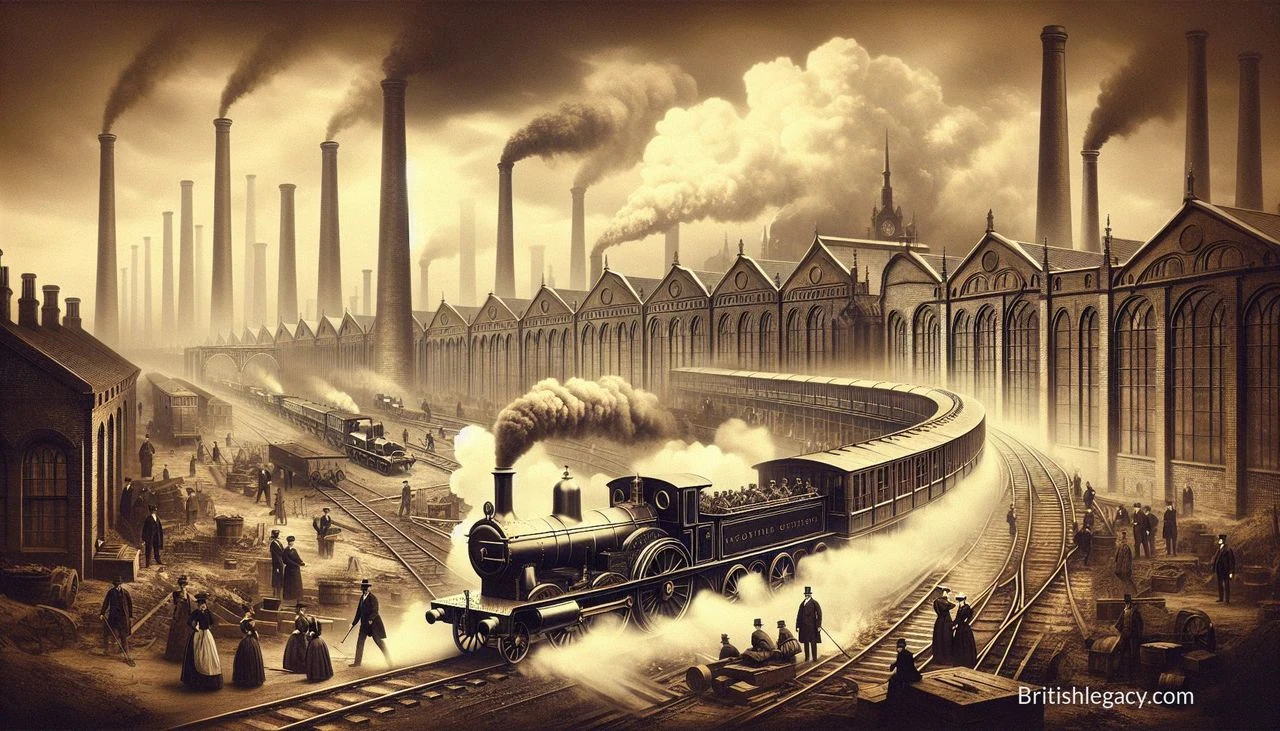
The company built Locomotion, designed by George Stephenson, for the Stockton and Darlington Railway. On 27 September 1825, Stephenson drove it on the line’s opening journey. It hauled wagons of coal and goods, as well as the passenger carriage Experiment, on a public trip from Shildon to Stockton via Darlington. This was not the first locomotive ever made. Its importance lay in what the railway demonstrated: steam could haul freight and carry passengers on a public line, connecting a colliery district with towns and a port.
The opening was a landmark because it changed how railways could be understood. A wagonway had principally served a particular industrial purpose; the Stockton and Darlington Railway showed how a public line might serve more than one kind of traffic. Its success helped make steam railways a credible proposition for investors and other railway promoters. Stephenson’s contribution came through the survey, his advocacy of steam power, the locomotive and the engineering decisions that helped make the line operate.
Rocket and the Liverpool and Manchester Railway
The Liverpool and Manchester Railway raised the stakes. It would link two major commercial centres and carry both passengers and freight. Stephenson’s preference for gentle gradients shaped the engineering: he had observed that even a modest incline could consume a substantial share of a locomotive’s power. The route therefore required difficult works, including cuttings, embankments and viaducts. One of its best-known obstacles was Chat Moss, an unstable peat bog over which the railway had to be carried.
As construction neared completion, the railway’s directors held the Rainhill Trials in October 1829 to determine which locomotive should be used. The Stephensons entered Rocket, which won. The popular story of the engine can obscure the collaboration behind it. Robert Stephenson was responsible for its detailed design, while his father, in Liverpool overseeing construction of the line, remained in communication and offered suggestions. Henry Booth, the railway’s treasurer, suggested using a fire-tube boiler, an idea that had also been explored by the French engineer Marc Seguin. The result drew on several people’s experience and improvements, rather than on a single act of invention.
The trials helped establish that locomotives could combine speed, endurance and reliability well enough for a commercial railway. When the Liverpool and Manchester Railway opened on 15 September 1830, it became the first public inter-city railway in the world to use locomotives. The opening ceremony included a procession of trains and prominent visitors, but it was also marked by tragedy: William Huskisson, a Member of Parliament, was struck by a locomotive and later died. The accident gave a stark measure of the risks accompanying a new form of transport. The railway nevertheless succeeded and helped make regular steam travel between cities a practical reality.
From railway projects to a national network
After the Liverpool and Manchester Railway, Stephenson became a familiar and reassuring name to railway promoters. He worked on routes across the Midlands and the North, including the North Midland, York and North Midland, Manchester and Leeds, and Birmingham and Derby railways. He also advised on projects beyond Britain. His experience was valuable not because every judgement proved right, but because he had helped deliver railways and understood the relationships between locomotives, track, gradients and construction.
Stephenson’s preferred track gauge, 4 feet 8½ inches, became the basis of the standard gauge used by most of the world’s railways. The measurement had been used on lines associated with his work, including the Stockton and Darlington. A common gauge offered a basis for separate lines to connect as networks rather than remain isolated routes. It was a standard reached through practical choices and subsequently adopted widely, not a measurement that Stephenson imposed on every railway by himself.
His later work also had local consequences. He became involved in the Leicester and Swannington Railway, intended to bring coal from western Leicestershire into Leicester. Stephenson invested in the project and in the Snibston estate, where coal reserves lay close to the proposed line. The mine supplied coal to Leicester by rail and helped reduce the city’s coal costs. Here the benefits of railway development were not merely a matter of faster journeys: more effective transport could change the price and availability of a basic fuel.
Not every railway decision made by Stephenson became the chosen course. He favoured cautious gradients and, at times, longer routes than some of his successors considered necessary. His estimates and organisation also drew criticism, and differences with the engineer Joseph Locke contributed to a lasting rift. These limits matter to the story. Stephenson was not an infallible authority, but an experienced engineer working during a period when railway design, construction and business practice were still taking shape.
In 1847 Stephenson became the first president of the Institution of Mechanical Engineers. The appointment recognised a career that had taken engineering from colliery workshops and railway projects into a developing profession. He died at Tapton House, near Chesterfield, on 12 August 1848. His second wife, Elizabeth Hindmarsh, had died in 1845; earlier in 1848 he had married Ellen Gregory. He was buried at Holy Trinity Church in Chesterfield.
Why George Stephenson deserves a place in British Legacy
George Stephenson deserves a place in British Legacy because his importance lies in making railways work as a system. He helped develop locomotives for industrial use, tackled the fragile track and difficult gradients that constrained them, surveyed routes, promoted steam power on public lines and supported the manufacturing capacity needed to supply engines. The Stockton and Darlington Railway demonstrated that steam could carry passengers as well as freight; the Liverpool and Manchester Railway showed that locomotive travel could connect major cities. Those achievements were collaborative, and they built on earlier work by other engineers. Stephenson’s distinction was his sustained role in joining practical engineering to public transport.
The benefits reached beyond engineering milestones. Railways offered a way to move coal and goods more effectively, connect towns and commercial centres, and make passenger journeys part of a public service. At Leicester, the railway and mining interests associated with Stephenson helped bring coal into the city and reduce its cost. The gauge he favoured became the basis for a widely used standard, helping separate routes develop into connected networks. His career also shows how engineering authority could be disputed: a self-educated colliery engineer had to establish his standing alongside more formally recognised scientific figures. Remembering Stephenson in a British context is therefore not simply a celebration of a famous locomotive. It is recognition of a Northumberland engineer whose work helped alter the movement of people and goods, and whose influence became embedded in the infrastructure of everyday life.
Sources
George Stephenson — Wikipedia, revision 1371935840
Adapted in part from George Stephenson by Wikipedia contributors, under CC BY-SA 4.0. Text has been edited and combined with the existing article; this adapted text is shared under the same licence. Contributor history.