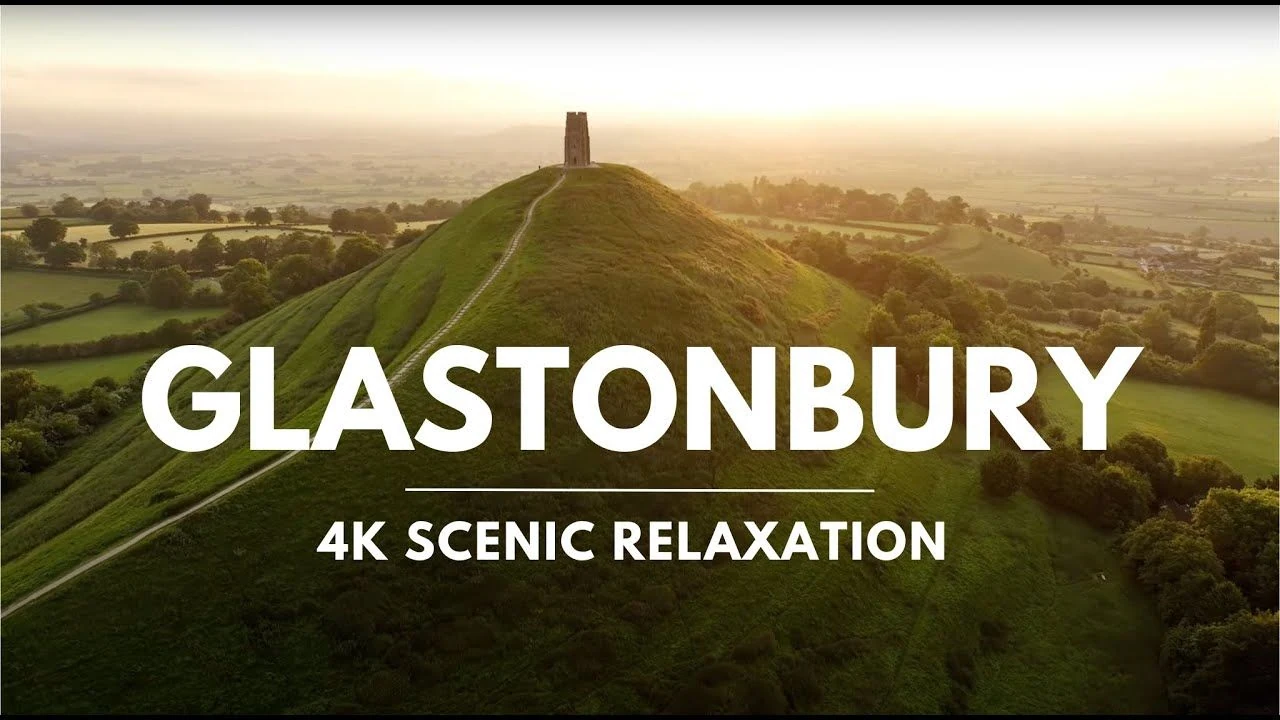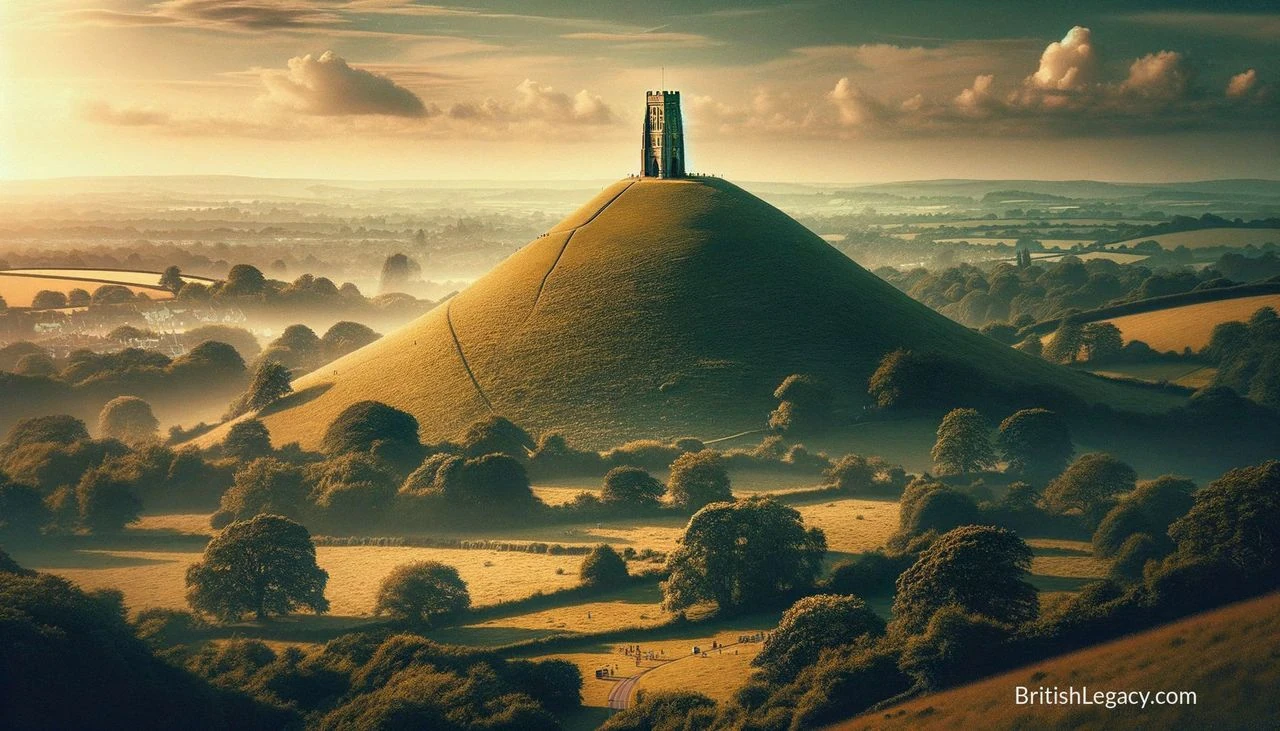
Glastonbury Tor rises above the Somerset Levels, its distinctive summit marked by the roofless tower of St Michael’s Church. The hill is at once a physical landmark, an archaeological site and a place layered with religious and legendary associations. Its terraces remain unexplained; excavations have revealed traces of people who visited or lived on the summit across many centuries; and its links with Arthurian Avalon have helped make it a focus for pilgrims and spiritual seekers. At the centre of these different histories stands a surviving medieval tower, the last visible remnant of a church with a much longer story.
A hill shaped by landscape and mystery
The Tor stands near the town of Glastonbury in Somerset, rising to 518 feet above the surrounding Levels. Its position makes it visible for miles across the low-lying landscape. The hill is formed from layers of Jurassic rock, with resistant Bridport Sands capping softer deposits below. The erosion of the surrounding material helped leave the hill standing prominently above the plain.
Seven roughly symmetrical terraces, or lynchets, run around its slopes. Their origin is uncertain. They have been explained as the result of natural differences in the underlying stone and clay, as agricultural terraces, as defensive earthworks, or as a route leading towards the summit. Another suggestion interprets them as part of a three-dimensional labyrinth. None of these explanations has been established conclusively. The terraces are therefore not straightforward evidence of a particular use, but an enduring archaeological puzzle.
The Tor’s position amid the Levels can also produce a striking optical effect: in certain atmospheric conditions, it appears to rise out of mist. That landscape setting helps explain its power as a landmark, while the hill’s geology and the unresolved terraces give it an importance beyond its dramatic outline. The site is protected as a scheduled monument, and the tower is a Grade I listed building. The National Trust manages the Tor.
Evidence of occupation, and a Christian summit
Finds from the summit indicate human activity long before the surviving tower. Neolithic flint tools show that people visited the site in prehistory, while later finds include Iron Age and Roman material. Excavations carried out between 1964 and 1966 uncovered evidence of occupation in the fifth to seventh centuries. Among the discoveries were postholes, hearths, a metalworker’s forge, burials and fragments of sixth-century Mediterranean amphorae. The evidence points to activity on the hill in the early medieval period, although it does not establish a continuous settlement.
Several buildings stood on the summit during the late Saxon and early medieval periods. A stone cross base and the remains of structures associated with a church and possible hermitage indicate Christian use. A broken wheel-cross head, dated to the tenth or eleventh century, was found partway down the hill. The first church of St Michael is thought to have been built of timber in the eleventh or twelfth century, with monk cells nearby.
In 1243, Henry III granted a charter for a six-day fair at the site. On 11 September 1275, an earthquake destroyed the timber church. A later stone church, also dedicated to St Michael, was built in the fourteenth century. It survived until the Dissolution of the Monasteries in 1539, when the church was demolished apart from its tower. That tower, with its buttresses and bell openings, still marks the summit. The Tor was also the place where Richard Whiting, the last Abbot of Glastonbury, was executed with two of his monks, John Thorne and Roger James.
A monument cared for and contested by time
The surviving tower has required repair over the centuries. Richard Colt Hoare bought the Tor in 1786 and funded repairs to the tower in 1804, including rebuilding its north-east corner. The property later passed to the Neville-Grenville family. After Robert Neville-Grenville’s death in 1936, the Tor was sold to the National Trust, which took control in 1937 after raising money through public subscription.
Conservation has had to respond both to the structure and to the pressure of visitors. Excavations in the 1960s identified cracks in the rock, while wind erosion exposed the tower’s footings. Repairs included concrete work to the foundations. As increasing footfall threatened the terraces, paths were laid to guide visitors to the summit. Later work included repairs to the tower and rebuilding its parapet, with some damaged masonry replaced by new stone.
The hill’s significance has also reached beyond Somerset. A model loosely based on the Tor, with a tree in place of the tower, featured in the opening ceremony of the London 2012 Olympic Games. Its appearance offered a way to bring a recognisable Somerset landmark into a ceremony staged before a global audience.
Avalon, pilgrimage and living spirituality
Glastonbury Tor’s Arthurian associations belong to the history of legend and belief, rather than to an established account of Arthur’s life. The hill has been linked with Avalon and with the Welsh name Ynys Afallon, while Gerald of Wales wrote about the alleged discovery at Glastonbury of the coffins of Arthur and Guinevere in 1191. These traditions helped connect the Tor to the Arthurian stories, but they do not establish that the hill was where Excalibur was forged or where Arthur was taken after his final battle.
The Tor’s religious history is not confined to legend. Christian pilgrimage to the hill dates back at least to the eleventh century, associated with the dedication to St Michael. In later centuries, interest in Celtic mythology added other interpretations. The Tor became associated with Gwyn ap Nudd, a figure connected with the Otherworld, and was imagined as an entrance to Avalon or the land of the fairies.
Modern spiritual movements have added further meanings to the landscape. The hill and nearby sites have become important to Goddess movements, and the water of Chalice Well has been given symbolic significance. A procession carrying an effigy of the Goddess up the Tor has formed part of this modern devotional landscape. Claims about earth energies, ley lines and the Glastonbury Zodiac also belong to spiritual and esoteric traditions, not to established archaeological explanations. The zodiac theory, proposed by Katherine Maltwood in 1927, describes a vast figure said to be marked out by landscape features; its proposed antiquity is not supported by the evidence described for the site.
Why Glastonbury Tor deserves a place in British Legacy
Glastonbury Tor deserves a place in British Legacy because its importance rests on several distinct, evidenced strands of history. The hill preserves traces of human activity from prehistoric times, material from the Iron Age and Roman periods, and evidence of early medieval occupation. Its churches document the growth of Christian use on the summit, while the standing tower connects that history to the medieval stone building and the destruction of its predecessor in the earthquake of 1275. The remains are not a simple, complete story: the terraces’ purpose is still unknown, and the history of occupation is pieced together from archaeological evidence. That uncertainty is part of the site’s historical value.
The Tor also shows how places acquire meaning across generations. Christian pilgrimage, Arthurian writing, later Celtic interpretations and contemporary spiritual practice have all contributed to its cultural life, though legend and belief should not be confused with archaeological proof. Its position above the Somerset Levels makes it a landmark in the landscape; its surviving tower and protected remains give that prominence a tangible historical basis. Conservation work, including paths to reduce damage from footfall, helps keep the site accessible while protecting its fragile features. Together, the hill’s geology, archaeology, architecture and changing traditions make Glastonbury Tor a distinctly Somerset place with a lasting place in Britain’s history and imagination.
Sources
Glastonbury Tor — Wikipedia revision 1377087696
Adapted in part from Glastonbury Tor by Wikipedia contributors, under CC BY-SA 4.0. Text has been edited and combined with the existing article; this adapted text is shared under the same licence. Contributor history.