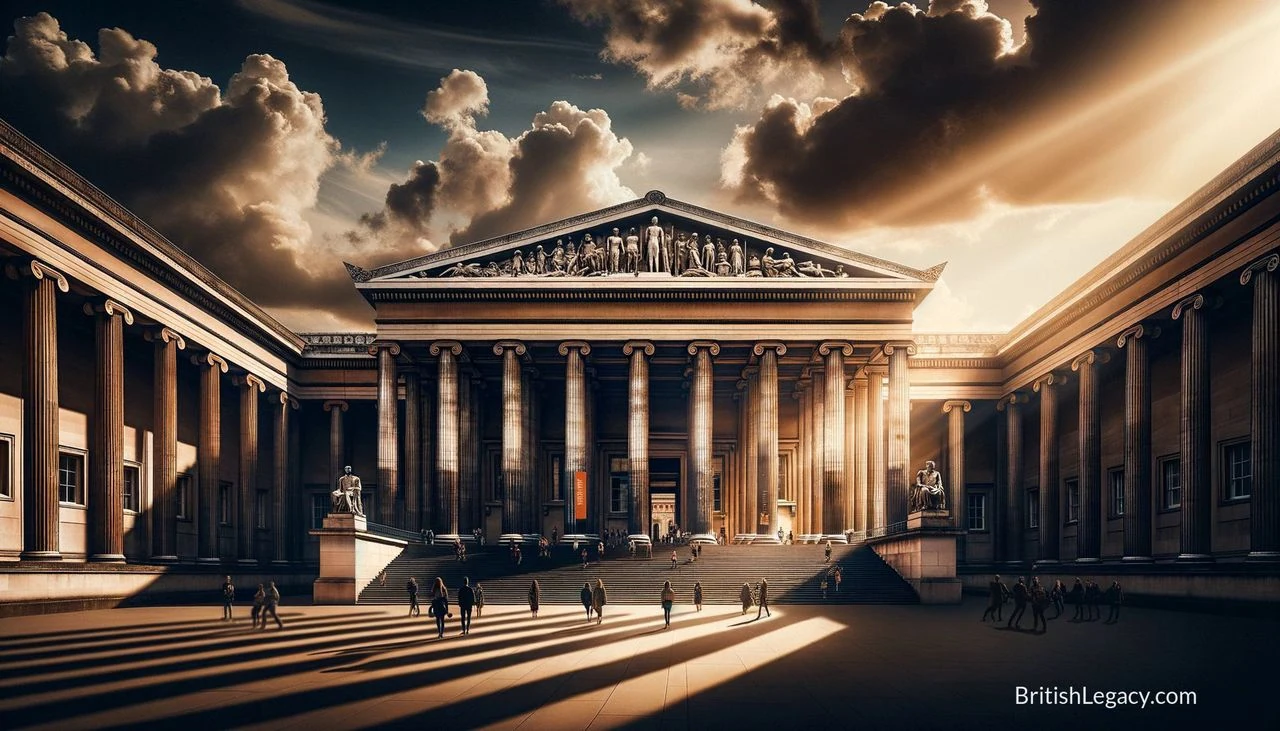
In Bloomsbury, a Greek Revival façade of Ionic columns fronts a museum whose collection ranges across continents and more than two million years of human history. The British Museum began with a parliamentary act in 1753 and opened to visitors in 1759. Conceived as a public institution for learning, it has grown into one of the world’s largest museums. Its story is also bound up with Britain’s imperial past and continuing arguments over the ownership and display of cultural objects.
A national museum takes shape
The museum’s foundations lay in the collection of Sir Hans Sloane, an Anglo-Irish physician and naturalist based in London. On his death in 1753, his collection—about 71,000 objects, including books, manuscripts, natural-history specimens, prints and antiquities—was bequeathed to King George II for the nation. Parliament agreed to pay Sloane’s heirs £20,000 and established the museum by statute on 7 June that year. Two further libraries, the Cottonian and Harley collections, were added; the Old Royal Library followed in 1757.
This was a new kind of national institution: neither a royal nor a church collection, and intended to be freely open to the public. The trustees chose Montagu House in Bloomsbury, where the first galleries and a reading room opened on 15 January 1759. At first, books and natural-history specimens occupied much of the space. The museum also became a centre for study: in 1763, Daniel Solander was employed to reorganise its natural-history collection according to the Linnaean system.
As gifts and acquisitions accumulated, Montagu House could no longer accommodate the collections. A new building, designed by Sir Robert Smirke, began to take shape in the 1820s. Its Greek Revival frontage, completed as part of a much larger building project, gives the museum its distinctive presence on Great Russell Street. The Round Reading Room, designed by Smirke’s brother Sydney, opened in 1857. The museum’s early role as both library and museum would eventually change: the British Library Act 1972 separated the library department, although the library remained in the building until its move to St Pancras in 1998.
Objects, collections and changing boundaries
The collection is often described as containing about eight million objects, while the Wikipedia account gives a larger total of more than 13 million objects held at the British Museum. Only a small fraction is on public display at any one time. The holdings span archaeology, art and material culture from ancient and modern societies; they include Egyptian mummies, Assyrian palace reliefs, Greek sculpture, British and European antiquities, prints, coins and objects from Asia, Africa, Oceania and the Americas.
Among its most recognised objects is the Rosetta Stone, a trilingual inscription from 196 BC. After the British defeat of the French campaign in Egypt, the stone was presented to the museum by George III in 1802. Its parallel texts became crucial to the decipherment of Egyptian hieroglyphs. The collection also includes major ancient Egyptian sculpture and a wide range of objects from the Nile Valley, as well as Assyrian reliefs and cuneiform tablets from sites including Nimrud and Nineveh.
The Parthenon sculptures, often called the Elgin Marbles, form another prominent part of the museum’s Greek collection. They were removed from the Acropolis by agents of the 7th Earl of Elgin between 1801 and 1812 and acquired by the museum in 1816. The collections grew through gifts, purchases and archaeological excavations, many conducted during the period of British imperial expansion. That history is essential context for understanding how objects from around the world came to be held in London.
Collections from Britain and Europe provide a different view of the museum’s breadth. They include the Sutton Hoo ship burial objects, the Mold gold cape, Roman-British finds and the Lewis chessmen. Other departments hold extensive collections of Asian art, African material culture, prints and drawings, and coins and medals. The museum is therefore not simply a gallery of celebrated masterpieces: it is also a research collection whose objects can illuminate daily life, artistic practices and political histories across time.
Learning, research and a transformed courtyard
Scholarship and public access have been part of the museum’s purpose since its early years. Its reading rooms and collections served researchers for generations; the Round Reading Room closed when the British Library moved to St Pancras. The museum continues to publish research and to make collection information available online. Its online database had nearly 4.5 million object entries in two million records at the start of 2023, according to the Wikipedia account.
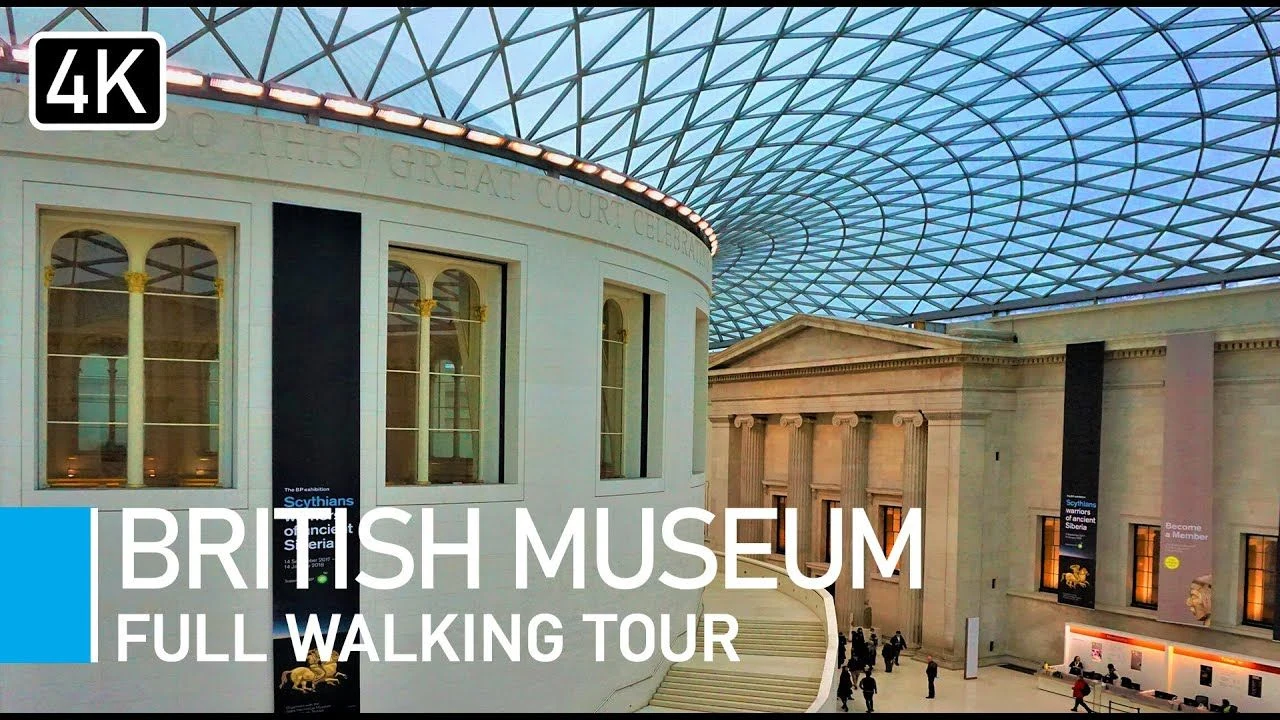
The departure of the library made it possible to redevelop the central courtyard. The Queen Elizabeth II Great Court, designed by Foster and Partners with engineers Buro Happold, opened in 2000 beneath a glass-and-steel roof. Its covered public space reorganised movement through the building and made the former reading room part of the visitor route. The museum has also developed conservation and exhibition facilities, including the World Conservation and Exhibitions Centre, completed in 2014.
In 1972, the exhibition Treasures of Tutankhamun drew more than 1.6 million visitors, a landmark in the museum’s public reach. Temporary exhibitions have since presented subjects from the history of ancient Persia to the Hajj. Digital collections and exhibitions extend that work beyond the galleries, while the museum’s free general admission places its permanent displays within reach of a broad public.
Ownership, responsibility and public debate
The museum’s international collections also make it a focus for disputes about acquisition and restitution. The Parthenon sculptures are claimed by Greece; the Benin Bronzes, Rosetta Stone and other objects are also among items named in repatriation claims. Such questions concern more than the artistic importance of objects: they involve the circumstances in which they were removed, the laws governing museum collections and the claims of communities and countries connected to them.
The museum has argued that legislation restricts its trustees’ ability to dispose of collection objects. It has nevertheless returned some items, including Tasmanian Aboriginal ancestral remains, where the law allowed. These competing positions—between legal restrictions, public stewardship and calls for return—remain part of the museum’s present-day responsibilities. Its collections are not a neutral record of human history: the routes by which they reached London are themselves part of that history.
The institution has faced other tests of trust and accountability. In 2023, the museum disclosed that items including gold, jewellery and gems had been stolen over a significant period. An independent review and a police investigation followed, and the museum announced a plan to digitise its collection. The episode underscored how care for objects depends not only on conservation expertise but also on sound systems of oversight.
Why The British Museum deserves a place in British Legacy
The British Museum belongs in British Legacy because its history shows how Britain built public institutions around the collection, study and display of material from many societies. Founded by Parliament and opened to the public in the eighteenth century, it widened access to objects and knowledge that had once been held in private collections. Its galleries bring together artefacts that can help visitors explore ancient Egypt, Greece, Mesopotamia, Britain and cultures across the world. Its library, publications, conservation work and online records extend that educational role beyond a visit to Bloomsbury.
That legacy should be presented with the same care as the collections themselves. The museum’s growth was shaped by British imperial power, and some of its best-known objects remain the subject of claims for return. A meaningful account of the institution must therefore hold public learning and difficult questions of ownership together, rather than treating the objects as detached from the circumstances of their acquisition. The museum matters to Britain not because it offers an uncomplicated story of national achievement, but because it makes that story—and Britain’s place in wider histories—available for study and debate. Its continuing value rests on scholarship, public access and an honest engagement with the responsibilities that accompany stewardship.
Sources
Adapted in part from British Museum by Wikipedia contributors, under CC BY-SA 4.0. Text has been edited and combined with the existing article; this adapted text is shared under the same licence. Contributor history.