
Stainless steel is so familiar that its significance can disappear into everyday use: in knives and saucepans, food-processing equipment and the fittings of factories and hospitals. Its history leads to Sheffield, where Harry Brearley investigated how chromium could change steel and recognised that a laboratory sample resistant to chemical attack might solve a practical problem at home as well as in industry. His work helped make durable, rust-resistant cutlery possible. The discovery was not the whole story: Brearley’s contribution also lay in showing what the material might be for.
A working education in steel
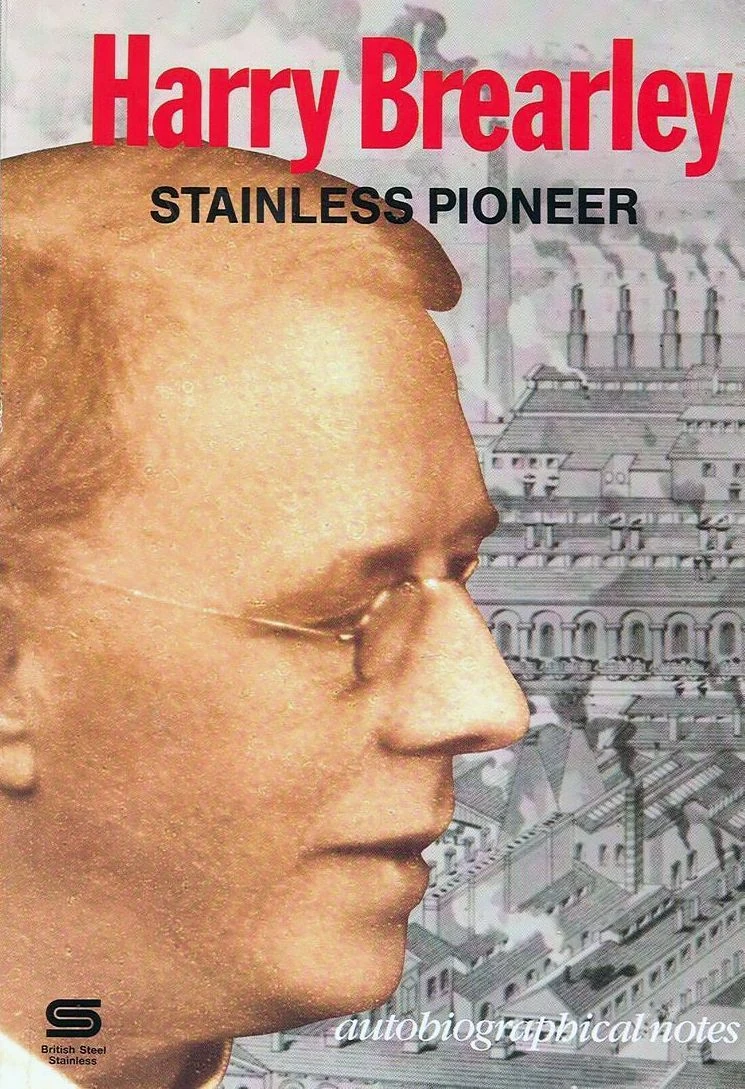
Brearley was born in Sheffield on 18 February 1871, the son of steelworker John Brearley. He left Woodside School at twelve and began work as a labourer in the steelworks where his father was employed. He later became a general assistant in the company’s chemical laboratory. Those early jobs brought him into contact with steel production and chemical analysis, but his developing expertise depended on study as well as experience.
He studied at home and attended evening classes, specialising in steel production techniques and associated methods of chemical analysis. By his early thirties, he had earned a reputation for sound practical judgement in industrial metallurgy. In 1908, two of Sheffield’s principal steelmaking firms, Thomas Firth & Sons and John Brown & Co., jointly established Brown Firth Laboratories and appointed him to lead the research enterprise.
The appointment marked a substantial step from the works floor to research leadership. Brearley’s authority came through work, study and the ability to address problems that mattered to steelmakers. He was not concerned with metallurgy only as theory: the purpose of investigation was to understand how steel behaved and what makers could do with that knowledge. His career also included technical writing. In 1902 he co-authored The Analysis of Steel-works Materials; later books treated tool steel, case-hardening and heat treatment. These publications place the stainless-steel discovery within a wider working life devoted to steel and its properties.
The problem inside the gun barrel
Brearley’s research into chromium steel began with a problem in arms manufacturing. In the years immediately before the First World War, the internal surfaces of gun barrels were suffering erosion and excessive wear under high temperatures. This is sometimes simplified into a story about trying to prevent barrels from rusting. The supplied Wikipedia account makes a useful distinction: erosion and wear, rather than corrosion, were the problem that prompted the research.
At Brown Firth, Brearley investigated the effects of changing the proportions of carbon and chromium in steel. Chromium was already known to affect the material’s behaviour, including its response to high temperatures. His experiments examined carbon concentrations around 0.2 per cent by weight and chromium levels between 6 and 15 per cent. The aim was to measure how different compositions behaved, not to stumble upon a material without a programme of investigation.
The discovery emerged during metallographic work, the examination of a metal’s microstructure. Samples had to be polished and chemically etched before they could be studied. A dilute solution of nitric acid in alcohol could etch ordinary carbon steel. Some chromium-rich experimental samples, however, resisted the treatment. Their resistance made them difficult to prepare for examination, but it also revealed a valuable property: they were unusually resistant to chemical attack.
From rustless steel to stainless steel
The finding’s importance depended on recognising that it had applications beyond the original research problem. A thin film of chromium oxide forms at the surface of chromium-containing steel and helps protect the metal from corrosion. That protective behaviour became the basis of a material associated with durability and resistance to staining. The alloy’s potential was therefore not confined to high-temperature service or military manufacture.
Brearley initially called the new alloy “rustless steel”. “Stainless steel” is associated with Ernest Stuart of R. F. Mosley’s, a Sheffield cutlery manufacturer. The name conveyed the material’s useful quality in terms that manufacturers and customers could readily understand. The change also accompanied a shift from experimental result to possible commercial product: the steel could be considered not merely as a laboratory curiosity but as a material for making things people used.
The precise date of the first casting is not consistent within the supplied Wikipedia text. It reports that the first true stainless steel was produced on 13 August 1913, while also giving 20 August 1913 as the date associated with Brearley’s casting number 1008 in an account attributed to the American Society for Metals. Both accounts place the breakthrough in 1913; the discrepancy means that a single exact date should not be stated without qualification. The reported casting contained 12.8 per cent chromium and 0.24 per cent carbon.
Sheffield’s long-established cutlery industry helped Brearley see where the alloy might be useful. Carbon-steel knives could rust unless they were frequently polished. Alternatives such as sterling silver or electroplated nickel silver avoided that problem, but were more expensive. Brearley tested the new steel with food acids, including vinegar and lemon juice, and saw promise in cutlery, saucepans and equipment for processing food.
This was a practical insight as much as a chemical one. A material that better resisted staining and corrosion could make utensils more durable and easier to maintain. It offered manufacturers a new option between rust-prone carbon steel and expensive alternatives. In a city whose metalworking expertise included cutlery, the prospect of a steel suited to everyday kitchen use connected laboratory research directly to an established local trade.
A discovery, then further development
Brearley’s discovery helped open the field of stainless steel, but he did not create every alloy or application that followed. The material’s subsequent history involved continued research. Brearley left Brown Firth Laboratories in 1915 after disagreements over patent rights. The supplied Wikipedia text records a United States patent connected with cutlery in 1916 and the establishment of the Firth-Brearley Stainless Steel Syndicate in 1917 to license export rights abroad. The sequence illustrates that a scientific finding could raise difficult questions about commercial control and the rights attached to a new material.
The work continued after his departure. His successor, Dr W. H. Hatfield, is credited with developing 18/8 stainless steel in 1924. That chromium-nickel alloy contains 18 per cent chromium and 8 per cent nickel, and the supplied account describes it as one of the most widely used stainless steels. Hatfield’s contribution belongs to the material’s later development; it does not erase Brearley’s earlier role in identifying the promise of chromium-rich steel and demonstrating its practical value.
The reach of stainless steel grew well beyond cutlery. The current article and the supplied account describe its use in settings including food production, medical and laboratory equipment, chemical handling, transport and buildings. Corrosion resistance can be valuable where equipment must withstand washing, food acids, chemicals or exposure to the elements. These applications speak to the importance of the material’s development over time; they should not all be presented as Brearley’s individual inventions.
The distinction matters because a famous discovery can become a misleadingly simple story. Brearley was responsible for a crucial early breakthrough and for recognising a use that fitted Sheffield’s manufacturing strengths. Later research expanded the family of stainless steels and their applications. The material became consequential through that continued work as well as through the original discovery.
Steelmaking, writing and a wider legacy
After leaving Brown Firth, Brearley joined Brown Bayley’s Steel Works in Sheffield and became a director of the firm in 1925. He continued to write about steel. His publications included Steel Makers, published in 1933, and Knotted String, his autobiography, published in 1941. Alongside his earlier technical books, these titles show that his working life encompassed research, industry and the recording of knowledge.
In 1920, Brearley received the Bessemer Gold Medal of the Iron and Steel Institute. It was recognition from within a field central to Sheffield’s industrial history. His career had begun in a steelworks as a boy; by then, he had led a major research laboratory and contributed to a discovery whose uses extended from the city’s cutlery trade to wider manufacturing.
His connection to South Yorkshire also found expression outside industry. In 1941 he founded the Freshgate Trust Foundation, a grant-making charity intended to provide a “fresh gate”, or new opportunity, for people born into modest circumstances. The supplied Wikipedia account describes its aims in terms of opportunities including travel, education, the arts and music, and says that it continues to award grants for charitable purposes in South Yorkshire. This part of his story shifts attention from the properties of a material to the chances available to people.
Brearley died in Torquay on 14 July 1948, aged 77. He was cremated at Efford Crematorium near Plymouth, and his ashes were scattered in its Garden of Remembrance. Sheffield later commemorated the centenary of his discovery. In 2013, a mural of Brearley, painted by Sarah Yates, also known as Faunagraphic, was commissioned for the side of a building on Howard Street. The mural offered a public reminder of a discovery that began in a laboratory but became part of the city’s industrial history.
Why Harry Brearley deserves a place in British Legacy
Harry Brearley deserves a place in British Legacy because his achievement joined close scientific observation to a practical understanding of what people and manufacturers needed. His research began with steel erosion under high temperatures, but experiments with chromium produced samples resistant to chemical attack. He recognised that this property could matter beyond the initial research context. In Sheffield, where cutlery-making was an established trade, the new steel offered a way to make knives less prone to rust and less dependent on frequent polishing. That was not an abstract improvement: it widened the possibilities for everyday utensils and for the makers who produced them.
His legacy also reflects a particular Sheffield and British industrial story. Brearley left school at twelve, worked in a steelworks and built his expertise through employment, home study and evening classes. He went on to lead Brown Firth Laboratories, write about steel and receive the Bessemer Gold Medal. Stainless steel’s later uses arose through further work by other metallurgists, including W. H. Hatfield; remembering that continuation gives Brearley credit without claiming that he made every subsequent development. His contribution to South Yorkshire extended beyond metallurgy through the Freshgate Trust Foundation, which sought to open opportunities for people from modest circumstances. Together, his discovery, technical work and philanthropy give his legacy a material and civic dimension: a useful change in the things people could make, and an effort to widen what people could do.
Sources
Harry Brearley — Wikipedia, revision 1369240858
Adapted in part from Harry Brearley by Wikipedia contributors, under CC BY-SA 4.0. Text has been edited and combined with the existing article; this adapted text is shared under the same licence. Contributor history.

.jpg)