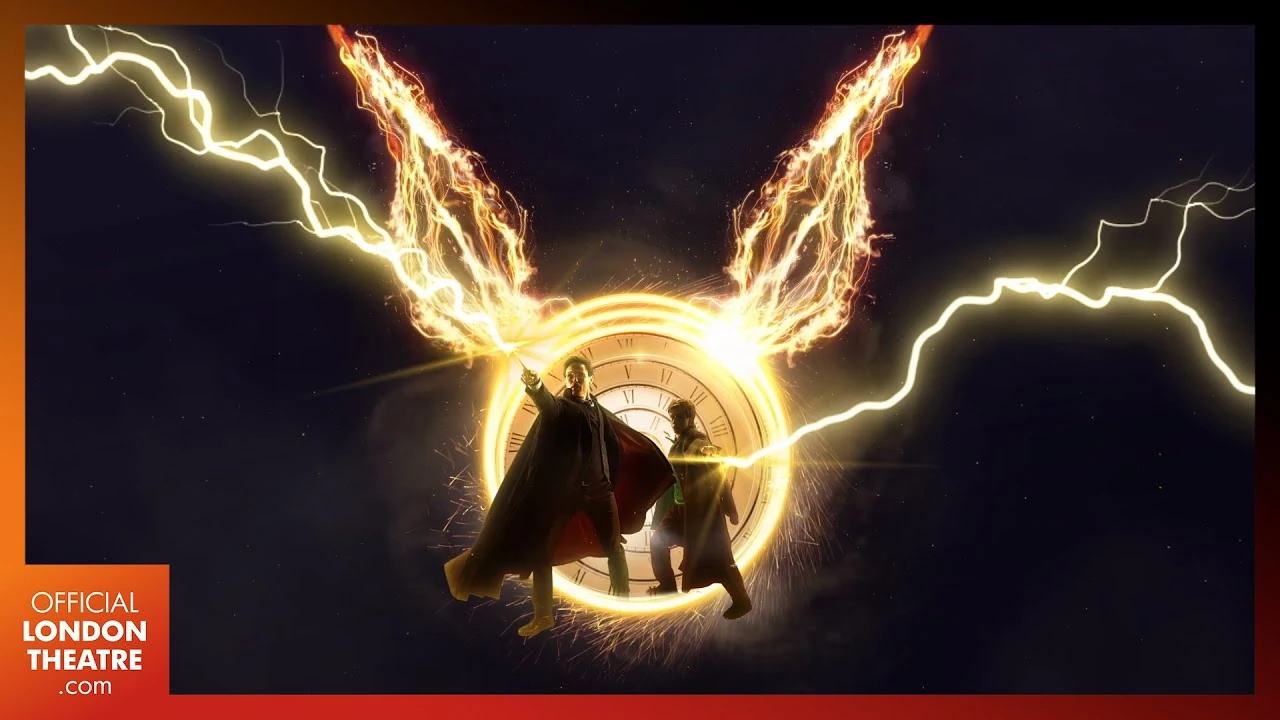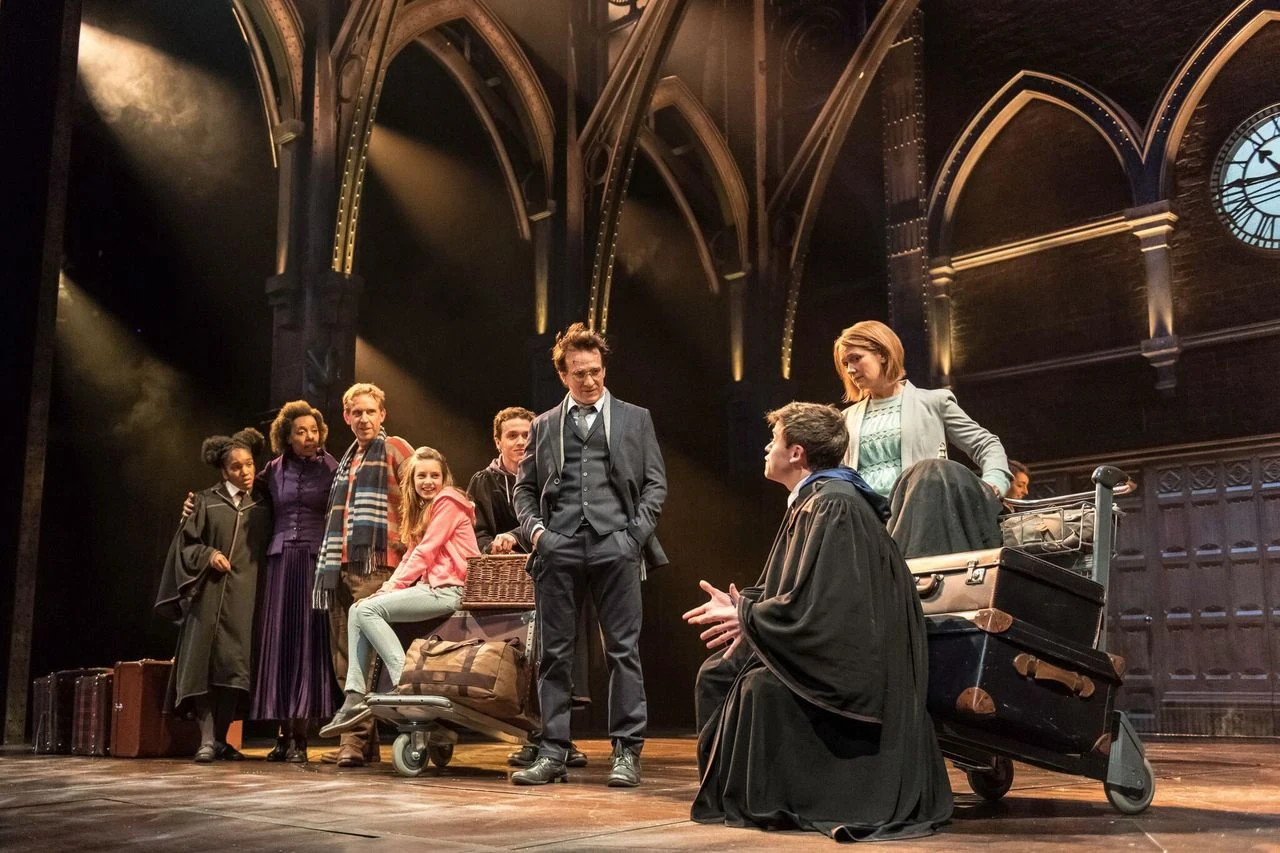
At the Palace Theatre in London, the world of Harry Potter moved from the page to the stage in a production built around a new generation. Harry Potter and the Cursed Child follows Albus Potter, Harry’s younger son, and his friendship with Scorpius Malfoy as they attempt to change the past. Its West End opening in 2016 brought a large-scale fantasy story to a British theatre stage, with illusion, movement and design central to the telling.
A new story, written for the stage
The play was written by Jack Thorne from an original story by Thorne, J. K. Rowling and John Tiffany. It is set 19 years after the events of Harry Potter and the Deathly Hallows, and takes up the lives of characters familiar from Rowling’s novels while placing their children at the centre of the action. Thorne is the playwright; Rowling and Tiffany joined him in developing the story.
Harry is now head of the Department of Magical Law Enforcement at the Ministry of Magic. His son Albus begins at Hogwarts under the weight of the Potter name and is sorted into Slytherin rather than the Gryffindor associated with his family. He befriends Scorpius, Draco Malfoy’s son. Both boys struggle with the stories others tell about their families, while the distance between Albus and Harry grows.
Their attempt to use a Time-Turner to prevent Cedric Diggory’s death becomes the play’s engine. Interference with the past produces altered versions of the present, including one in which Voldemort has won and Harry is dead. The boys’ actions force them to confront the consequences of changing history; the plot ultimately turns on their effort to restore the original timeline and on a gradual repair of the relationship between father and son.
That family conflict gives the fantasy its human scale. Albus is not simply trying to reproduce his father’s achievements: he wants to be understood on his own terms. Scorpius, meanwhile, faces suspicion attached to his family. Their friendship offers both boys a source of belonging, while their journey through alternative timelines tests the choices they make and the assumptions they inherit.
From Palace Theatre previews to opening night
The Palace Theatre was announced as the play’s home in 2015. Previews began there on 7 June 2016, before the official opening on 30 July. The initial production was presented in two parts, which could be seen on one day or over two evenings. This extended format gave the story room for multiple acts and a succession of changes in time and circumstance.
Jamie Parker played Harry Potter in the original West End cast, with Noma Dumezweni as Hermione Granger and Paul Thornley as Ron Weasley. Sam Clemmett played Albus and Anthony Boyle played Scorpius. Other members of the principal cast included Poppy Miller as Ginny Potter and Alex Price as Draco Malfoy. Dumezweni’s casting as Hermione prompted public discussion; Rowling responded that the novels had never specified Hermione’s skin as white. The original West End company numbered 42 actors.
John Tiffany directed the production, with Steven Hoggett as movement director and Christine Jones responsible for set design. Katrina Lindsay designed the costumes, Neil Austin the lighting, Gareth Fry the sound and Imogen Heap the music. Jamie Harrison created the illusions. Together, these contributions made theatrical technique part of the story’s appeal: stage magic was not merely decoration, but a means of presenting a world in which people can disappear, transform and travel through time.
The original cast gave its final performances in May 2017. The production’s run was interrupted in March 2020 when performances were suspended during the COVID-19 pandemic; it resumed in October 2021. The West End production continued in its two-part form after other productions had adopted shorter, single-part versions. The supplied Wikipedia article records a planned change in October 2026, when the West End production was due to reopen in one part. That future schedule is distinct from the play’s original format and opening.
A London production with an international life
The play’s theatrical model travelled well beyond London. A Broadway production opened at the Lyric Theatre in April 2018, followed by productions in Melbourne, San Francisco, Hamburg, Toronto and Tokyo. The work has also been staged in Dutch at The Hague. Versions have differed: the original two-part structure was revised into a single performance in several cities, with cuts and adjustments to suit the new format. The West End’s long continuation of the two-part version made London an important point of comparison as the play developed internationally.
The production’s route abroad demonstrates the practical demands of staging it. The Broadway theatre underwent renovation before the show arrived, while venues in Melbourne and Toronto were also adapted. These details reflect a work designed around more than its script: staging, auditorium and technical effects were integral to the experience. The play’s international reach is measurable in audience numbers as well as geography; the Wikipedia article reports that productions worldwide had sold more than six million tickets.
Its reception was not uniform. Critics often praised the performances, production and illusions, while responses among Harry Potter readers were more divided over the plot and its relationship to the novels. The original London production won nine Laurence Olivier Awards in 2017, including Best New Play, and received 11 nominations. The Broadway production later won six Tony Awards, including Best Play, from ten nominations. The awards recognised a range of work, from acting and direction to design and sound, rather than the story alone.
The script also reached readers in print. A Special Rehearsal Edition was published on 31 July 2016, followed by a revised Definitive Collector’s Edition in 2017. The book-form script allowed audiences who had not attended a performance to encounter the dialogue and stage directions, though reading it could not reproduce the production’s live effects. The distinction between text and performance became part of the play’s public life: it was both a continuation of a globally familiar fictional world and a theatrical work whose effects depended on actors, designers and technicians working in real time.
Why Harry Potter and the Cursed Child deserves a place in British Legacy
Harry Potter and the Cursed Child deserves a place in British Legacy because its first production was rooted in London theatre and made the West End the launch point for a major new chapter in a British-created fictional world. The Palace Theatre staging brought Jack Thorne’s writing together with John Tiffany’s direction and the work of a large creative team. Its nine Olivier Awards, including Best New Play, recognise the scale of that achievement across performance, direction, sound, lighting and design. The production’s illusions and movement were not incidental attractions: they helped translate time travel and magic into live theatre.
The play also shows how a London production can become an international theatrical undertaking without losing its connection to its original home. Productions in several countries adapted the staging and, in many cases, changed the two-part structure, while the West End retained that original form for years. More than six million tickets sold worldwide speak to the reach of the work, but the lasting British significance lies in the process behind that reach: a new stage story, made for performance, developed by writers, performers and theatre-makers, and launched at a historic London venue. Its mix of literary inheritance and practical stagecraft gives it a clear place in the story of contemporary British theatre.
Sources
Harry Potter and the Cursed Child · Harry Potter and the Cursed Child
Adapted in part from Harry Potter and the Cursed Child by Wikipedia contributors, under CC BY-SA 4.0. Text has been edited and combined with the existing article; this adapted text is shared under the same licence. Contributor history.