In Shakespeare’s Henry IV, Part 1, a kingdom under pressure is seen from three very different places: the king’s court, the rebels’ councils and the tavern where Prince Hal keeps company with Sir John Falstaff. Their stories converge at the Battle of Shrewsbury, where Hal kills the rebel Hotspur and begins to prove himself as a future ruler. Yet the play’s ending is no simple settlement. The battle checks the rebellion, but other opponents remain, leaving the conflict open for its continuation in Henry IV, Part 2.
A play of its own unsettled moment
Shakespeare probably wrote the play in the mid-1590s, during the later years of Elizabeth I’s reign. It was almost certainly being performed by 1597; the earliest recorded performance took place at court on 6 March 1600, before the Flemish ambassador. It was entered in the Stationers’ Register in February 1598 and printed in quarto later that year. Its repeated printings — new editions appeared in 1599, 1604, 1608, 1613, 1622, 1632, 1639 and 1692 — indicate an early and sustained readership.
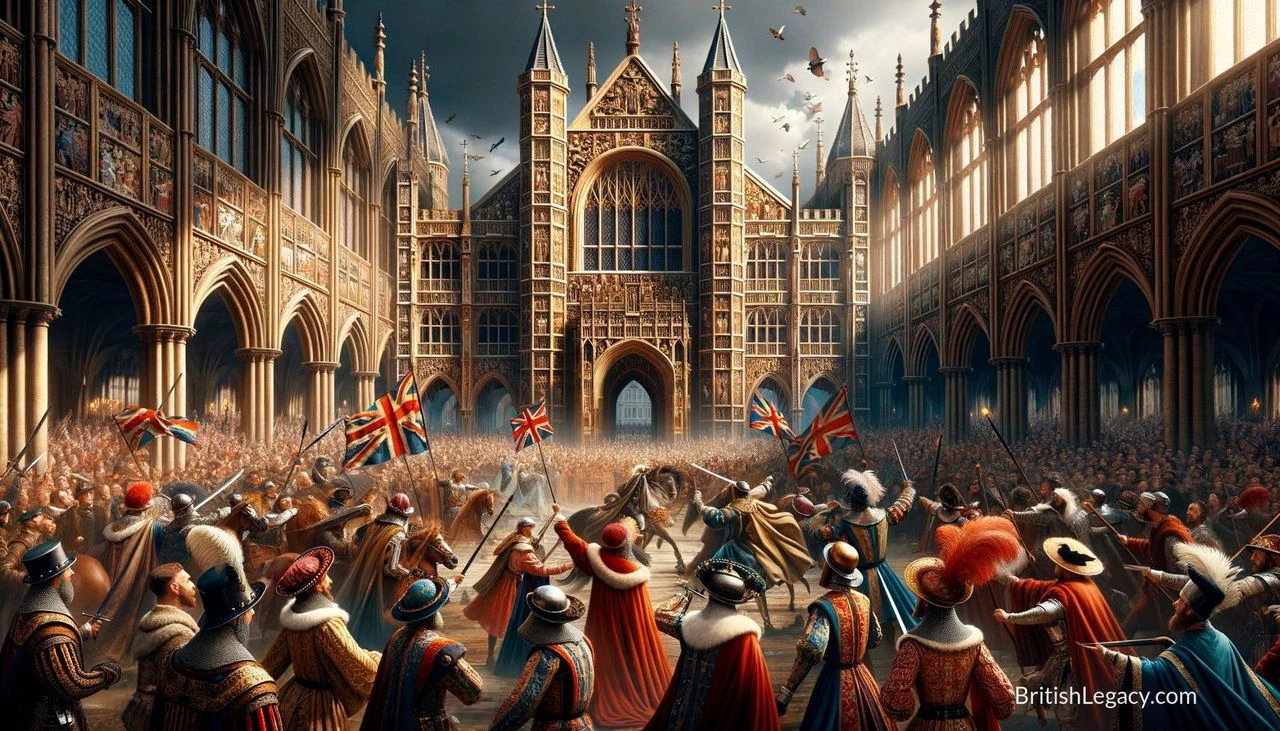
The action is set in England in the early fifteenth century, during the reign of Henry IV. The king’s hold on power is troubled by the memory of his usurpation of Richard II’s throne, conflict on the borders with Scotland and Wales, and growing opposition from the Percy family, who had helped him secure the crown. Shakespeare’s story of an older political crisis was written when questions of succession and stability were prominent in England. The play brings those concerns into focus through both the business of rule and the king’s unease about his heir.
Its source was principally the 1587 edition of Raphael Holinshed’s Chronicles, which drew in turn on Edward Hall’s account of the Lancaster and York families. The play is the first of Shakespeare’s two works about Henry IV and the second in the group of four history plays commonly called the Henriad, which follows the reigns of Richard II, Henry IV and Henry V.
Three worlds draw towards Shrewsbury
The play develops through three groups whose stories initially run alongside one another. At court, Henry IV and his advisers try to contain revolt. Among the rebels are the Percy family — Henry Percy, Earl of Northumberland; his brother Thomas Percy, Earl of Worcester; and Northumberland’s son, Harry Percy, known as Hotspur. Their allies include the Welsh rebel Owen Glendower, the Scottish Earl of Douglas and Edmund Mortimer.
The immediate dispute begins over prisoners and ransom. After fighting the Scots at Homildon Hill, Hotspur withholds hostages taken there, against the king’s orders. Henry, meanwhile, refuses to pay Glendower the ransom demanded for Mortimer, Hotspur’s brother-in-law. The quarrel deepens existing grievances against the king and draws the rebels together. The play presents an alliance with its own competing interests, rather than a single, uncomplicated challenge to the crown.
Hal’s circle belongs to Eastcheap and the Boar’s Head Tavern. The prince, Henry IV’s eldest son, spends time there with Falstaff, Poins, Bardolph and Peto instead of at court. Falstaff is a knight whose quick wit and appetite for pleasure make him a comic centre of the play; he is also cowardly, and his conduct exposes the distance between the language of honour and the realities of war. Hal takes part in a prank in which he and Poins disguise themselves and rob Falstaff after a highway robbery, so that they can hear him invent an account of what happened.
In a soliloquy, Hal explains that he does not intend to remain in this life indefinitely. He plans to return to court and surprise those who have judged him by his tavern companions. That explanation invites questions about whether his change is a genuine coming of age, a carefully timed public performance, or both. Hal’s conduct in the play moves towards a royal role, but it does not make the earlier scenes irrelevant: the tavern’s comic, sometimes unflattering perspective remains part of the political story.
Honour tested in battle and in comedy
As the rebellion grows, Hal reconciles with his father and receives command of an army. He vows to fight Hotspur, while Falstaff is ordered to recruit foot soldiers. Falstaff exploits the commission, taking bribes from men who want to avoid service and withholding the wages of the poor men he recruits. This subplot makes the costs of war visible beyond the claims of noble leaders.
At Shrewsbury, the opposing forces meet in a battle on which the rebellion’s prospects depend. Hal and Hotspur fight one another; Hal kills Hotspur in single combat. Falstaff, left alone during their encounter, pretends to be dead to escape Douglas. When he sees the field is clear, he wounds Hotspur’s corpse and claims the credit for the killing. Hal allows him to keep the claim. The episode turns an apparent act of generosity into another comic question about reputation, truth and the value attached to martial honour.
Falstaff’s reflection on honour sharpens that question. In his Act 5 soliloquy, he asks whether honour can heal a wound or restore a lost limb, and concludes that it is “a word” and “air”. His practical scepticism clashes with the heroic ideals associated with Hotspur and with the public expectations placed on Hal. The speech can be played as a pointed challenge to the pursuit of glory or as an expression of Falstaff’s cowardice; the play leaves room for both readings. Its comedy does not cancel the danger of the battle, but makes the language used to dignify that danger harder to accept without scrutiny.
The battle ends with a serious setback for the rebels, not the end of revolt. Henry plans to execute Worcester, formerly one of his closest allies. Hal shows mercy to Douglas, releasing him without ransom. The Archbishop of York and Northumberland remain opponents of the king, and their continued resistance carries the story into the next play. Hal has distinguished himself, but the political order is still contested.
Falstaff, the text and the stage
Falstaff’s name has a history of its own. Evidence in the surviving texts and in later accounts indicates that Shakespeare first called the character Oldcastle, after the historical John Oldcastle, a Protestant martyr with powerful living descendants. The name was changed to Falstaff, based on the historical Sir John Fastolf. The surviving play also includes an epilogue to Henry IV, Part 2 that explicitly distinguishes Falstaff from Oldcastle. The episode is a reminder that theatrical comedy could meet political and religious sensitivities outside the playhouse.
The play’s interpretation has also shifted. Its first title page advertised Henry Percy and the comic Sir John Falstaff, but not Prince Hal. For much of its performance history, Hotspur was often treated as the leading role; in the twentieth century, the coming-of-age account of Hal became more prominent. That shift draws attention to the play’s formal balance: the title’s king has relatively few scenes, while the court, rebel and tavern plots give the audience several competing views of authority and public identity.
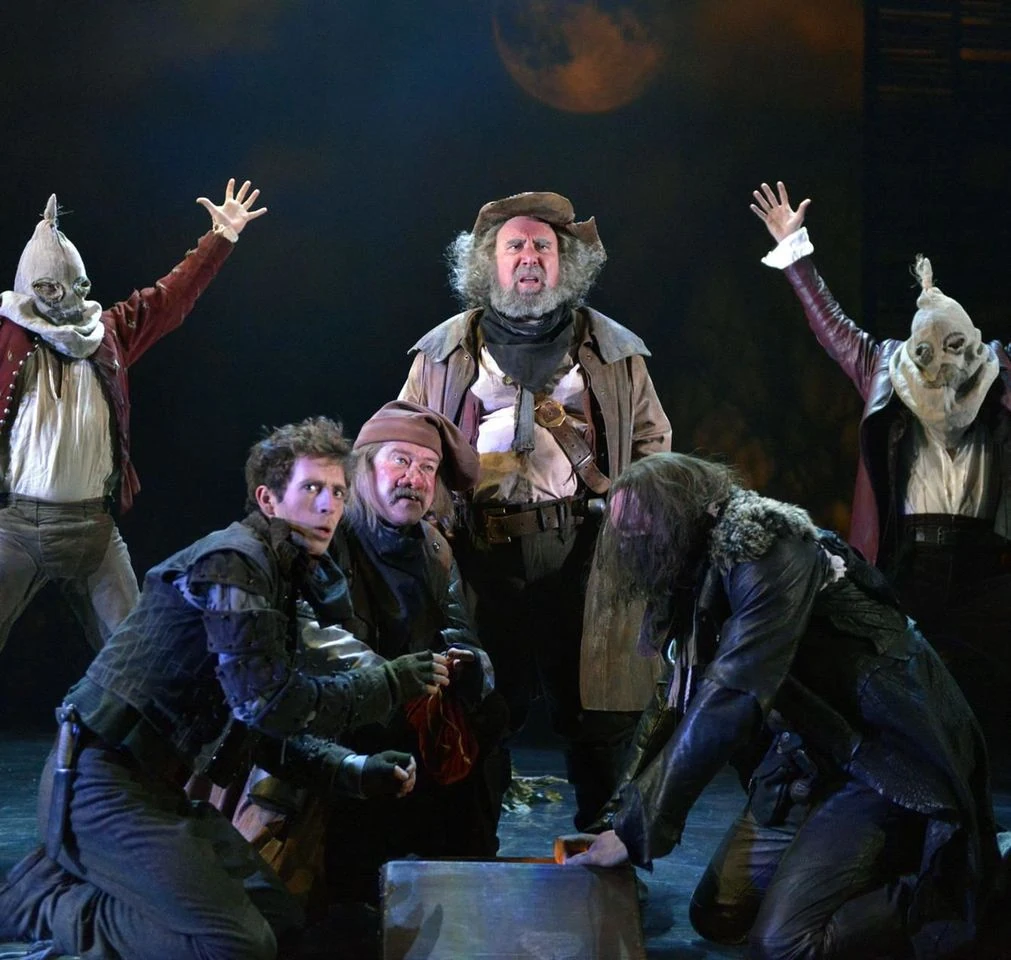
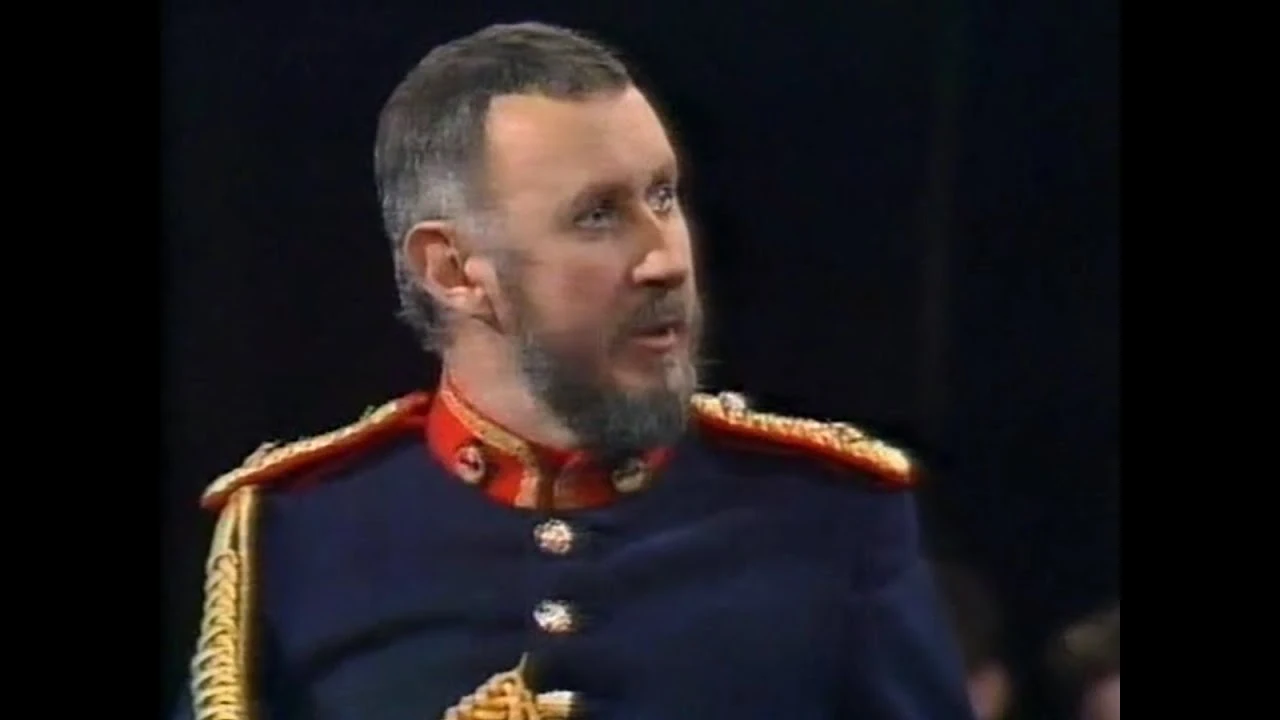
Stage and screen versions have continued to rearrange the material. BBC television produced An Age of Kings in 1960, a Shakespeare Plays version in 1979 and The Hollow Crown in 2012. Orson Welles’s film Chimes at Midnight (1965) condensed the two Henry IV plays and drew on other Shakespeare works. BBC Television likewise combined the two parts in its 1995 adaptation. In 2024, Robert Icke’s Player Kings, starring Ian McKellen as Falstaff, Toheeb Jimoh as Hal and Richard Coyle as Henry IV, played in London before touring the UK. These different versions demonstrate how directors and actors can change the balance between political crisis, Hal’s development and Falstaff’s comedy without losing the play’s central tensions.
Why Henry IV, Part 1 deserves a place in British Legacy
Henry IV, Part 1 belongs in British Legacy because it is a substantial work of English drama whose history is tied to both the theatre and the political questions of its time. Shakespeare turned an earlier English conflict into a play about the vulnerabilities of kingship, the costs of rebellion and the making of a public heir. Its early performance by 1597, court performance in 1600 and repeated quarto editions show that it mattered to audiences and readers in Shakespeare’s own era. Its continued presence on British stages, including the 2024 London run and UK tour of Player Kings, connects that history with present-day performance.
The play’s enduring value lies not in a single uncomplicated moral but in the way its parts challenge one another. Hal’s route towards responsibility unfolds beside Falstaff’s rejection of honour as an abstraction, while Falstaff’s lies and exploitation complicate any easy celebration of his wit. The rebels’ political grievances, the king’s need to preserve authority and the soldiers’ material hardship give the comedy serious company. By bringing these perspectives into one dramatic structure, Shakespeare made a story of English succession speak to questions that remain legible in performance: what makes leadership credible, how public reputation is fashioned, and who bears the consequences when rulers and nobles go to war.
Sources
Adapted in part from Henry IV, Part 1 by Wikipedia contributors, under CC BY-SA 4.0. Text has been edited and combined with the existing article; this adapted text is shared under the same licence. Contributor history.