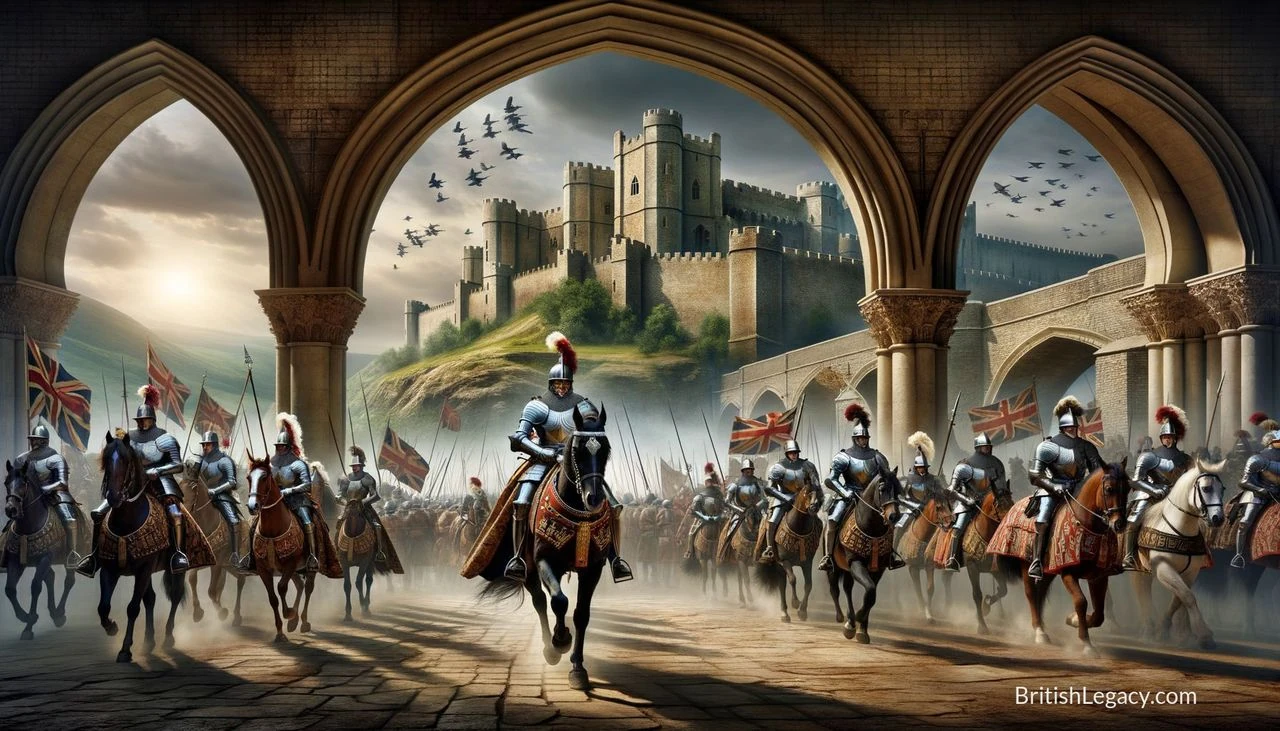
Shakespeare’s Henry V follows an English king’s campaign in France towards the Battle of Agincourt, but its drama is not confined to the battlefield. The king must justify his claim, command an exhausted army and turn a perilous expedition into a story his soldiers can share. Speeches such as “Once more unto the breach” and the St Crispin’s Day oration give the play its forceful public language; the scenes around them also keep attention on fear, fatigue and the human consequences of war.
A play shaped by history and performance
William Shakespeare wrote Henry V in the Elizabethan period. The play is generally believed to have been first performed in 1599, probably at the Globe Theatre in London, though the precise circumstances of its premiere are not established here. Shakespeare drew on historical chronicles, including Raphael Holinshed’s Chronicles of England, Scotland, and Ireland, for the historical framework. He made that material into theatre: the Chorus addresses the audience and supplies descriptions that bridge scenes and invite spectators to imagine events on a larger scale than the stage can show.
The story begins with a king presented as changed from the wayward young man seen in the earlier Henry IV plays. Now resolved to secure his rule, Henry pursues a claim to the French throne and prepares to invade. Political argument gives way to the campaign itself, but the play’s movement from court to battlefield keeps the question of authority in view: Henry must make his case, then persuade others to follow him into danger.
Harfleur, Agincourt and the king’s words
At the siege of Harfleur, Henry’s “Once more unto the breach” speech urges his troops into action. Later, on the eve of Agincourt, the St Crispin’s Day speech imagines a fellowship formed by the men who will share the battle. These addresses are often remembered as declarations of courage and unity. In the play, they also show a king using language to shape how his army understands its risks and its place in the campaign.
Agincourt is the dramatic climax. The English are depicted as tired and outnumbered as they face the French forces, and their victory follows Henry’s attempt to rally them. The play’s emphasis on daunting odds lends the battle its momentum, while its scenes before and around the fighting prevent the campaign from becoming only a pageant of triumph. The distinction matters: Shakespeare gives Henry the language of heroic leadership, yet places that language amid the danger and strain of war.
The ending shifts from combat to courtship, as Henry woos Catherine of Valois. Their prospective marriage suggests a path towards peace between England and France, though the play does not erase the violence that preceded it. The change of register—from battlefield exhortation to negotiation and courtship—makes the conclusion a political settlement as well as a personal one.
Reinterpretations on stage and screen
The play’s speeches and battle scenes have supported many later interpretations. Laurence Olivier’s 1944 film adaptation and Kenneth Branagh’s 1989 version carried Shakespeare’s account of the campaign to cinema audiences. Their different moments of release placed the story before new audiences and renewed attention to its language, its image of English military resolve and the costs that accompany it. Those adaptations are part of the play’s continuing cultural life, rather than proof that its meaning is fixed.
Henry V has also travelled beyond Britain through performances and adaptations around the world. Its St Crispin’s Day speech is often used as inspirational rhetoric, while the play’s wider themes of leadership, loyalty and national identity invite contrasting readings. The Chorus, Henry’s arguments for war and the portrayal of the soldiers leave room to question what the stirring speeches ask their listeners to accept.
The play has been associated with ideas of English identity, particularly during periods of conflict. Its use as a morale-boosting work during the Second World War is one example of how audiences have connected its language of endurance with their own circumstances. That history of reception sits alongside the play itself: a work written in Elizabethan England, drawing on chronicle history, and repeatedly reinterpreted for later stages, screens and political moments.
Why Henry V deserves a place in British Legacy
Henry V belongs in British Legacy because it is a major work of English theatre that has helped successive audiences examine kingship, war and national identity. Shakespeare builds its campaign around recognisable dramatic episodes—the siege of Harfleur, the night before Agincourt and the battle itself—while giving those events a distinctive theatrical form through the Chorus and the king’s speeches. The play’s language has lasted beyond its original setting: “Once more unto the breach” and the St Crispin’s Day oration remain among its best-known passages.
Its legacy is not simply an image of English victory. The tension between inspiring rhetoric and the danger faced by the soldiers gives performers and audiences material to celebrate, question or reinterpret. The Olivier and Branagh film adaptations, its international performance history and its reported use as a morale-boosting work during the Second World War show how the play has been repeatedly put to new purposes. That continuing life—rooted in Shakespeare’s English history play, but open to changing readings of leadership and conflict—is a specific contribution to Britain’s theatrical and cultural inheritance.