In Henry VI, Part 1, military defeat abroad and rivalry at home feed the same crisis. Shakespeare’s history play begins with the death of Henry V and the loss of English positions in France. As the young Henry VI inherits the crown, his nobles quarrel over influence; across the Channel, Joan of Arc leads the French resistance. The result is not a straightforward celebration of English victory, but a drama in which faction and personal ambition help undo the legacy of the dead king.
A play with an uncertain beginning
The play is usually called Henry VI, Part 1, or 1 Henry VI, and is associated with William Shakespeare. Its authorship is disputed: some scholars regard it as a collaboration involving Thomas Nashe and other dramatists, while others have argued for Shakespeare alone or for different divisions of responsibility. In 2016, Oxford University Press credited Christopher Marlowe alongside Shakespeare for the three Henry VI plays in its New Oxford Shakespeare series; its attribution for this play also named Nashe and an anonymous writer, with Shakespeare as adapter. The evidence does not settle the debate, so the play is best understood as a work whose authorship remains contested.
A performance record offers a firmer point in its early history. Philip Henslowe’s diary records a play called Harey Vj at the Rose Theatre in Southwark on 3 March 1592. It was performed 15 times and earned £3 16s 8d. The identification with Henry VI, Part 1 is widely accepted, though the possibility that Henslowe meant a now-lost play has not been entirely excluded. If the identification is right, the play was on stage as a new work by March 1592 and was probably written in 1591.
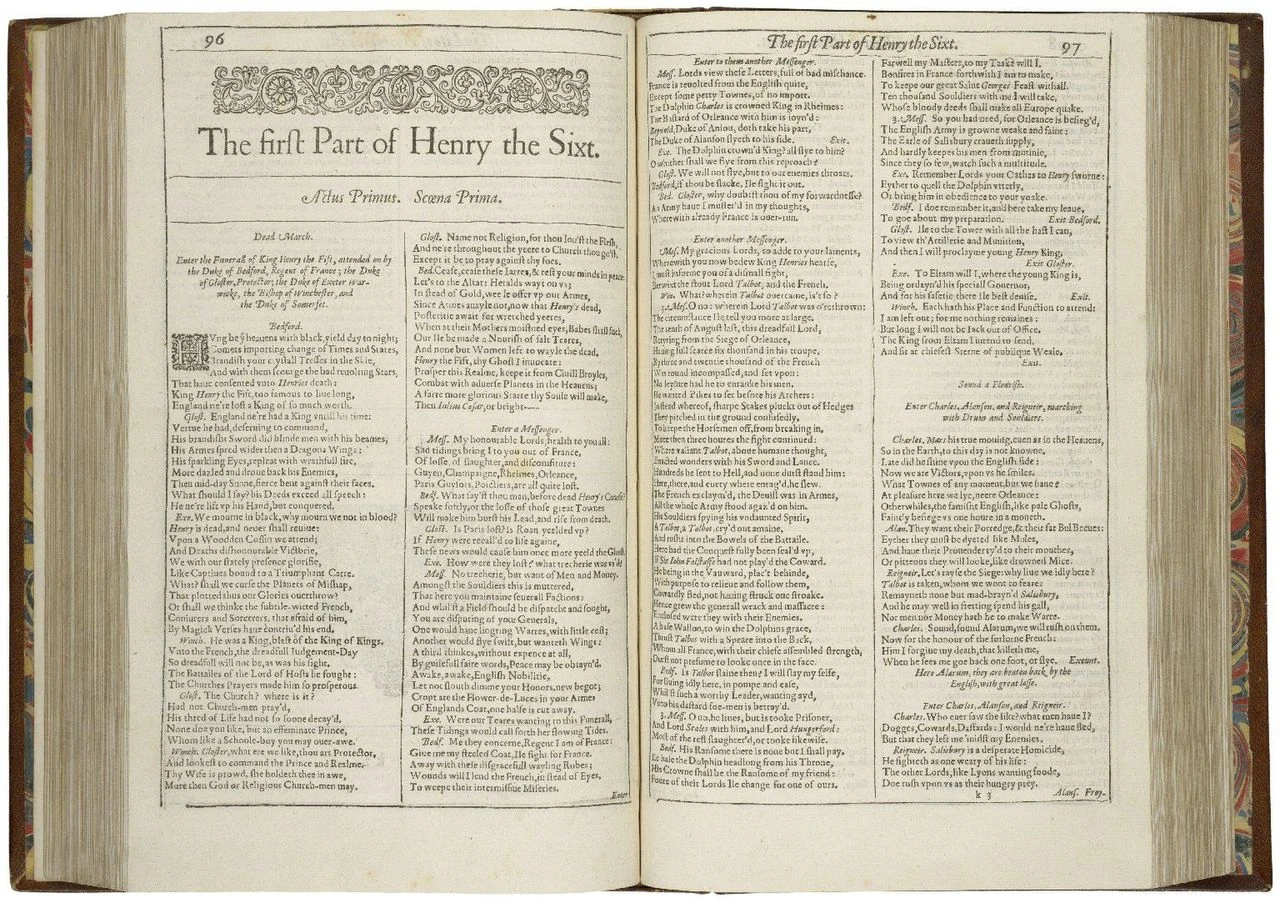
Performance evidence does not, however, tell us the order in which Shakespeare and his collaborators composed the three plays. Some scholars argue that Part 1 came first, while others think it followed Part 2 and Part 3. The text was not published until the 1623 First Folio, under the title The first part of Henry the Sixt; when it acquired the familiar “Part 1” title is uncertain.
France lost, England divided
The opening funeral for Henry V quickly gives way to reports of English setbacks in France. His brothers, the Dukes of Bedford and Gloucester, and their uncle Exeter face a kingdom whose young king has yet to take control. Bedford leaves to command the army; Gloucester remains in England; Exeter prepares Henry for his coronation. In Orléans, the French leader Charles summons Joan la Pucelle, who says that visions have shown her how to defeat the English. After she wins a single combat against him, Charles gives her command of his forces.
Joan’s first successes and the English recovery of Orléans establish a pattern of reversals. The play follows fighting around Orléans and Rouen, and later the English fail to send the reinforcements Talbot needs at Bordeaux. Richard Plantagenet and the Duke of Somerset are so absorbed in their rivalry that each suspects the other of responsibility for the confused orders. Talbot and his son die in the resulting defeat. The action gives military loss a political cause: the English are not merely beaten by an opponent but weakened by divisions among their own leaders.
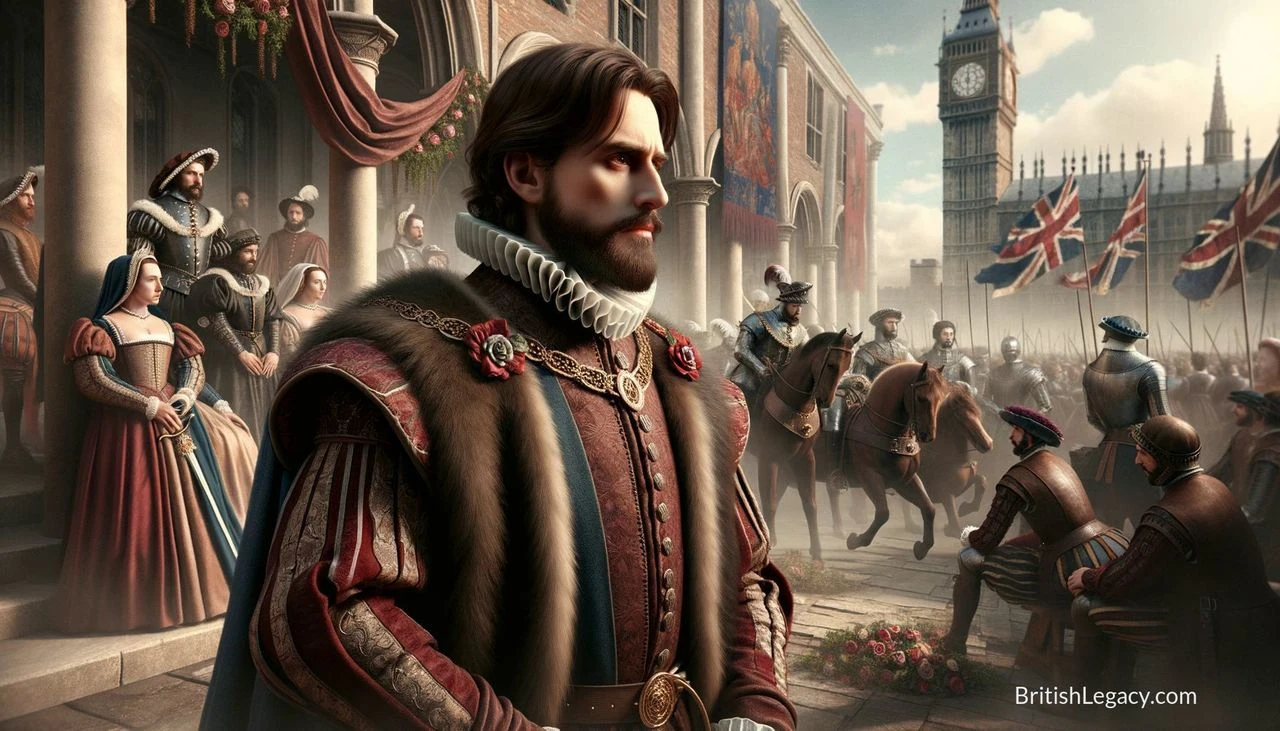
That rivalry acquires its enduring emblem in the Temple Garden scene. Richard and Somerset ask the assembled nobles to choose between them by selecting a white or red rose. The colours come to stand for York and Lancaster. Henry chooses a red rose, unaware of the divisions his gesture signifies. The later Wars of the Roses are not yet fully under way, but the play makes visible the competing allegiances that will carry the conflict forward through the next two plays.
Meanwhile, Joan persuades the Duke of Burgundy, who had fought for the English, to join the French. Eventually captured, she is condemned by the English. Her shifting portrayal is part of the play’s difficulty and interest: the French regard her as a saviour, while the English call her a witch. At her trial and execution, the language of supernatural power and saintliness gives way to a desperate attempt to escape death. Her fate, like Talbot’s, is shaped by the conflict around her rather than by a simple division between heroes and villains.
The play closes not with a settlement, but with arrangements that point towards further disorder. Suffolk has captured Margaret of Anjou and wants her to marry Henry, hoping to gain influence through her. Gloucester advises against the match, but Henry agrees after hearing Suffolk’s praise of Margaret. The French terms for peace are accepted reluctantly and with an intention to break them. The ending therefore leaves both the political and military conflicts unsettled.
History made for the stage
Shakespeare’s principal historical sources for the play were Edward Hall’s The Union of the Two Noble and Illustre Families of Lancaster and York (1548) and Raphael Holinshed’s Chronicles (1577; second edition 1587). The play’s account is not a neutral chronicle: its historical material is selected and reshaped into conflict among rival families, military leaders and competing claims to authority. The trilogy’s broader sequence, often grouped with Richard III, follows the dynastic story from the death of Henry V in 1422 to Henry VII’s accession in 1485.
The play’s mixture of battle, political argument and supernatural accusation has prompted very different critical responses. Its many on-stage fights and violent deaths led some critics to regard it as crude or immature; others have defended the spectacle as a way of bringing history and martial action before a public audience. The play also draws attention to language itself: speeches persuade, insults attack, and public declarations can conceal private intentions. In the rose scene, a silent choice communicates what the nobles will not say aloud. That tension between words, gestures and political consequences gives the play’s factional conflict a theatrical form.
Its theatre history has included both standalone performances and adaptations that reshape the trilogy. A definite performance at Covent Garden in 1738 is recorded; the next certain English performance came in 1906, at the Shakespeare Memorial Theatre in a production of the two history tetralogies. In 1953, Birmingham Repertory Theatre staged the play after productions of the other two parts. Judi Dench played Joan in that production.
Later productions have made the play’s place within a larger history cycle central to their approach. In 1977, Terry Hands presented all three Henry VI plays at the Royal Shakespeare Theatre, with Alan Howard as Henry and Helen Mirren as Margaret. The Royal Shakespeare Company’s 2000 history cycle, directed by Michael Boyd, formed part of an eight-play sequence; the company revived the cycle in 2006. These productions show how the play can be staged both as an account of events in France and as the opening movement of a longer story about power and civil conflict.
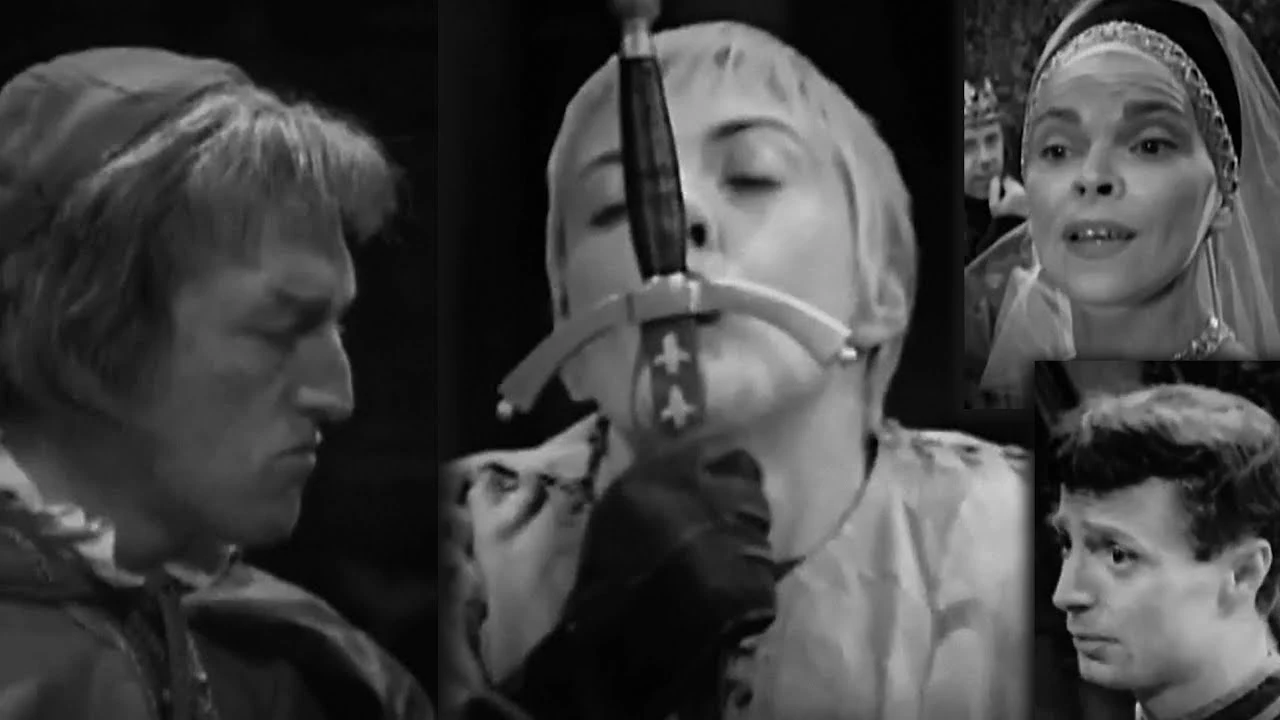
Television brought the play to another audience. The BBC’s 1960 serial An Age of Kings included an abridged episode, “The Red Rose and the White”. Jane Howell’s BBC Television Shakespeare production, made in 1981 and broadcast in 1983, placed it first in a linked adaptation of the four-play history sequence. Howell and designer Oliver Bayldon set the plays in a children’s adventure-playground setting, making the rivalry and political disorder visible without aiming for historical realism. The production’s approach treated the history not as a closed past but as theatre capable of prompting reflection on political conflict.
Why Henry VI, Part 1 deserves a place in British Legacy
Henry VI, Part 1 deserves a place in British Legacy because it turns a period of English history into a drama about how political division can compound military failure. Its account of the losses in France is bound to the quarrel between Richard and Somerset; the rose-picking scene gives that rivalry a memorable theatrical sign, while also preparing audiences for the Yorkist and Lancastrian struggle that continues through the trilogy. The play’s importance is not that it offers a straightforward record of events, but that it shows history being shaped into an argument about authority, faction and the consequences of choices made at court.
Its continuing British theatrical life is part of that legacy. The Rose Theatre performance recorded in 1592 connects the play with the London stage of Shakespeare’s time, while later performances at Covent Garden, the Shakespeare Memorial Theatre, Birmingham Repertory Theatre and the Royal Shakespeare Theatre show its return to British stages across centuries. BBC adaptations further carried the history play into television, where Jane Howell’s playground setting made its rivalries legible in a new medium. The play’s disputed authorship and uncertain compositional order also matter: they remind us that the early history of Shakespearean drama was collaborative and that its texts invite debate. Through performance, adaptation and argument, Henry VI, Part 1 remains a British work of theatre that makes political history something audiences can watch, question and revisit.
Sources
Henry VI, Part 1 — revision 1360463137
Adapted in part from Henry VI, Part 1 by Wikipedia contributors, under CC BY-SA 4.0. Text has been edited and combined with the existing article; this adapted text is shared under the same licence. Contributor history.