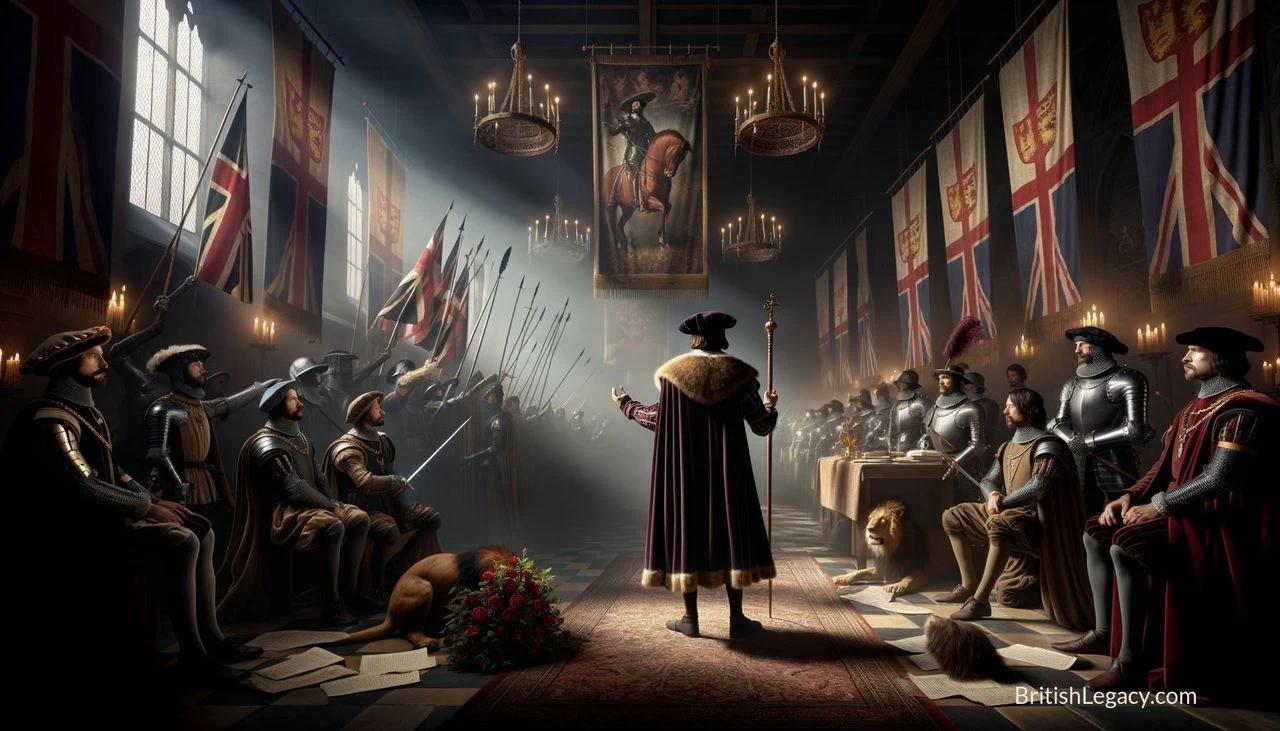
In Henry VI, Part 2, the kingdom does not collapse in a single stroke. It comes apart through rival claims, compromised justice and a king unable to command the loyalty of his court. William Shakespeare sets the play amid England’s dynastic struggle between Lancaster and York, moving from the marriage of Henry VI and Margaret of Anjou to the first Battle of St Albans. Along the way, the murder of the popular Duke of Gloucester and Jack Cade’s rebellion expose disorder both at court and among the people.
A history play between three parts
The play belongs to Shakespeare’s sequence of histories about the Wars of the Roses. Together, Henry VI, Part 1, Henry VI, Part 2, Henry VI, Part 3 and Richard III trace a dynastic conflict through the changing fortunes of the English throne. The events dramatised in Part 2 include the death of Henry’s trusted adviser Humphrey, Duke of Gloucester, the political rise of Richard, Duke of York, and the outbreak of fighting at St Albans in 1455.
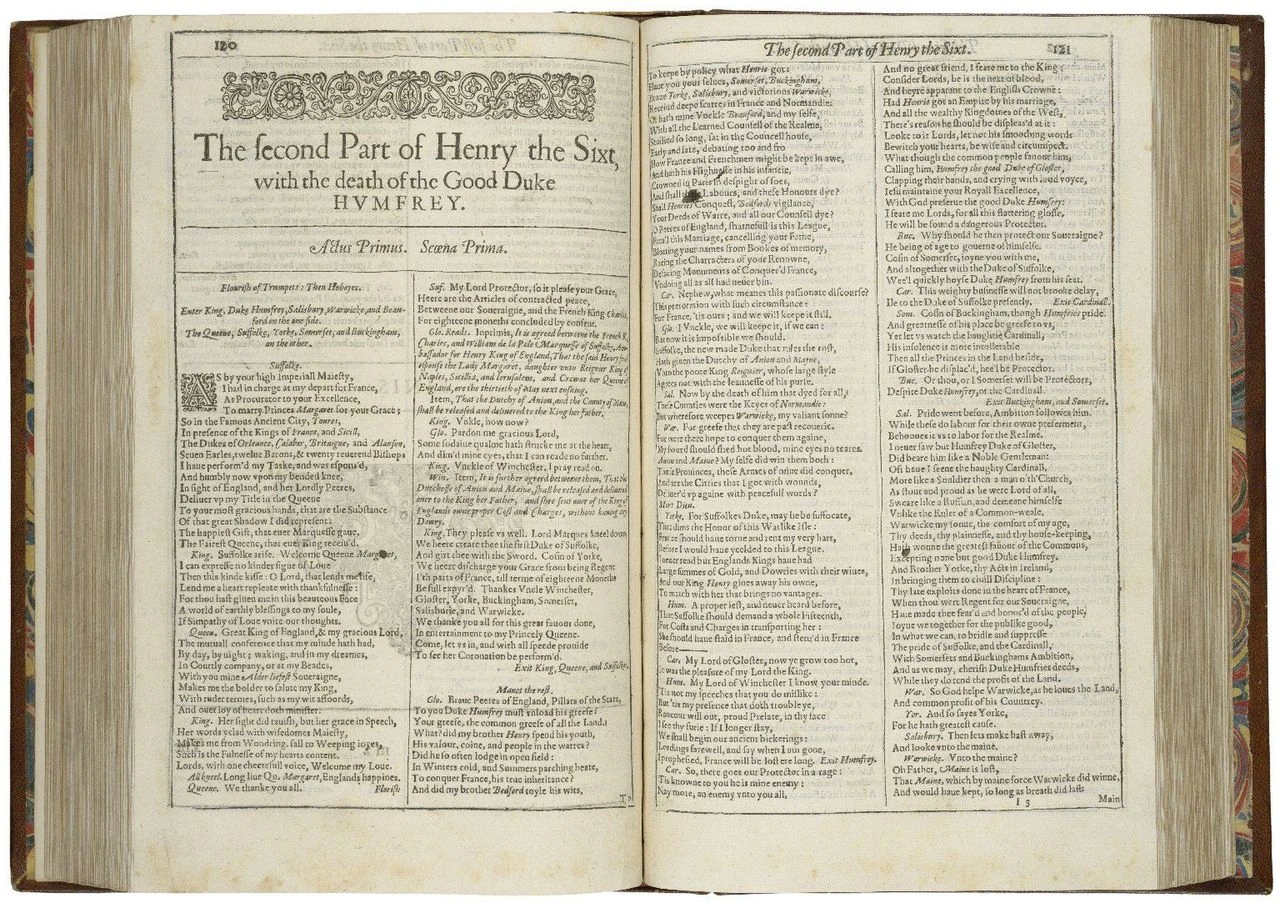
The play’s date is not entirely straightforward. A version titled The First part of the Contention betwixt the two famous Houses of Yorke and Lancaster was entered in the Stationers’ Register in 1594 and printed that year. The text now known as Henry VI, Part 2 appeared in the 1623 First Folio, under the title The second Part of Henry the Sixt, with the death of the Good Duke Humfrey. The relationship between the earlier quarto, commonly called The Contention, and the Folio play has been debated: it has been read as a reported version of a performance, an earlier draft, or a text that combines elements of both. Evidence that the sequel was on stage by 1592 supports a likely date of composition around 1591 or 1592, rather than establishing a precise premiere date.
For its account of English history, Shakespeare drew on chronicles including Edward Hall’s The Union of the Two Noble and Illustre Families of Lancaster and York and Raphael Holinshed’s Chronicles. The play reshapes its material for the stage. In particular, it brings Cade’s rebellion, York’s return from Ireland and the Battle of St Albans into a tightly connected dramatic sequence, although the historical events unfolded over a longer period.
Gloucester’s fall and York’s ambition
The opening brings Margaret to court as Henry’s queen, but the marriage is already entangled in factional politics. William de la Pole, Earl of Suffolk, has helped arrange the match and seeks influence through Margaret. Humphrey, Duke of Gloucester, Henry’s uncle and Lord Protector, stands in their way: he is trusted by the king and popular with the people. Suffolk and his allies work to discredit him, while Gloucester’s wife, Eleanor, is arrested after becoming involved in a scheme involving necromancy.
Gloucester is accused of treason and imprisoned. Before he can face trial, Suffolk arranges his murder. His death is a decisive breach in the kingdom’s already fragile order: those who wield power have not merely defeated a political opponent but bypassed the law. The Cardinal of Winchester later dies after falling ill, while Suffolk is banished and killed by pirates. Margaret receives news of Suffolk’s death in the form of his severed head, one of the play’s stark reminders of how political conflict becomes personal grief and bodily violence.
As these events unfold, York prepares his own challenge to Henry. He tells the Earls of Salisbury and Warwick of his claim to the throne and wins their support. Before leaving to command an army in Ireland, he arranges for Jack Cade to lead a popular rising. Cade’s rebellion allows York to test whether the people might support a wider move against the king. Cade briefly takes control in London, but Lord Clifford persuades his followers to abandon him. Cade escapes and is later killed by Alexander Iden.
York returns to England with an army, claiming that he wants to protect Henry from the Duke of Somerset. When Somerset is found free rather than imprisoned as York expected, York openly advances his claim. The nobility divide between the houses of York and Lancaster. At St Albans, York’s son Richard kills Somerset, while Clifford is killed by York. Henry flees the battlefield with Margaret; York and his allies set out in pursuit. The ending carries the conflict directly into Henry VI, Part 3.
Power, justice and the common people
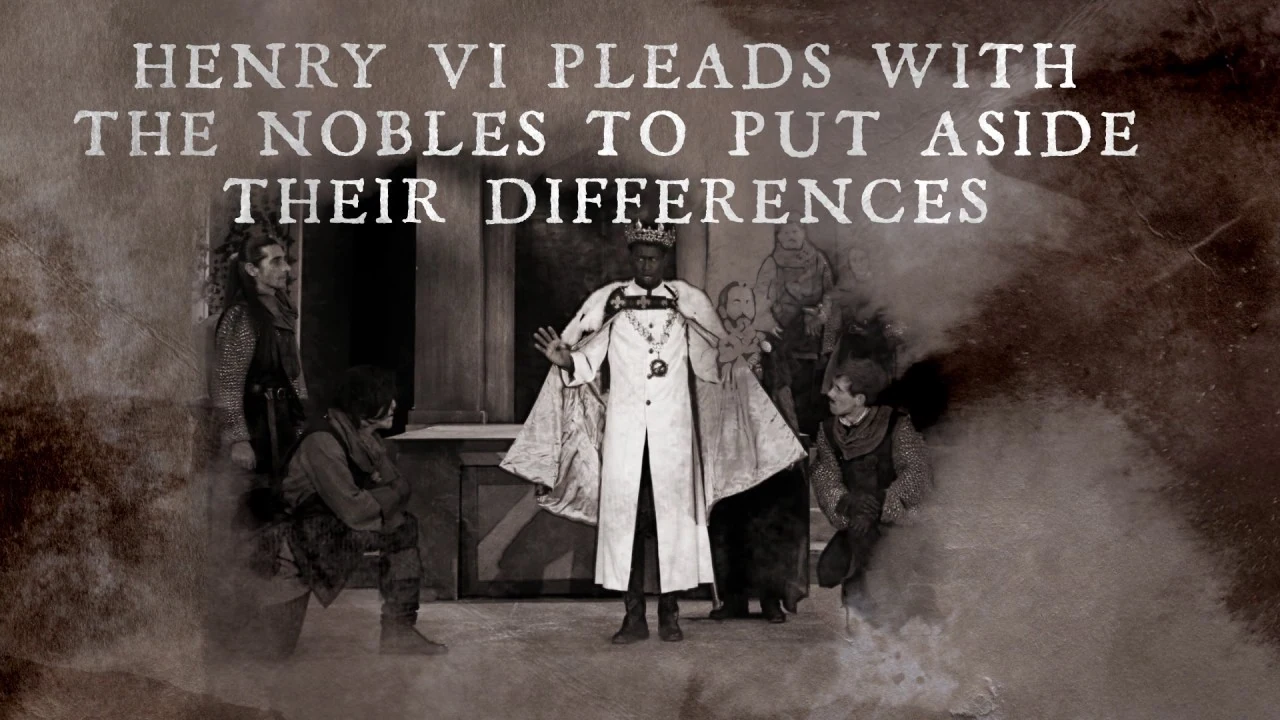
Henry is depicted as religious and compassionate, but those qualities do not make him an effective ruler. He cannot reconcile his nobles or hold his court to account. He consents to Gloucester’s imprisonment despite believing him innocent, then grieves when he can no longer help him. The contrast between the king’s Christian ideals and the ambitions around him gives the play one of its central tensions: private goodness offers little protection when institutions of justice are manipulated by those seeking power.
The play tests justice at several levels. Gloucester is killed before he can be tried; Cade’s rebellion turns against officials and the legal order; and Cade’s sidekick Dick the Butcher declares, “the first thing we do, let’s kill all the lawyers”. The line belongs to a wider portrayal of law under pressure, not a simple verdict on the legal profession. Among the nobles and the rebels alike, force and self-interest repeatedly displace fair process.
Shakespeare also distinguishes the court from the commons through changes in speech. Courtly characters often speak in formal verse, while Cade’s followers tend towards prose. As Cade gains authority, he adopts the language of command, including the royal “we”. That shift makes his rebellion more than an interlude in the aristocratic contest: it shows how quickly resistance to a corrupt order can reproduce its appetite for domination. The play’s most sustained contrasts include Henry’s piety against Margaret’s political force, and the claims of justice against the violence used to secure power.
On stage, on screen and in translation
The play has been performed both alone and as part of Shakespeare’s larger history cycle. The first recorded post-Restoration performance of the complete play took place at London’s Surrey Theatre in 1864. In the twentieth century, Douglas Seale directed it at Birmingham Repertory Theatre in 1951, followed by the other two Henry VI plays. Terry Hands’s Royal Shakespeare Company production of 1977 presented the trilogy with Alan Howard as Henry and Helen Mirren as Margaret.
Michael Boyd’s RSC history cycle brought the play together with five other histories in This England: The Histories, first staged in 2000 and revived in 2006. The production treated the eight plays as a connected sequence; its version of Part 2 was also presented under the title England’s Fall. In 2012, the Globe to Globe Festival included a production by Albania’s National Theatre, directed by Adonis Filipi. These examples show how directors and companies have placed the play in different contexts: as one part of a long national chronicle, or as a drama whose civil conflict can speak to other histories of political violence.
Television brought the history plays to a wider audience. The BBC’s An Age of Kings adapted the sequence in 1960. A later BBC production, directed by Jane Howell for the Television Shakespeare series, used a children’s adventure-playground set for the first tetralogy. The artificial setting, changing costumes and deliberate doubling of actors made social breakdown visible as the sequence progressed. Its Henry VI, Part 2 was based on the Folio text, though it also made cuts and changes. Radio adaptations, including BBC broadcasts across several decades, further carried the plays beyond the theatre.
Why Henry VI, Part 2 deserves a place in British Legacy
Henry VI, Part 2 deserves a place in British Legacy because it turns a particular English dynastic crisis into a sustained examination of how political authority fails. Its movement from Henry’s marriage to the deaths of Gloucester and Suffolk, Cade’s rising and the battle at St Albans links private ambition to public disorder. The play does not present rebellion as an uncomplicated remedy: Cade challenges the existing order, yet his rule becomes coercive too. That perspective gives the drama more substance than a procession of rival claimants. It asks what happens to justice when leaders treat institutions as tools, and what follows when confidence in those institutions breaks down.
Its legacy also lies in the continuing work of British theatre and broadcasting. Productions by the Royal Shakespeare Company, the Birmingham Repertory Theatre, the Globe and the BBC have repeatedly returned to the play, sometimes as a complete drama and sometimes within the wider history cycle. Each form has offered new ways to stage its crowded politics and make its changing fortunes legible to audiences. The play’s English historical setting is not, on its own, a claim to national importance; its contribution is the durable dramatic language it gives to questions of power, accountability and social fracture. Through performance, adaptation and debate over its changing texts, Henry VI, Part 2 remains part of Britain’s living theatrical inheritance.
Sources
Henry VI, Part 2 — Wikipedia revision 1364346081
Adapted in part from Henry VI, Part 2 by Wikipedia contributors, under CC BY-SA 4.0. Text has been edited and combined with the existing article; this adapted text is shared under the same licence. Contributor history.