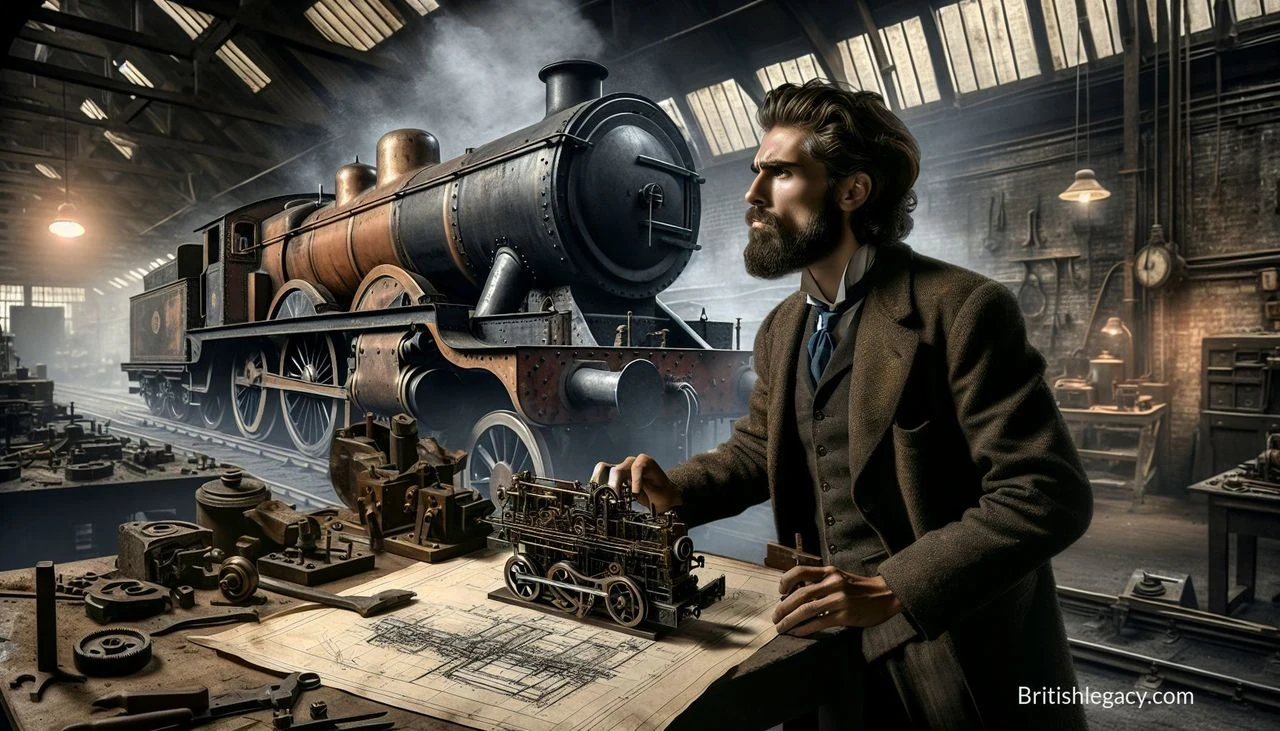
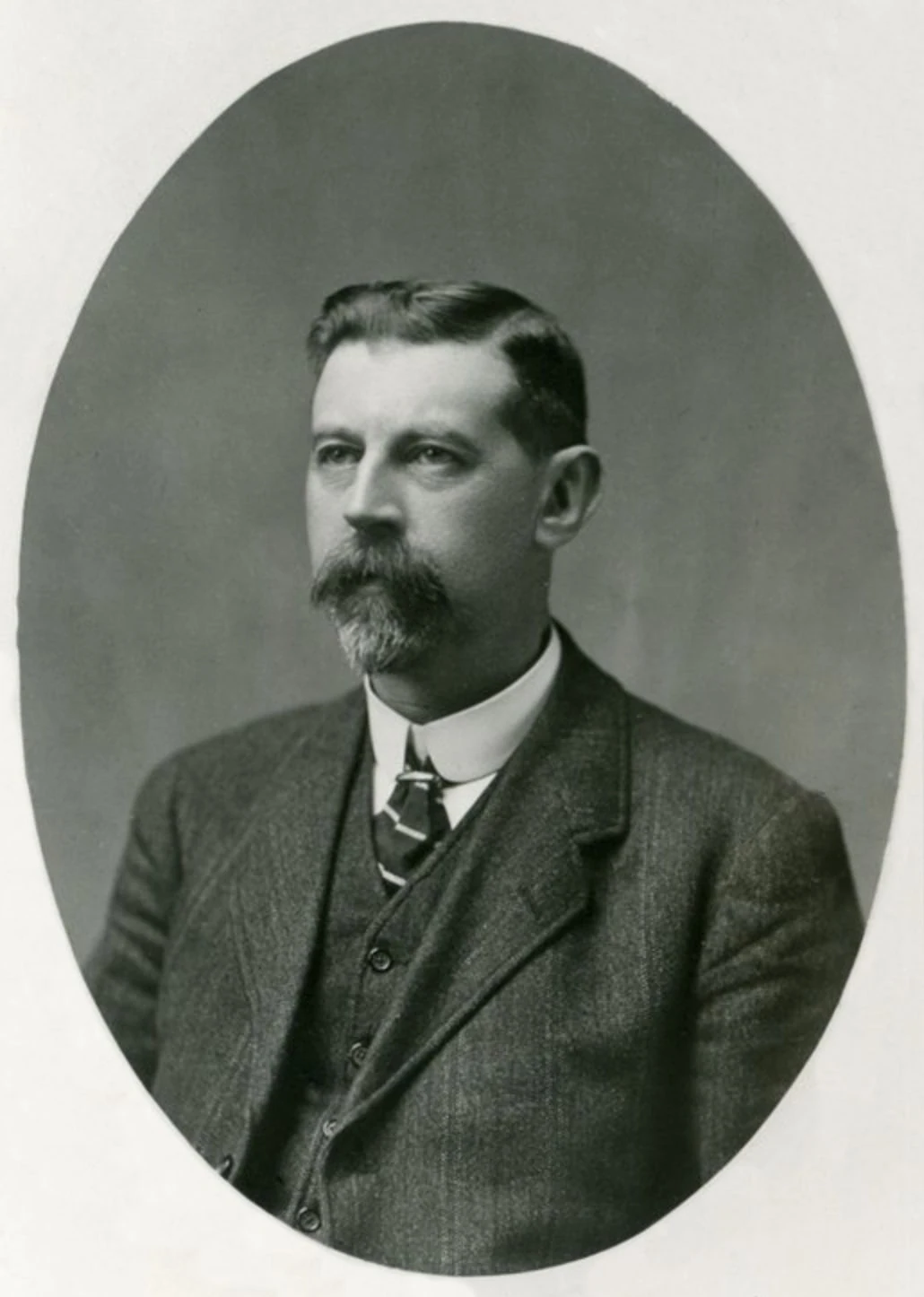
Herbert William Garratt’s name travelled further than he did. The articulated steam locomotive he designed was used across Africa, South America, South-east Asia, Australia and New Zealand, where difficult terrain and lightly built railway lines often made conventional engines a poor fit. His achievement was not to invent articulation itself, but to arrange a locomotive’s boiler, engine units and supplies in a way that made power and flexibility work together.
Born in London in 1864, Garratt learnt his trade on British railways and in engineering works before taking posts overseas. His design answered a problem he had encountered in different railway systems: how to move heavier trains over routes constrained by sharp curves, limited track capacity and the cost of major reconstruction. Patented in 1908, the Garratt locomotive gave railways another way to meet those constraints. Its first example, K1, was built in Manchester in 1909; today, the preserved locomotive offers a direct link between Garratt’s British engineering career and the design’s international reach.
Learning the work in Britain and abroad
Garratt’s engineering education began at the Bow works of the North London Railway. From 1879 to 1882, he served an apprenticeship under John Carter Park, the railway’s locomotive superintendent. He then gained experience at Doxford’s marine engineering works in Sunderland and worked as an inspector for Sir Charles Fox and Sir Alexander Rendel. These posts took him through different settings for engineering work, from railway locomotives to marine machinery and the inspection of designs.
In 1889, Garratt joined the Argentine Central Railway. He became its Locomotive Superintendent in 1892. Between 1900 and 1906, he worked for railways in Cuba, Lagos and Lima. The range of these appointments matters to the story of his later invention: he did not encounter railway engineering only through one British network. He worked in places where route conditions and available infrastructure could differ, and where adapting equipment to a railway’s limits was a practical concern.
Garratt was elected to membership of the Institution of Mechanical Engineers in 1902. In 1906, he returned to England and took a position inspecting locomotives built for the New South Wales Government Railways by British manufacturers. His career therefore connected practical railway work overseas with British engineering institutions and production. It also placed him in a position to see both the needs of railway operators and the capabilities of manufacturers.
The earlier imported account says Garratt became Locomotive Superintendent for the Carriage and Wagon Department of the Sierra Leone Government Railways. That appointment is not supported by the supplied Wikipedia text, which instead records his work for railways in Cuba, Lagos and Lima from 1900 to 1906. This feature does not repeat the unsupported Sierra Leone claim.
The constraints of a conventional locomotive
Railways could not always solve a demand for more capacity by laying heavier track or rebuilding bridges and curves. Such work could be costly, particularly on routes built with limited load-bearing capacity. A conventional locomotive also faced a design trade-off: a larger boiler and firebox could make more steam, but the added size and weight were difficult to accommodate on a restricted line. A long, rigid wheelbase could be awkward on tight curves, while concentrating too much weight risked damaging the rails.
Garratt’s design addressed these problems by changing the arrangement of the locomotive. It did not depend on the general idea of articulation being new. Earlier articulated systems existed, and the patent acknowledged previous double-bogie types. The distinctive contribution was a particular combination: a boiler with powered engine units at both ends, designed to provide substantial steaming capacity while allowing the locomotive to negotiate curves and spread its weight.
On a Garratt, the boiler and cab sat on a central frame between the two engine units, supported on pivots. The units at either end carried the coal and water supplies as well as the locomotive’s powered running gear. Instead of placing the whole arrangement on one long, rigid chassis, the design divided it into parts that could move in relation to one another. This articulation generally allowed Garratts to traverse sharper curves than comparable non-articulated locomotives.
Weight distribution was another important part of the design. Garratts commonly spread their weight across 12 to 16 driving wheels and 8 to 16 non-driving wheels, according to the supplied Wikipedia account. Spreading a locomotive’s weight over more wheels helped reduce destructive forces on lightly built rails. The arrangement did not make the condition of a route irrelevant, but it could make a more powerful locomotive practical where track capacity limited the alternatives.
The space available for the firebox also mattered. On a conventional locomotive, the firebox was restricted by the space between the frames. In the Garratt arrangement, the space beneath the central bridge between the engine units could allow a larger firebox, particularly valuable on narrow-gauge railways. A larger firebox could generate more steam, which in turn supported greater power. The design thus brought together flexibility, weight distribution and the capacity to make steam: linked advantages, rather than a single mechanical trick.
A patent becomes a manufactured locomotive
Garratt was granted a patent for the design in 1908. Beyer, Peacock & Company bought the sole rights of manufacture in Britain. The Manchester company provided a manufacturing base for an invention that needed to work as a dependable machine, not simply as a promising arrangement on paper. The first Garratt, K1, was built at Beyer, Peacock’s works in 1909 for service in Tasmania.
The earlier import gives 1907 as the patent year. The supplied Wikipedia article identifies 1908 as the year Garratt was granted the patent; the US patent material is not among the permitted research sources for this edition, so the article uses the year supported by Wikipedia. The import’s general account of an articulated design is retained, but its simplified description of boilers and engines pivoting separately is replaced with a more precise explanation of the central boiler unit and end engine units.
The arrangement proved useful on narrow-gauge lines, where there was often little room to enlarge a conventional locomotive. Because a Garratt could combine a substantial boiler and firebox with an articulated running arrangement, it could offer greater power without relying on a single, rigid frame. The type’s efficiency compared with fixed-frame locomotives could reduce the number of locomotives needed per train and allow heavier trains. In some cases, it also avoided the need to convert a railway to a wider gauge simply to increase capacity.
These are engineering advantages, not claims that one locomotive could resolve every transport problem. Railways still had to contend with their routes and infrastructure. But a design that could carry more while accommodating sharper curves and distributing weight offered operators a way to get more from existing lines. The potential benefit was especially clear where difficult terrain made new construction expensive and track capacity constrained the size or weight of conventional engines.
Use across continents, survival in Wales
Garratt locomotives were used in many regions, including Africa, South America, South-east Asia, Australia and New Zealand. The circumstances differed, but difficult terrain and railway lines with limited load-bearing capacity feature prominently in the explanation of the design’s adoption. Its ability to negotiate sharper curves and spread weight made the type suited to routes where a rigid locomotive could be restricted.
On those routes, Garratts could support heavier trains and, by doing so, make railway capacity less dependent on expensive reconstruction or conversion. The supplied Wikipedia account says their ability to reach previously impassable regions could increase human and economic interaction between settlements and reduce the isolation of remote areas. That is a description of the design’s potential effects across the network; it should not be mistaken for evidence that every Garratt route produced the same outcomes.
K1 connects this international history to Britain. Built in Manchester for service in Tasmania, it is identified in the supplied material as the first Garratt locomotive. The machine was repatriated by its builders in 1947 and acquired by the Ffestiniog Railway in 1966. It was later restored for use on the rebuilt Welsh Highland Railway. Its preservation means that the design is represented not only in accounts of railway engineering but by an example linked to British manufacture and railway heritage.
The type’s name also endured in the industry. After the original patents expired in 1928, Beyer, Peacock used “Beyer-Garratt” to distinguish its locomotives. The name came to identify a family of machines that had outlived their inventor and continued to be built and used. Garratt died on 25 September 1913, aged 49, before the design’s full international spread. Its subsequent use gave his engineering work a life beyond his own career.
Why Herbert William Garratt deserves a place in British Legacy
Herbert William Garratt deserves a place in British Legacy because his work joined British engineering training and manufacture to a practical problem shared by railways around the world. Born in London, apprenticed at the North London Railway’s Bow works, and elected to the Institution of Mechanical Engineers, he developed his career through both British and overseas railway work. His 1908 patent did not claim the idea of articulation as wholly new. Its importance lay in the arrangement he devised: a central boiler and cab carried between powered engine units, with coal and water at the ends. That configuration helped balance the demand for power with the constraints of track, weight and curves.
The benefits were concrete. Garratt locomotives could distribute weight over many wheels, handle sharper curves than comparable rigid engines and provide space for a larger firebox, particularly useful on narrow-gauge lines. These capabilities helped railways carry heavier trains without always having to rebuild a route or alter its gauge. The design’s use across several continents shows that it addressed needs well beyond its inventor’s home country, while its Manchester-built first example, K1, preserves a specifically British connection. Now maintained in Wales, K1 makes the engineering principle visible: a machine built to adapt to difficult railway conditions. Garratt’s legacy is therefore both a British story of design and manufacture and an international one of practical railway engineering.
Sources
Herbert William Garratt · Herbert William Garratt
Adapted in part from Herbert William Garratt by Wikipedia contributors, under CC BY-SA 4.0. Text has been edited and combined with the existing article; this adapted text is shared under the same licence. Contributor history.