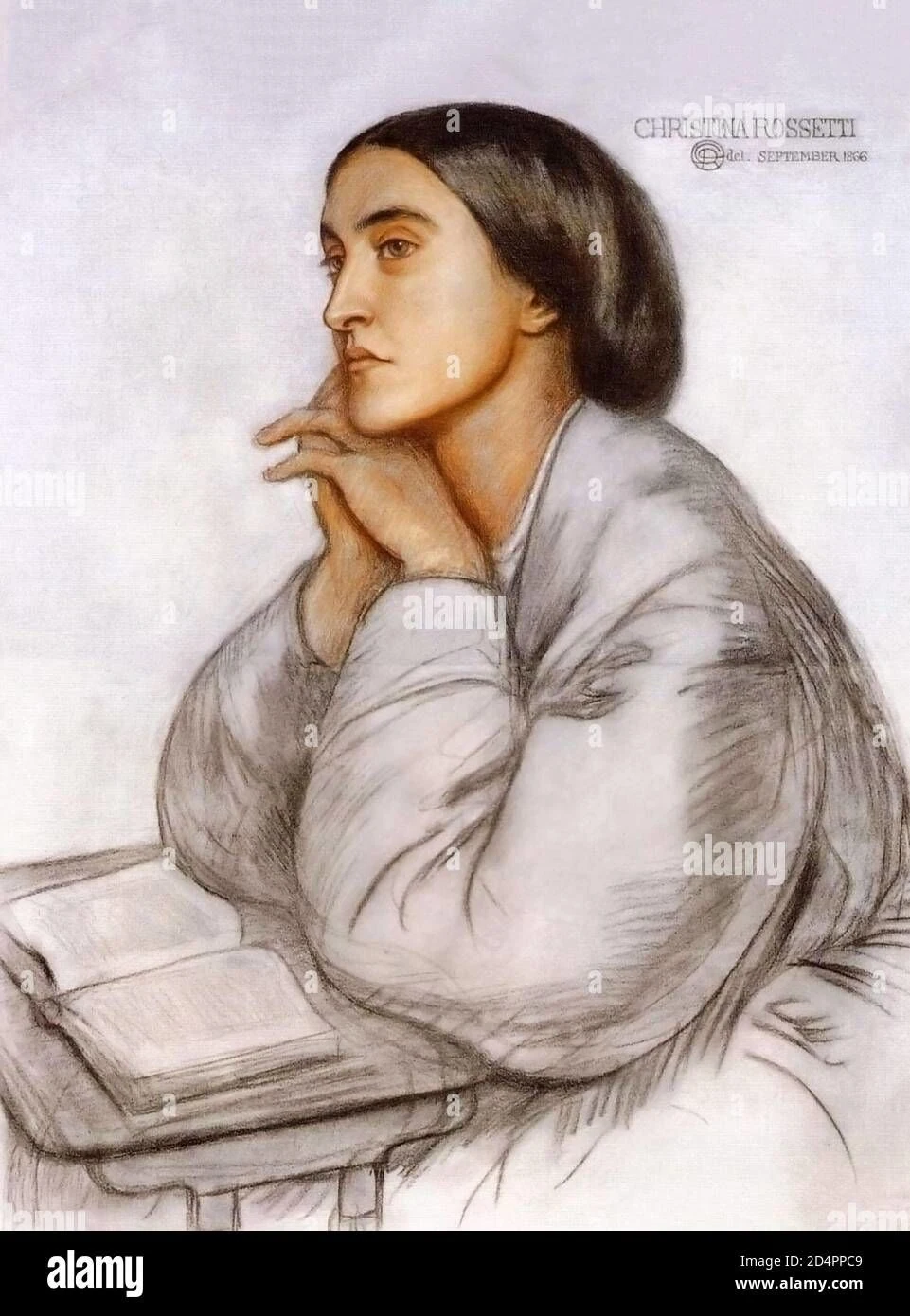
Christina Rossetti wrote poems that could appear simple on the surface while holding difficult questions about desire, faith, loss and the choices available to women. In ‘Goblin Market’, two sisters encounter goblin merchants; in ‘Remember’, a speaker weighs love against the pain of being remembered. Rossetti also wrote nursery verses and Christmas carols that travelled well beyond the Victorian literary circles in which her work first appeared. Her writing joined formal experiment and religious conviction to an alertness to the pressures of ordinary life.
A London childhood in an artistic family
Christina Georgina Rossetti was born in London on 5 December 1830, the youngest of four children. Her father, Gabriele Rossetti, was an Italian poet and political exile; her mother, Frances Polidori, was the sister of writer John William Polidori. Christina’s siblings were Maria Francesca, Dante Gabriel and William Michael. The children grew up in a household where poetry, art, religion and politics were part of family life. They made a family magazine, and all four tried their hand at writing or illustration.
Christina and Maria were educated at home. She read religious writing, classical works, novels and fairy tales, and was drawn to poets including Keats and Scott. Italian literature was also part of the family’s intellectual world. Her early education was shaped by the contrast between her mother’s devout Protestantism and her father’s unorthodox religious views. When Christina was 14, she suffered a nervous breakdown and left school. Depression and ill-health would affect her throughout her life.
By the mid-1840s, the family was under financial strain as Gabriele’s health deteriorated. Christina’s mother began teaching to support them. Christina’s own attention turned increasingly towards religious devotion: she and her mother and sister became absorbed in the Anglo-Catholic movement within the Church of England. The movement’s influence remained important in her poetry. In 1853, Christina and her mother tried running a school in Frome, Somerset; the venture failed, and they returned to London the following year. Gabriele died in 1854.
Finding a poetic voice
Rossetti began collecting and dating her poems in 1842. A small volume of her work was privately printed for family and friends in 1847. Two poems appeared in the Athenaeum in 1848, and in 1850 she published in The Germ, the Pre-Raphaelite periodical edited by her brother William, using the name Ellen Alleyne. These early steps placed her writing alongside the circle associated with Dante Gabriel and the Pre-Raphaelite movement, although her work developed its own distinctive concerns.
Her first commercially printed collection, Goblin Market and Other Poems, appeared under her own name from Macmillan in 1862. The title poem follows sisters Laura and Lizzie and their encounters with goblin sellers. Its narrative of temptation and rescue has invited markedly different readings: critics have treated it as a religious allegory, a meditation on gender and female agency, and a story of desire and recovery. The poem’s imaginative world does not settle into a single explanation. Its force lies partly in the way its fairy-tale surface can carry moral and emotional complexity.
Rossetti continued to publish poetry and devotional writing. The Prince’s Progress and Other Poems followed in 1866, and Sing-Song: A Nursery Rhyme Book in 1872. She later issued further collections, including A Pageant and Other Poems in 1881. In 1893 she oversaw an enlarged edition of Sing-Song and published the devotional prose work The Face of the Deep. The range of these books matters: the writer of ‘Goblin Market’ was also a maker of hymns, nursery verses and sustained religious reflection.
Faith, relationships and the limits of biography
Rossetti’s religious life shaped both her subject matter and her decisions. She became engaged to the painter James Collinson, a founding member of the Pre-Raphaelite Brotherhood, but ended the engagement in 1850 after he returned to Catholicism. Later, between 1864 and 1866, she was involved with the poet and translator Charles Cayley. She ultimately could not marry him because he was agnostic and she was passionately devout. Rossetti never married.
Her work also shows that religious belief did not narrow her attention to private devotion. She opposed slavery in the United States, cruelty to animals and the exploitation of girls in prostitution. She was ambivalent about women’s suffrage, while later readers have found feminist questions in her poetry. ‘In the Artist’s Studio’, for example, reflects on the way an artist’s idealised vision can overwhelm the person represented. Her writing’s complexities resist reducing her either to a symbol of Victorian piety or to a straightforward modern political voice.
Ill-health continued to mark Rossetti’s later years. She was diagnosed with Graves’ disease in 1872 and suffered a near-fatal attack in the early 1870s. Breast cancer was diagnosed in 1893; after the tumour was removed, the disease recurred. She died in London on 29 December 1894, aged 64, and was buried in the family grave at Highgate Cemetery. Her private papers were later destroyed by her brother William, who sought to protect her reputation. That loss places limits on what can be said about her inner life beyond the surviving work and records.
Poems that travelled into music
Rossetti’s poetry continued to find readers after her death. Her standing did not initially match that of her contemporary Elizabeth Barrett Browning, and her popularity waned in the early twentieth century amid Modernism. Later scholarship renewed interest in her work, including its religious and sexual tensions. Writers influenced by her include Ford Madox Ford, Virginia Woolf, Gerard Manley Hopkins, Elizabeth Jennings and Philip Larkin.
Some of her best-known writing entered British seasonal life through music. Rossetti wrote the words of ‘In the Bleak Midwinter’, later set to music by Gustav Holst and Harold Darke, and ‘Love Came Down at Christmas’, which has also been arranged as a carol. Those settings gave her poems an afterlife beyond the page, reaching listeners who may know the lyrics without knowing their author. Her nursery poems likewise demonstrated a command of rhythm and compact form that served very different audiences from the readers of her longer, more challenging work.
Why Christina Rossetti deserves a place in British Legacy
Christina Rossetti deserves a place in British Legacy because she made a lasting contribution to the country’s literary and musical culture without writing in only one register. ‘Goblin Market’ combines a gripping narrative with questions about temptation, salvation, gender and desire; ‘Remember’ compresses love and loss into a sonnet; and Sing-Song shows her skill with verse for children. Her devotional writing, including The Face of the Deep, gives another dimension to a body of work in which religious belief is not a decorative theme but a lasting intellectual and emotional force.
Her influence is visible both in later writers who drew on her work and in the carols that brought her words into British musical life. ‘In the Bleak Midwinter’ and ‘Love Came Down at Christmas’ have carried her poetry into recurring public and family traditions, while her poems continue to invite new interpretations rather than yielding a single settled meaning. Rossetti’s place in the literary record also matters because she built a substantial career as a woman writer in the nineteenth century, publishing across poetry, children’s verse and devotional prose. Remembering her means recognising not just two famous poems, but the range, craft and continuing reach of a writer who helped shape how British readers encounter poetry on the page and in song.
Sources
Christina Rossetti — Wikipedia, revision 1377862632
Adapted in part from Christina Rossetti by Wikipedia contributors, under CC BY-SA 4.0. Text has been edited and combined with the existing article; this adapted text is shared under the same licence. Contributor history.