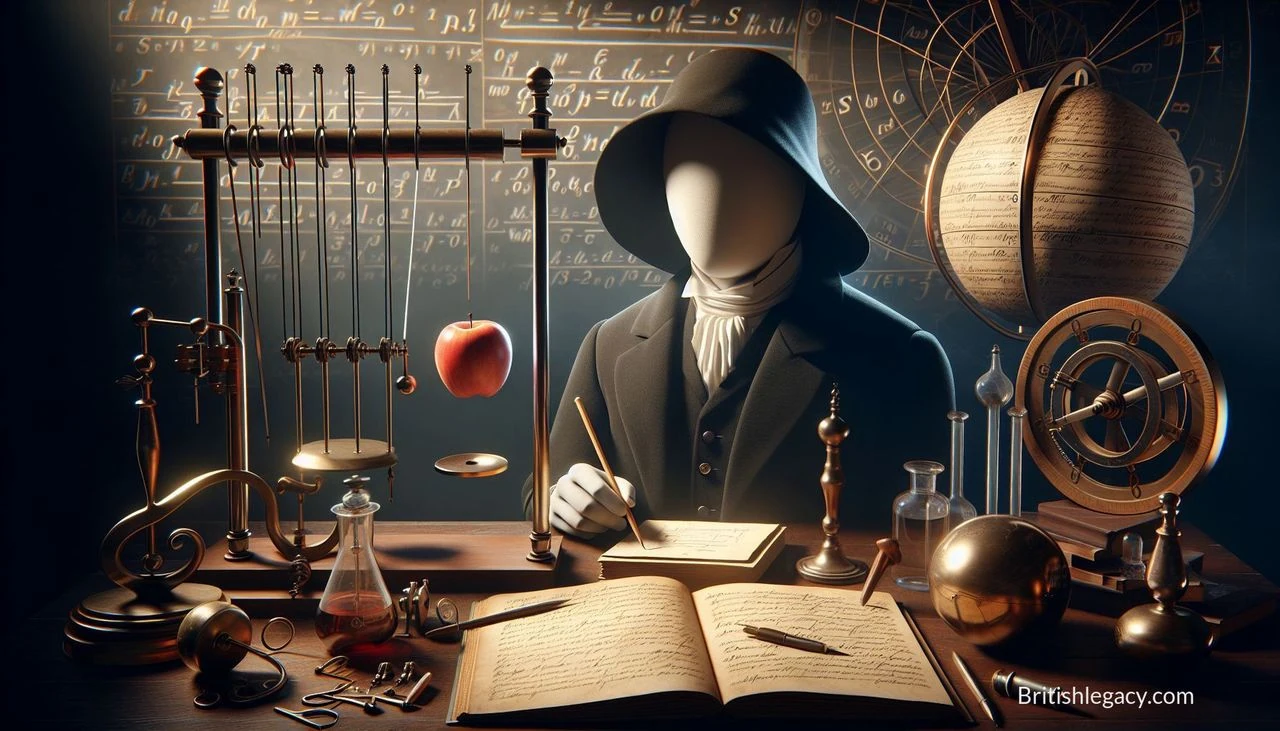
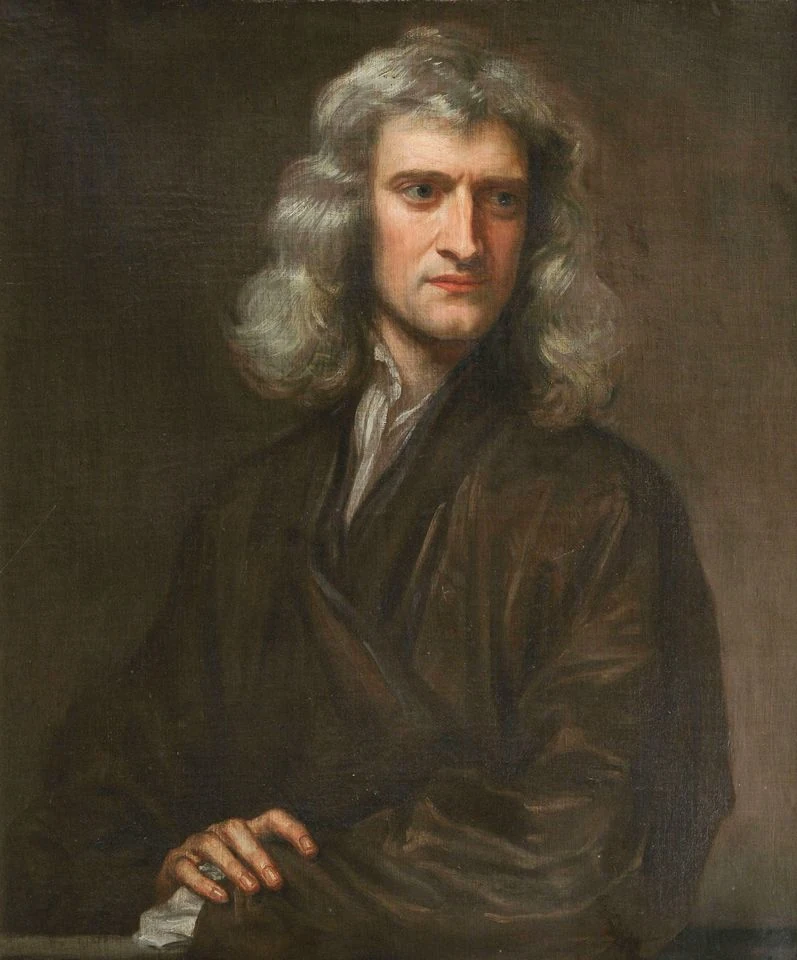
Isaac Newton is often reduced to an apple, a wig and a formula learnt at school. That familiar shorthand obscures the scale of his achievement. In the Principia, published in 1687, Newton showed how mathematical rules could explain motion on Earth and the movements of bodies in the heavens. His work helped establish classical mechanics; his experiments transformed the study of light; and his later service at the Royal Mint brought his insistence on accuracy into public life. He was not only a scholar whose ideas travelled far beyond England, but a figure formed and employed within the country’s schools, university, scientific society and government institutions.
From Woolsthorpe to Cambridge
Newton was born at Woolsthorpe in Lincolnshire on 25 December 1642 according to the calendar then used in England, a date equivalent to 4 January 1643 today. His father had died before his birth. As a child, Newton was educated at The King’s School in Grantham, where he became known for making models and mechanical devices. His schooling was interrupted when his mother brought him home with the intention that he manage the family property. Farming did not suit him; after encouragement from people connected with the school and his family, he returned to his studies.
In 1661, Newton entered Trinity College, Cambridge. The university’s teaching was still substantially grounded in Aristotle, but Newton’s reading extended to newer natural philosophers and astronomers. He pursued mathematics, mechanics and optics through private study, rather than following a straightforward path from lectures to discovery. He graduated in 1665, and returned to Cambridge after the university reopened. In 1667 he was elected a fellow of Trinity. Two years later he succeeded Isaac Barrow as Lucasian Professor of Mathematics, a position he held until 1702.
Cambridge gave Newton a base for work that would later change several branches of mathematics and science. It also placed him within a continuing scholarly community: he became a Fellow of the Royal Society in 1672 and, from 1703, served as its president. Yet his central discoveries were not all made in public view. Newton often kept his working papers to himself and could be slow to publish. The difference between making an idea and establishing it for other people would shape much of his career.
The plague years and the foundations of calculus
The Great Plague prompted Cambridge to close in 1665, and Newton went back to Woolsthorpe. During the next two years he developed ideas in mathematics that he called fluxions, now recognised as an early form of calculus; carried out important investigations into light; and began to consider how gravity might extend beyond the Earth. These were not a single sudden revelation, but connected lines of work developed through calculation, experiment and repeated thought.
Newton’s early work on calculus preceded its independent development by the German mathematician Gottfried Wilhelm Leibniz. Both men are credited with developing the subject, though they used different notation; Leibniz’s notation became the more widely adopted system. Disputes over priority later became bitter. The lasting importance of Newton’s contribution is not settled by awarding one person exclusive credit: calculus supplied mathematical methods that could be used to analyse change, motion and curves, and became an essential tool across mathematics and the physical sciences.
The often-used label annus mirabilis, or “year of wonders”, can make the Woolsthorpe period sound effortless. Newton’s work instead depended on concentrated study and on turning ideas into methods that could be demonstrated and developed. His notebooks and papers record a mind working across subjects, but many of the results took years to reach print. The apple story belongs to the later public memory of Newton’s thinking about gravity; the significant achievement was the sustained mathematical work required to connect falling bodies with the motion of the Moon and planets.
The Principia: motion on Earth and in the heavens
Published in 1687, Philosophiæ Naturalis Principia Mathematica brought Newton’s account of motion and gravitation into a single mathematical system. Edmond Halley encouraged the project and helped finance publication. The book was demanding, written in a compressed geometrical style rather than for a general readership, but its central claim was clear in consequence: the same principles could be applied to bodies moving on Earth and to celestial bodies moving through space.
Newton’s three laws of motion describe how bodies respond to forces. In simplified terms, a body maintains its state of rest or uniform motion unless a force changes it; the change in motion depends on the force applied and the body’s mass; and forces between interacting bodies are equal and opposite. Together, these laws made motion something that could be analysed quantitatively. They provided a framework for explaining the movement of objects and for working out the effects of forces, rather than treating motion as a phenomenon that could only be described.
The Principia also set out universal gravitation. Newton argued that the force drawing an object towards Earth is of the same kind as the force governing planetary orbits. This joined terrestrial and celestial motion within one account. Using the mathematics of his system, he addressed planetary movement and the paths of comets, among other problems. Newtonian mechanics remained the dominant scientific framework for centuries. Its laws are still useful approximations for many situations, even though later theories changed the account of nature in conditions involving very high speeds or strong gravitational fields.
Newton’s achievement was therefore not simply a list of laws. He provided a way to relate observations to mathematical explanation and apply the same reasoning across different scales. The Principia helped make mechanics a coherent subject and gave later scientists, engineers and mathematicians a structure they could test, extend and use.
Prisms, colour and the reflecting telescope
Newton’s investigations of light brought another change in how natural phenomena could be studied. In prism experiments, he showed that white light separates into a spectrum of colours and that those colours can be recombined to produce white light. The colours, in his account, were not simply added to otherwise colourless light by passing through glass. The prism separated rays with different refrangibility. Newton presented his work on light and colour to the Royal Society in 1672, beginning a public exchange that brought both attention and criticism.
His optical work also had a practical consequence. Refracting telescopes use lenses, but lenses bend different colours by different amounts, producing chromatic aberration. Newton built a reflecting telescope that used mirrors instead. The instrument, made in 1668, demonstrated a workable alternative to the refracting design and became the basis of the type known as the Newtonian telescope. He later published Opticks in 1704, bringing together his investigations of light and colour in a major work distinct from the mathematical treatment of motion in the Principia.
These achievements show Newton moving between experiment, theory and instrument-making. The prism provided a means to test claims about light; the telescope applied an understanding of optics to a design problem. In both cases, careful observation mattered alongside mathematical reasoning. His work did not end debate about the nature of light, but it established influential questions and methods for those who followed.
From Trinity to the Royal Mint
Newton’s public responsibilities extended well beyond Cambridge. He moved to London in 1696 to become Warden of the Royal Mint, and became Master in 1699. He held the latter office until his death in 1727. Although such appointments could be treated as sinecures, Newton took the Mint’s work seriously. His tenure coincided with the recoinage and with persistent problems of clipping and counterfeiting. He applied himself to the administration of coinage and the investigation and prosecution of counterfeiters.
The Mint’s work concerned matters that affected daily trust in money: the weight and quality of coins, the security of their production and the effort to prevent fraud. Newton’s administrative role brought a different kind of precision from that of his scientific work, but the concern for measurement and standards is a connecting thread. He was not merely a celebrated scholar placed in an honorary office. He exercised authority at the Mint and engaged in the practical work of protecting the coinage.
Newton remained president of the Royal Society while serving at the Mint. The combination of scientific leadership and public office makes his career more varied than the familiar image of a solitary thinker suggests. In 1705, Queen Anne knighted him during a visit to Trinity College. He died in London on 31 March 1727, aged 84, according to the calendar now in use. He was buried in Westminster Abbey, where his monument stands in the nave.
A complicated and wide-ranging scholar
Newton’s intellectual life was not confined to the fields for which he is most often remembered. He also wrote on theology and studied alchemy, and his surviving interests reveal a scholar working in a world where the boundaries between disciplines did not match those drawn today. Much of his theological writing remained private during his life. His religious views were unconventional, though he did not make a public declaration of them. A concise account of his scientific achievements should not mistake the published works for the full extent of his inquiries.
His temperament and professional relationships were not invariably easy. Newton could be intensely competitive, and his disputes with other scholars, including the conflict with Leibniz over calculus, became damaging. Those tensions are part of the record, but they do not diminish the importance of the mathematical and experimental work itself. Nor does his reputation rest on a single legend. It rests on results published over decades, on a body of work that brought mechanics and optics forward, and on the institutions in which he taught, debated and held office.
The story of the apple is best understood in that context. Accounts by people who knew Newton connect his thinking about gravity with the sight of a falling apple, but the familiar embellishment of an apple striking his head is not needed to explain the achievement. The insight mattered because Newton pursued its implications: whether the force that drew an apple downwards might also extend to the Moon. Turning that question into a mathematical account took sustained work, and its clearest public expression came in the Principia.
Why Isaac Newton deserves a place in British Legacy
Newton deserves a place in British Legacy because the evidence of his achievement is both intellectual and practical. Born in Lincolnshire and educated at Grantham and Cambridge, he developed methods that changed the study of motion, mathematics and light. The Principia connected terrestrial and celestial movement through a common mathematical account; his work on prisms made colour a subject for systematic experiment; and his reflecting telescope showed how a scientific understanding could produce a new instrument. These are specific contributions, not a general claim that one individual created modern science. Their importance lies in the methods and explanations that later scholars and practitioners could examine, teach and extend.
His British legacy also has an institutional dimension. Newton’s career ran through Trinity College, the Royal Society and the Royal Mint, and his burial in Westminster Abbey marks the place he came to hold in national remembrance. At the Mint he applied precision to coinage and took action against counterfeiting, bringing his abilities into work that supported confidence in everyday money. His life therefore links intellectual discovery with the responsibilities of public office. Newton’s influence reached far beyond Britain, but the schools, university and scientific and civic institutions through which he worked were part of his English experience. Remembering him here means recognising both the ideas that transformed the study of nature and the work by which he served the institutions of his own country.
Sources
Isaac Newton — Wikipedia revision · Isaac Newton — Wikipedia
Adapted in part from Isaac Newton by Wikipedia contributors, under CC BY-SA 4.0. Text has been edited and combined with the existing article; this adapted text is shared under the same licence. Contributor history.