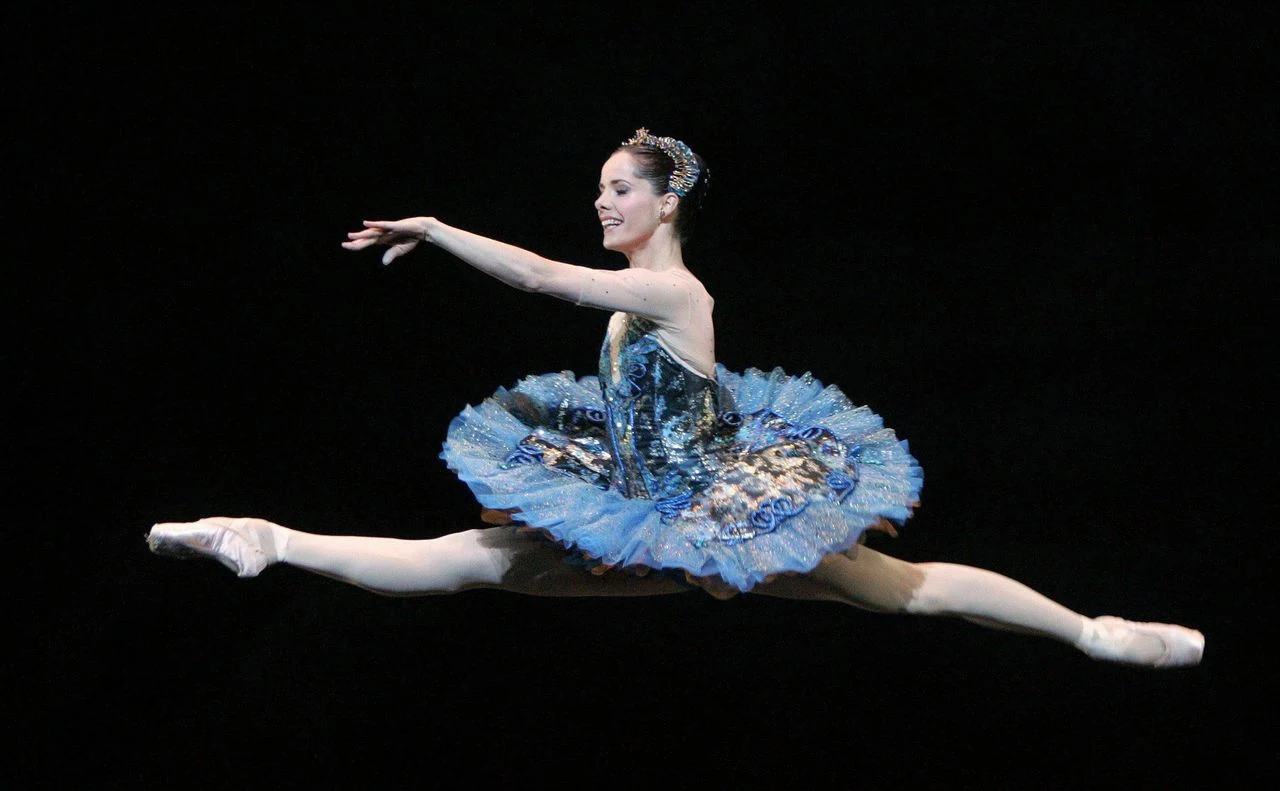
Darcey Bussell’s career brought together the demands of classical ballet and a rare breadth of public work. She spent more than two decades with the Royal Ballet, becoming its youngest principal dancer, and performed more than 80 roles, including 17 created for her. After retiring from ballet in 2007, she continued to put dance before wider audiences as a television presenter and judge, author and advocate for dance education.
Training and an early breakthrough
Bussell was born in London on 27 April 1969. She studied stagecraft at the Arts Educational School before joining the Royal Ballet Lower School at White Lodge, Richmond Park, in 1982. At 16, she progressed to the Upper School in Barons Court. While studying, she won the Prix de Lausanne, an important early distinction, and appeared in school productions at Covent Garden.
In 1987 she joined Sadler’s Wells Royal Ballet. The following year, while still at school, choreographer Kenneth MacMillan gave her a leading role in The Prince of the Pagodas. The part led to her move to the Royal Ballet. On the ballet’s opening night in 1989, aged 20, she was promoted to principal dancer, becoming the youngest in the company’s history.
That rapid rise did not define her work as a single succession of headline roles. Bussell remained with the Royal Ballet for her professional career, which lasted more than two decades, while also appearing as a guest artist with companies including New York City Ballet, La Scala Theatre Ballet, Kirov Ballet, Hamburg Ballet and the Australian Ballet.
A wide repertoire and a final performance
Bussell danced major classical roles such as Aurora in The Sleeping Beauty, Odette and Odile in Swan Lake, the Sugar Plum Fairy in The Nutcracker and Giselle. Her repertoire also included roles in MacMillan’s Winter Dreams and The Prince of the Pagodas, as well as Masha in Manon—a breadth that extended well beyond the three ballets most often named in accounts of her career.
Her work in The Sleeping Beauty returned her to Aurora in four different productions. One was Sir Anthony Dowell’s production, which she opened at the Kennedy Center in Washington, DC, in front of President Clinton. She also made several appearances with New York City Ballet, beginning in 1993 in the Agon pas de deux. Such engagements placed a Royal Ballet principal within a wider international dance culture without loosening her connection to the London company.
Bussell retired from ballet on 8 June 2007 in a performance of MacMillan’s Song of the Earth, set to Mahler’s Das Lied von der Erde. The performance took place at the Royal Opera House and was broadcast live on BBC Two. Her departure was a marked close to a stage career built on both classical repertory and work by contemporary choreographers.
Dance beyond the theatre
Television gave Bussell another way to make dance visible. She first joined the Strictly Come Dancing judging panel during the final stages of the 2009 series, then returned as a permanent judge in 2012. She remained on the panel until 2019. Her work for the BBC also included documentaries about ballet and its performers: Darcey’s Ballet Heroines, Darcey’s Ballet Heroes and programmes exploring Audrey Hepburn, Margot Fonteyn and Fred Astaire. In 2018, she presented a documentary on the mental health benefits of dance.
Her public dance work included a prominent part in the London 2012 Olympic closing ceremony. Descending into the stadium as the “Spirit of the Flame”, she led a troupe of 200 ballerinas and four male dancers before the Olympic flame was extinguished. She also co-presented the final of the first BBC Young Dancer competition in 2015, bringing a working knowledge of performance to a programme focused on emerging talent.
Books formed another strand of her work. In 2008, a children’s series called Magic Ballerina, developed from an idea and storyline initiated by Bussell, began publication. Its central character, Delphie, joins a ballet school and discovers magical shoes. Bussell also co-wrote The Young Dancer with the Royal Ballet School and published the autobiographical picture book Darcey Bussell in 2012, followed by Darcey Bussell: Evolved in 2018.
Recognition and service to dance
Bussell’s honours track her contribution to ballet and dance. She was appointed OBE in the 1995 New Year Honours for services to ballet, CBE in the 2006 Birthday Honours and Dame Commander of the Order of the British Empire in the 2018 New Year Honours for services to dance. Other recognition included a gold medal from the John F. Kennedy Center for the Performing Arts in 2006 and an honorary doctorate from the University of Oxford in 2009.
Her work with dance organisations has continued alongside broadcasting and writing. Since 2012, she has been president of the Royal Academy of Dance and campaign president for Birmingham Royal Ballet’s fundraising campaign. She has also served on the board of the Margot Fonteyn Foundation and as international patron of Sydney Dance Company. These roles connect her public profile with organisations involved in training, performance and the continuing life of dance.
Why Darcey Bussell deserves a place in British Legacy
Darcey Bussell’s place in British Legacy rests first on a specific achievement within British ballet: she rose from Royal Ballet School pupil to the company’s youngest principal dancer, then built a career there lasting more than two decades. Her repertoire crossed classical roles and MacMillan works, and its scale—more than 80 roles, with 17 created for her—shows a performer whose contribution was not confined to a handful of familiar appearances. Her final performance in Song of the Earth, broadcast from the Royal Opera House, also linked a major stage farewell to a national television audience.
Her legacy extends beyond the theatre because she has continued to work on how dance is seen, learned and sustained. Through television, including Strictly Come Dancing and programmes about ballet, she has brought dance into homes beyond the specialist audience. Her books for children and young dancers, her role with the Royal Academy of Dance and her work supporting Birmingham Royal Ballet connect public visibility with education and institutions. The importance of that combination is practical: ballet depends on audiences, training and organisations as well as the performances that attract attention. Bussell’s career has touched each of those parts of British dance life, making her story a fitting record of artistic achievement and sustained service to the art form.
Sources
Adapted in part from Darcey Bussell by Wikipedia contributors, under CC BY-SA 4.0. Text has been edited and combined with the existing article; this adapted text is shared under the same licence. Contributor history.