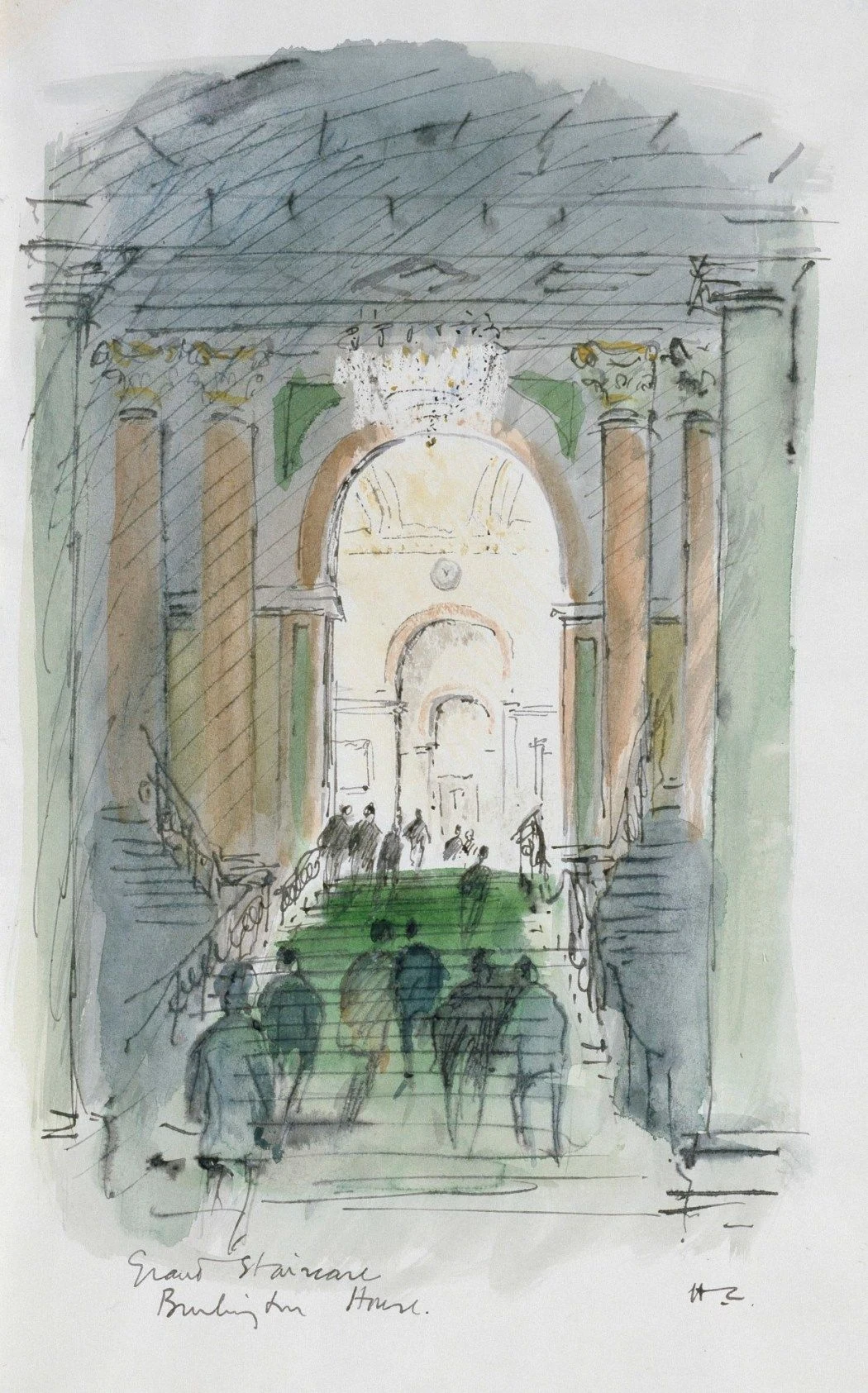
Hugh Casson’s part in the Festival of Britain was not to design the Royal Festival Hall alone, but to shape the wider architectural programme that gave the 1951 event its modern character. As director of architecture, he brought young architects into the project; the design of the hall itself was led by Leslie Martin. That distinction points to the breadth of Casson’s career. He designed and taught, worked across buildings and interiors, and wrote and broadcast about architecture and design.
From architecture student to wartime camouflage
Hugh Maxwell Casson was born in Hampstead, London, on 23 May 1910. His early childhood included time in Burma, where his father was posted with the Indian Civil Service, before he returned to England for his education. He attended Eastbourne College and studied architecture at St John’s College, Cambridge, from 1929 to 1931. He continued his architectural training at the Bartlett School of Architecture in Bloomsbury and spent time at the British School at Athens.
At Cambridge, Casson met Margaret Macdonald Troup, an architect and designer who later taught design at the Royal College of Art. They married in 1938 and had three daughters. Before the Second World War, Casson divided his time between teaching at the Cambridge School of Architecture and working in London for his former Cambridge tutor, Christopher ‘Kit’ Nicholson.
In 1938, Casson wrote New Sights of London for London Transport, a guide to contemporary architecture in the capital. It promoted modern buildings that Londoners could visit while criticising Britain’s record in innovative construction. During the war, he worked in the Air Ministry’s Camouflage Service, applying visual design to a practical military task.
Directing the Festival of Britain
In 1948, aged 38, Casson was appointed director of architecture for the Festival of Britain’s South Bank site. The festival, held in 1951, set out to celebrate peace and modernity in post-war Britain. Casson’s role was to lead the architectural programme, including the appointment of other young architects. The Royal Festival Hall became one of the best-known buildings associated with the site, but its modernist design was led by Leslie Martin, then 39. Casson’s contribution lay in directing the wider project, rather than claiming sole authorship of the hall.
The Festival’s work helped bring Casson national recognition. He was made a Knight Bachelor in the New Year Honours of 1952. In the following year, he designed street decorations in Westminster for the coronation of Elizabeth II. These projects placed architectural and visual design in the public realm, on a scale that reached well beyond the clients of a private practice.
After the war, Casson entered a partnership with the architect Neville Conder. Their work included corporate headquarters, university campuses and the Elephant House at London Zoo. They also worked on a building for the Royal College of Art and on the University of Cambridge’s Sidgwick Site arts faculty buildings. The Cambridge commission extended over roughly 30 years and included the Austin Robinson Building, which houses the Faculty of Economics, and the Marshall Library of Economics.
Teaching, interiors and the Royal Academy
Education remained central to Casson’s working life. From 1953 to 1975 he was professor of environmental design at the Royal College of Art; from 1955 to 1975, he was also professor of interior design there. His wife Margaret was a senior tutor at the college. Casson later served as its provost. The combination of teaching and practice kept his work connected to both the training of designers and the making of buildings.
His commissions also included important interiors. In 1955, he designed the interiors of the royal yacht Britannia. He designed suites at Buckingham Palace and Windsor Castle, and oversaw the team of designers and artists responsible for the interiors of P&O’s Canberra. These projects required him to work within existing structures and create settings for specific uses, rather than design only from a blank site.
Casson became an associate member of the Royal Academy in 1962 and a full member in 1970. He served as its treasurer from 1975 to 1976, then as president from 1976 to 1984. His long association with the institution linked his architectural career with the wider visual arts. The Royal Academy now awards an annual Hugh Casson Drawing Prize for an original work on paper in any medium where drawing is the clear emphasis; a room in the Keeper’s House also bears his name.
Drawing, writing and broadcasting
Casson’s work was not confined to buildings and interiors. He supplied watercolour illustrations for John Betjeman’s verse autobiography Summoned by Bells, first published in 1960; an illustrated edition appeared in 1989. His books included guides to Oxford, Cambridge and London, as well as a sketchbook of London buildings. He also wrote about subjects ranging from bridges and monuments to Victorian architecture.
In the 1980s, Casson presented the television series Personal Pleasures with Sir Hugh Casson, visiting stately homes and places he enjoyed. His work as a writer, illustrator and broadcaster extended his engagement with architecture beyond professional practice and the classroom. He was made a Knight Commander of the Royal Victorian Order in 1978 and a Member of the Order of the Companions of Honour in 1985. In 1984, he received the Albert Medal.
Casson died in Chelsea, London, on 15 August 1999, aged 89. His papers are held by the Victoria and Albert Museum. The continuing institutional reminders of his work include the Royal Academy’s drawing prize and named room, as well as the buildings produced through his long practice and teaching career.
Why Hugh Casson deserves a place in British Legacy
Casson’s place in British Legacy rests on a substantial public contribution, not simply on the fame of a single building. As director of architecture for the Festival of Britain, he helped organise a programme that presented post-war Britain through modern design and gave young architects a role in shaping its South Bank site. Recognising Leslie Martin’s leadership of the Royal Festival Hall’s design makes Casson’s own achievement clearer: he helped direct the larger architectural undertaking around it. His later partnership with Neville Conder produced work for universities, public institutions and London Zoo, while the Cambridge Sidgwick Site project continued across about three decades.
His contribution also reached into education and public culture. At the Royal College of Art, Casson taught environmental and interior design over more than two decades and later served as provost. At the Royal Academy, he moved from associate member to president, and the drawing prize bearing his name continues to recognise work on paper. His designs for Britannia, royal residences and Canberra show the range of his work with interiors; his books, illustrations and television programme brought buildings and design to broader audiences. Together, these roles connect architecture with education, public institutions and everyday encounters with designed spaces—a distinctly British record of service across several parts of cultural life.
Sources
Adapted in part from Hugh Casson by Wikipedia contributors, under CC BY-SA 4.0. Text has been edited and combined with the existing article; this adapted text is shared under the same licence. Contributor history.