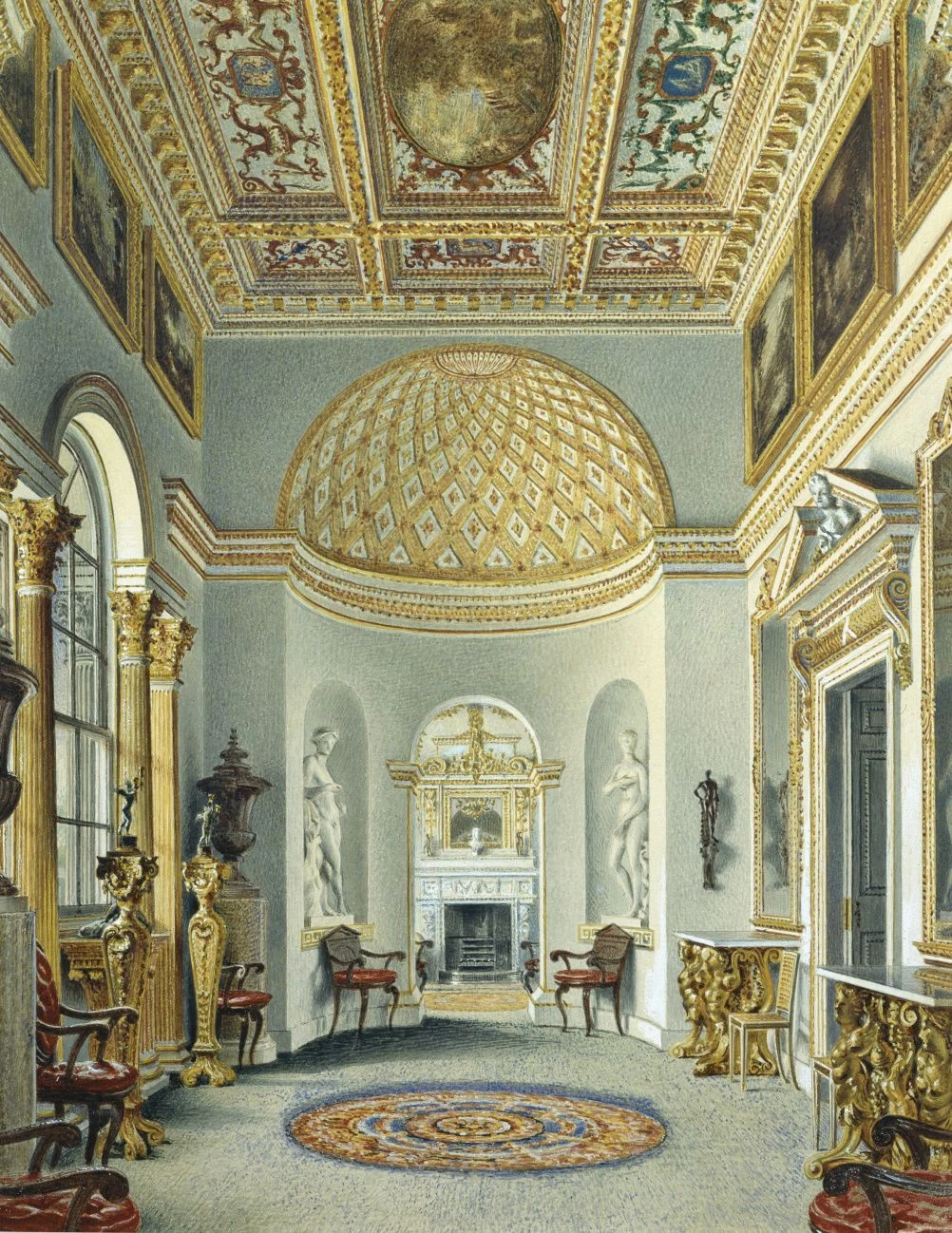
William Kent’s career crossed painting, architecture, furniture and garden design. He began as a sign and coach painter, travelled to Italy to study, and returned to England with an understanding of Palladian architecture shaped by direct experience of its Italian models. In the 1730s he applied that knowledge to buildings in London and country houses such as Holkham Hall. His landscape designs, meanwhile, helped establish the English landscape garden: an approach that made estates feel less like geometrical compositions and more like cultivated versions of nature.
A painter’s training and an Italian journey
Kent was born in Bridlington, in the East Riding of Yorkshire, in late 1685. He was baptised on 1 January 1686 as William Cant. His early career was as a sign and coach painter; his employer encouraged him to study art, design and architecture. A group of Yorkshire gentlemen then sponsored a period of study in Italy. Kent sailed from Deal in July 1709, travelled through Florence and reached Rome, where he studied and worked as a painter.
Italy gave him more than subjects to paint. In 1714 he toured northern Italy with Thomas Coke, later 1st Earl of Leicester, and encountered the palaces of Andrea Palladio in Vicenza. In Rome he also met Richard Boyle, 3rd Earl of Burlington, the aristocratic patron and architectural enthusiast with whom he would form a lasting professional partnership. Kent left Rome in 1719 and returned to England by way of Paris.
Painting remained part of his work after his return. He decorated rooms at Kensington Palace and contributed painted ceilings to Chiswick House and Burlington House. But design across different forms was his particular strength. He was appointed Principal Painter in Ordinary, or court painter, while his work increasingly extended to buildings, interiors, furniture and gardens. He began practising as an architect relatively late, in the 1730s.
Palladian ideas in houses and public buildings
Kent’s architecture helped bring the revived Palladian style into English practice. Burlington gave him the task of editing The Designs of Inigo Jones, published in 1727 with additional designs in the Palladian and Jonesian manner by Burlington and Kent. In the royal architectural establishment, the Board of Works, Kent went on to secure commissions for public buildings in London. His Royal Mews at Charing Cross was built between 1731 and 1733 and later demolished. The Treasury buildings in Whitehall followed in 1733–37. He also designed the Horse Guards building shortly before his death; it was built between 1750 and 1759.
These works brought classical forms into the capital’s civic setting. Kent’s public architecture was not simply a repetition of Palladio: its sources also included the work of Raphael and Giulio Romano. The Treasury commission, in particular, connected his architectural practice to the institutions and streetscape of central government. The original account gives a later end date for its construction, but the chronology used here is 1733–37.
Among his country-house commissions, Holkham Hall in Norfolk is the most complete expression of Palladian ideals. Kent worked on it with Thomas Coke and the architect Matthew Brettingham, who served as his assistant; the work was executed between 1734 and 1765. The house was not Kent’s sole contribution to the estate’s character. At Holkham and elsewhere, architecture, interior design and the surrounding landscape were related parts of a broader design practice.
His other architectural work ranged widely. At 44 Berkeley Square in London, he created a theatrical Baroque staircase and parade rooms. He designed domed pavilions at Badminton House in Gloucestershire and Euston Hall in Suffolk. Kent could also respond to a different historical setting: he produced Gothic designs for screens at Westminster Hall and Gloucester Cathedral. His work at 22 Arlington Street began in 1743 for Henry Pelham, then prime minister, but was completed by his assistant Stephen Wright after Kent’s death.
Gardens designed as composed landscapes
Kent was among the originators of the English landscape garden, whose apparently natural scenery offered an alternative to strictly formal layouts. His designs treated views, paths, water and architectural features as parts of a sequence. At Rousham House in Oxfordshire, he arranged Arcadian scenes with temples, cascades, grottoes and Palladian bridges. At Stowe in Buckinghamshire, his work included garden buildings and the Palladian Bridge. He also worked at Chiswick, Richmond, Claremont and the garden of Alexander Pope’s villa at Twickenham.
The results were not simply untouched countryside. A temple, bridge or carefully framed view could give a garden the character of a scene, while paths and changes of level guided visitors through it. Kent’s contribution was chiefly one of design rather than horticultural expertise; his technical knowledge of plants was limited by comparison with that of gardeners such as Charles Bridgeman, whose influence on Kent is also noted. At Stowe and Rousham, Kent developed and reshaped existing work as well as introducing his own ideas. The naturalistic style he helped establish would be developed on a larger scale by Capability Brown in the following generation.
Interiors, furniture and an expansive practice
Kent designed for the rooms inside the buildings as well as for their exteriors. His furniture and interior commissions included Chiswick House, Houghton Hall, Holkham Hall, Devonshire House and Rousham. At Hampton Court Palace he designed furnishings, and he also worked on rooms and a gateway in Clock Court. At Kensington Palace he contributed interiors, murals and painted ceilings, including work in the Cupola Room and on the grand staircase.
That breadth made Kent a conspicuous figure in his own day, but it also exposed him to ridicule. His commissions could extend well beyond architecture and interiors: he was asked to design ladies’ birthday dresses, decorating them with classical motifs. The painter and satirist William Hogarth made a burlesque of Kent’s altarpiece at St Clement Danes in 1725. Kent’s best-known practical design may be less monumental. In 1733 the 3rd Duke of Devonshire commissioned him to devise what is credited as the first wheeled baby carriage, an ornate vehicle pulled by a goat or small pony.
Kent died at Burlington House in London on 12 April 1748, aged 62. Horace Walpole later praised him as a painter, architect and “the father of modern gardening”, while judging his painting less favourably than his architecture and garden design. The description captures the range of his reputation, though it should not obscure the collaborative nature of many major projects or the work of people who developed the styles he helped to establish.
Why William Kent deserves a place in British Legacy
Kent deserves a place in British Legacy because his work connects the architecture of Georgian Britain with the design of its houses, public buildings and landscapes. His early study in Italy gave him close knowledge of Palladian architecture, which he adapted for English commissions rather than simply copying. The Treasury buildings put that classical vocabulary into the civic centre of London; Holkham Hall shows it applied to a country house through collaboration with Thomas Coke and Matthew Brettingham. These projects make his influence visible in places that still form part of the country’s architectural inheritance.
His importance also lies in treating the garden as a designed experience. At Rousham and Stowe, architecture, paths, water and views were arranged to create a sense of movement through a landscape. That approach helped shape the English landscape garden and provided a foundation for later designers, including Capability Brown. Kent’s practice crossed disciplines: he designed interiors and furniture, painted rooms and produced architectural work in both Palladian and Gothic idioms. The wheeled baby carriage is a reminder that his designs could also address ordinary practical needs. His British legacy is therefore not one building or style alone, but a connected body of work that helped define how Georgian Britain built, furnished and experienced its surroundings.
Sources
William Kent — Wikipedia, revision 1366671191
Adapted in part from William Kent by Wikipedia contributors, under CC BY-SA 4.0. Text has been edited and combined with the existing article; this adapted text is shared under the same licence. Contributor history.