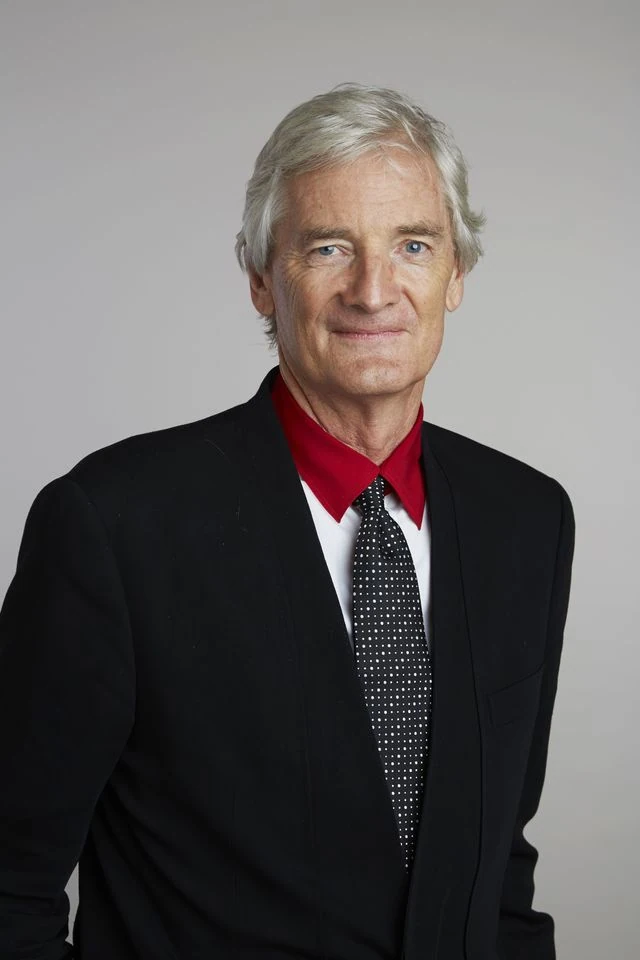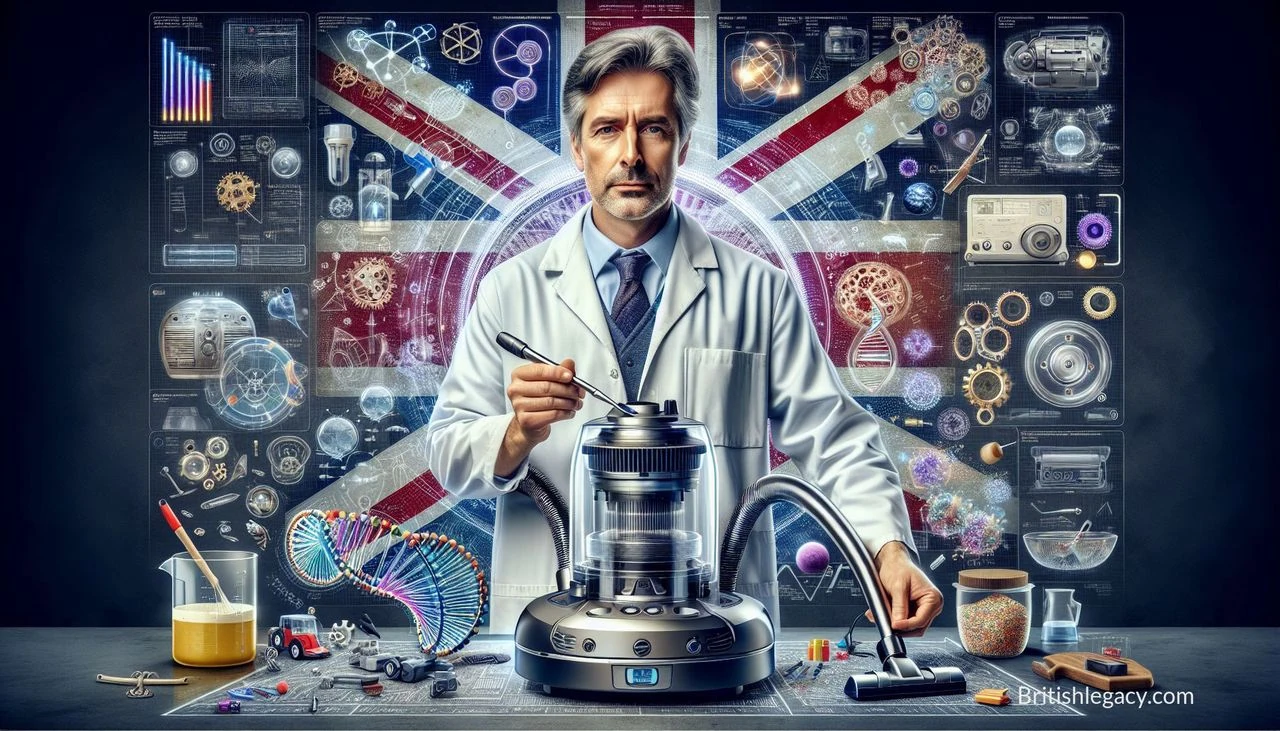
James Dyson’s best-known invention began with an ordinary frustration: a vacuum cleaner that lost suction as dust clogged its bag. Rather than accept the decline as an unavoidable part of using the machine, he pursued a different way to separate dust from air. The resulting cyclonic cleaner helped turn a domestic appliance into a public demonstration of engineering: its workings, including the movement of dust through the machine, could be seen as well as felt in its performance.
That cleaner was not a sudden success. It followed years of prototyping, an initial launch in Japan and difficulty finding British manufacturers willing to take on a product that challenged the market for replacement bags. Dyson’s story is therefore about more than a clever mechanism. It joins design to persistence, production and education, with roots in a series of earlier attempts to make familiar objects work better.
A designer’s education and early inventions
Dyson was born in Cromer, Norfolk, on 2 May 1947. His father died when he was nine; Dyson later described the family home after that loss as short of money. He attended Gresham’s School in Holt, where he became a long-distance runner. He later said that running taught him determination—a quality that would suit a career in which a workable design often emerged only after many unsuccessful attempts.
In 1965 he began studying at the Byam Shaw School of Art, then went to the Royal College of Art, where he studied from 1966 to 1970. He initially studied furniture and interior design before moving towards product design and industrial design. The structural engineer Anthony Hunt influenced that shift. Dyson’s education crossed the boundary between art and engineering: he learned to think about form, structure and how objects would be used, rather than treating design as decoration added after the technical decisions were made.
While connected with the Royal College of Art, he helped design the Sea Truck, a fast landing craft commissioned by Jeremy Fry. His first original invention was the Ballbarrow, a wheelbarrow that used a ball instead of a conventional narrow wheel. The change addressed a practical difficulty: a narrow wheel could dig into mud or soft ground, while a broader ball spread the load. Dyson also developed the Trolleyball, a trolley for launching boats, and designed the Wheelboat, which could travel on land and water.
The Ballbarrow took him beyond the drawing board. It brought the demands of manufacturing and selling into his work, along with the need to defend an idea in a marketplace. Those experiences would matter when he later tried to establish a new kind of vacuum cleaner. Before that better-known invention, Dyson had already begun working in a recognisable way: identify a physical annoyance, question whether it has to be accepted, and test a design that might remove it.
From a clogged bag to a cyclonic cleaner
In the late 1970s, Dyson became frustrated with the declining performance of his Hoover Junior vacuum cleaner. Fine dust clogged the pores in its bag, reducing suction. He had been thinking about airflow and filtration while working around the Ballbarrow’s powder-coating process, and he had seen cyclone technology used in a sawmill. A cyclone separates particles from air by spinning the air rapidly, throwing heavier material out of the airstream. Dyson’s central idea was to adapt that industrial principle for a domestic cleaner.
The proposal was simple to state but difficult to make work at household scale. Over about five years, Dyson made approximately 5,127 prototypes. The number has become shorthand for persistence, but it also describes the practical work behind the invention: a principle that seemed promising still had to be translated into a machine that could be manufactured and used.
In 1983, Dyson launched the G-Force cleaner in Japan through catalogue sales. British manufacturers and distributors had declined to handle it, in part because a bagless product threatened a business built around selling replacement dust bags. The G-Force received an International Design Fair Prize in Japan in 1991. Dyson had filed patents for the dual-cyclone cleaner in 1980, and established Dyson Ltd in 1991. In June 1993, he opened a research centre and factory in Malmesbury, Wiltshire; on 1 July, the first DC01 came off the production line in Chippenham, Wiltshire. By 1995, the DC01 was Britain’s best-selling vacuum cleaner.
This chronology matters. The G-Force was an early commercial expression of the idea, but its route to market was not the same as the later British production and sales success. The DC01 helped bring the technology to a much wider audience. The slogan “say goodbye to the bag” captured its difference, and the Dyson Dual Cyclone became the fastest-selling vacuum cleaner ever made in the UK, according to the supplied account. The company’s success eventually reached overseas markets too; in the United States in the early 2000s, Dyson cleaners were reported to lead the market by value, though not by units sold.
Success also brought a dispute over the protection of the invention. In 1999, Dyson sued Hoover in the High Court over its Triple Vortex bagless cleaner. The court ruled that Hoover had deliberately copied a fundamental part of Dyson’s patented designs, and Hoover agreed to pay £4 million in damages. The case placed intellectual property alongside engineering in the story: developing a product was only one part of establishing it in a competitive market.
Making the workings visible
Dyson’s products made function part of their appearance. A transparent bin or visible cyclone could show what the machine was doing; an unusual shape could follow from airflow, handling or the placement of a motor. The visual character of these appliances was not simply a surface treatment over conventional machinery. It helped communicate that their internal operation had been reconsidered.
That approach extended beyond vacuum cleaners. In 2000, the company introduced the ContraRotator washing machine, with two drums turning in opposite directions. It was discontinued in 2005, having failed commercially. In 2006, Dyson launched the Airblade hand dryer, which used a thin, fast-moving layer of air to remove water from the skin rather than relying on heat. The Air Multiplier fan followed in 2009, presenting airflow without external blades; later versions added heating, air-purifying and humidifying functions. In 2016, the company launched the smaller, quieter Supersonic hair dryer.
Dyson also turned to robotics. The 360 Eye robot vacuum, introduced in Tokyo in 2014, used scanning and mapping for navigation, alongside cyclonic dust separation and a custom-designed digital motor. These products did not all share the same purpose or commercial outcome. Taken together, however, they show a company applying engineering work on airflow, motors and sensing to different everyday tasks.
Some experiments remained experiments. The ContraRotator’s discontinuation is a useful reminder that technical ambition does not guarantee a lasting product line. Nor should the many vacuum prototypes be mistaken for a recipe in which every failed attempt automatically leads to a successful one. Their significance is more specific: Dyson was prepared to make and test repeated versions of a design before settling on a machine he would back, and the company continued to invest in research and development.
Institutions, honours and engineering education
Dyson’s connection with the Royal College of Art continued long after his student years. He became its Provost on 1 August 2011, succeeding Sir Terence Conran, and remained in the post until 1 July 2017. The appointment brought him back to an institution where his own movement from art towards industrial design had helped shape his career. It also reflected the close relationship between design and engineering in his work.
He received several major British honours. Dyson was appointed a Commander of the Order of the British Empire in the 1998 New Year Honours for services to industrial design. In 2007, he was appointed a Knight Bachelor for services to business—not, as the original imported article stated, for services to industrial design. He was elected a Fellow of the Royal Society in 2015 and appointed to the Order of Merit in 2016 for achievements in industrial design. He was also elected a Fellow of the Royal Academy of Engineering and appointed a Royal Designer for Industry in 2005.
In 2002, Dyson established the James Dyson Foundation to support design and engineering education. Its work includes resources for schools and the James Dyson Award, an international design award intended to encourage young design engineers. The foundation’s educational approach reflects an important part of Dyson’s own career: invention involves making, testing and learning from mistakes, rather than waiting for an idea to arrive fully formed.
In 2017, the Dyson Institute of Engineering and Technology opened on the company’s Wiltshire campus. Its model combines study for an engineering degree with work on live engineering projects. The arrangement connects higher education with an industrial setting, giving students experience of engineering work alongside their studies. It is one part of a wider effort to support future engineers, rather than a substitute for the schools and university partnerships funded by the foundation.
That support also reached established universities. The foundation funded the Dyson School of Design Engineering at Imperial College London and supported the Dyson Centre for Engineering Design at the University of Cambridge. Both extend the practical side of engineering education: students need places and facilities in which they can develop, test and refine designs. Alongside those projects, the foundation’s school resources and award provide other ways for young people to encounter design and engineering.
Why James Dyson deserves a place in British Legacy
James Dyson deserves a place in British Legacy because his work connected inventive thinking with the practical demands of daily life. The cyclonic vacuum cleaner began with a specific problem—a bag clogging with dust and diminishing suction—and required far more than the initial insight that a cyclone might help. Dyson turned the principle into a domestic machine through years of prototypes, patents, manufacturing decisions and the effort to find a market for a product that challenged established expectations. The G-Force’s launch in Japan and the later production of the DC01 in Wiltshire make that route clear: invention becomes consequential when it can be made and used.
His wider design work, from the Ballbarrow to the hand dryer and hair dryer, continued to ask how familiar objects could be rebuilt around their function. Not every product endured, and the discontinued ContraRotator belongs in the account alongside the commercial successes. The story is more useful when it includes both ambition and limits: engineering offers possibilities, not guaranteed outcomes.
Dyson’s British legacy also lies in the institutions and opportunities associated with his work. The James Dyson Foundation, its award and school resources, the Dyson Institute, and support for design engineering at Imperial and Cambridge all create routes for students to encounter practical engineering. These initiatives matter because they carry his emphasis on making and testing beyond the products of one company. Born in Norfolk, educated in London and closely associated with Wiltshire through manufacturing and education, Dyson’s career links British design training, industrial production and engineering study. His place in this history rests both on a machine that changed expectations of a household appliance and on efforts to equip others to design and build what comes next.
Sources
James Dyson — Wikipedia, revision 1372787524 · James Dyson — Wikipedia
Adapted in part from James Dyson by Wikipedia contributors, under CC BY-SA 4.0. Text has been edited and combined with the existing article; this adapted text is shared under the same licence. Contributor history.