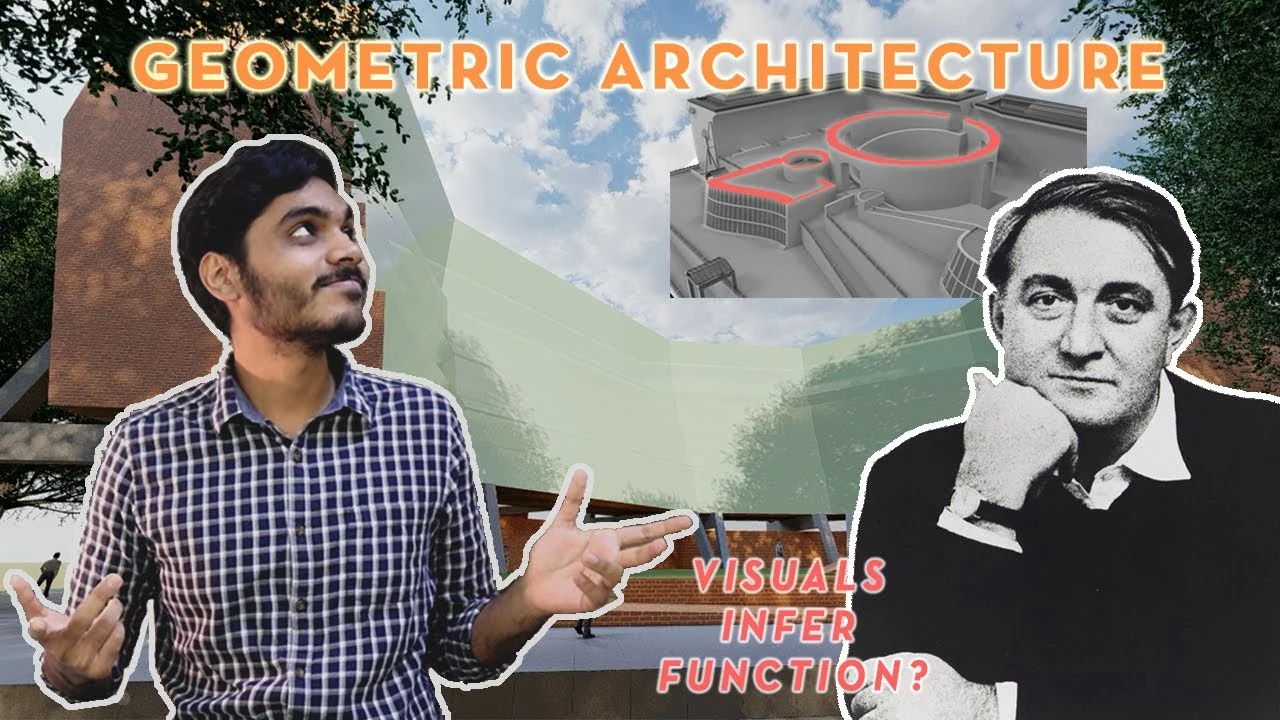
James Stirling’s buildings brought engineering, striking geometry and historical reference into close contact. The Leicester Engineering Building, designed with James Gowan, made an emphatic statement in post-war Britain; the Neue Staatsgalerie in Stuttgart later showed how Stirling could draw on classical forms while making a thoroughly contemporary building. Together, the two projects point to an architect whose work was never confined to a single visual formula.
From Glasgow to architectural practice
Stirling was born in Glasgow on 22 April 1926. After serving with the Black Watch during the Second World War, he studied at the University of Liverpool School of Architecture, graduating in 1950. His career would connect a Scottish birthplace and British architectural education with buildings that attracted attention well beyond the UK.
Stirling’s reputation rests in part on his willingness to make a building’s different functions and forms legible. Rather than relying on an undifferentiated façade, his designs could bring distinct elements together in a composition of their own. The Leicester Engineering Building is a clear example: its workshops, service tower and steeply sloping roof forms give the structure a recognisable profile while reflecting the practical work it was designed to accommodate.
Leicester: engineering made visible
Completed in 1963 and designed in collaboration with James Gowan, the Leicester Engineering Building is among Stirling’s best-known works in Britain. Its red-brick exterior, sharply angled roofs and varied geometric shapes set it apart from a more restrained institutional building. The contrast is not merely decorative: the design makes different parts of the building prominent rather than hiding them behind a uniform surface.
Glass-fronted workshops and a vertical service tower are among its defining features. Their presence gives the building a dynamic outline and connects its appearance to its engineering purpose. In the post-war British context, the project offered a forceful alternative to architectural uniformity. Its importance lies not only in a memorable exterior, but in the way the design treats practical requirements as material for architectural expression.
The Leicester project also established a partnership with Gowan that is central to the building’s story. Its distinctive character belongs to a collaborative design, not to Stirling working alone. The result shows how functional spaces and bold forms could be brought together without reducing the building to either pure utility or visual spectacle.
Classical echoes in Stuttgart
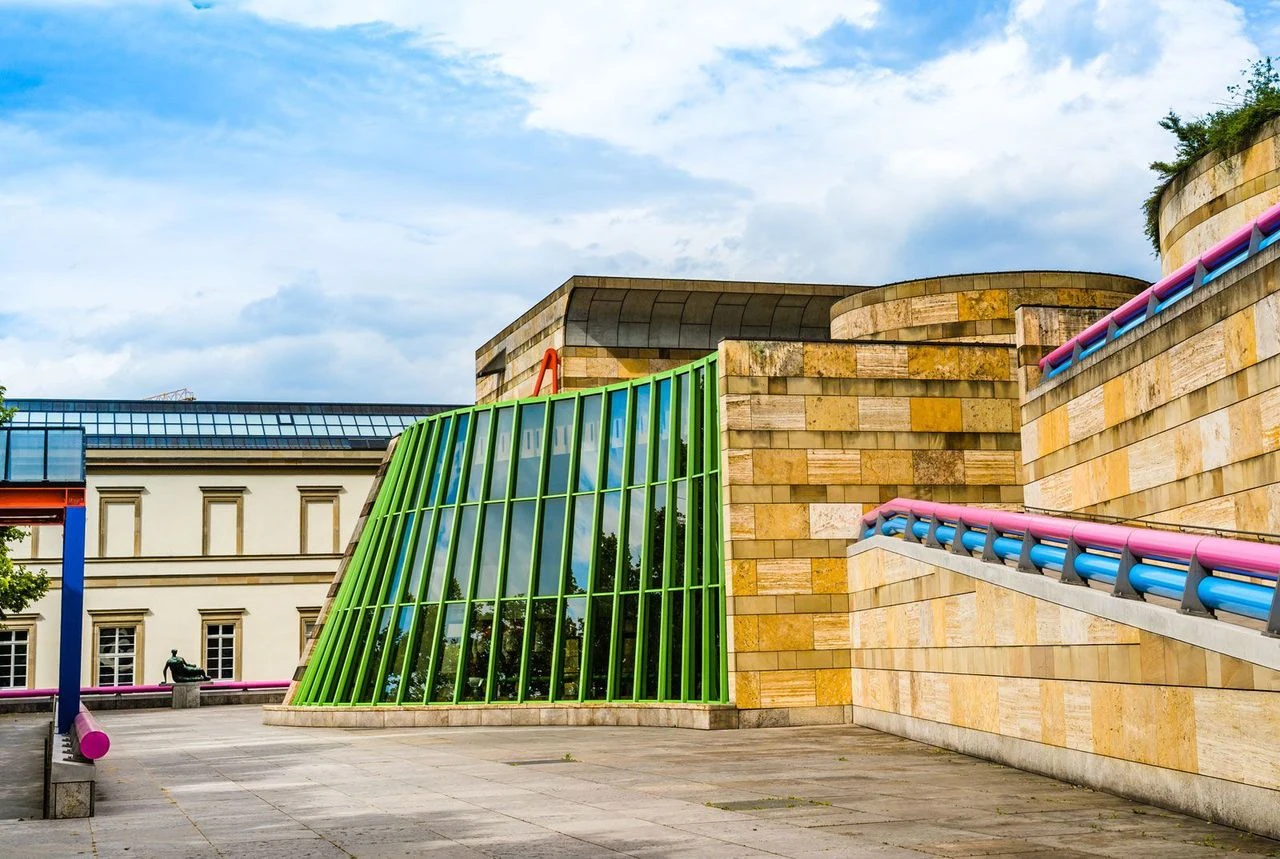
Stirling’s work in Germany took a different route. Completed in 1984, the Neue Staatsgalerie in Stuttgart combines contemporary design with references to classical architecture. Bold colours and varied materials contribute to its character, while colonnaded elements recall older architectural traditions. The effect is a meeting of historical reference and modern construction, rather than a straightforward return to a classical style.
The building demonstrates a broader range than the Leicester project. Where Leicester’s striking forms are closely associated with an engineering building’s functions, the Staatsgalerie uses historical forms as part of a dialogue between past and present. The contrast between the two works helps explain why Stirling cannot be reduced to a single label: his architecture could be modern in its means and playful in its engagement with architectural history.
The Neue Staatsgalerie strengthened Stirling’s international profile. The available account describes it as one of his most celebrated projects and notes that its design won awards, though it does not identify them. Its significance here is also visible in the building itself: it carries ideas associated with Stirling’s British career into a major project abroad, without simply repeating the Leicester design.
Influence and recognition
Stirling’s practice extended beyond the two buildings most prominent in this account. He is described as a theorist and educator as well as an architect, and as an influence on a generation of architects. The qualities associated with that influence include inventive use of materials, close attention to space and an interest in joining function with visual effect. These are consistent with the differences between Leicester and Stuttgart: each building uses its own arrangement of forms, materials and references.
In 1981, Stirling received the Pritzker Architecture Prize. The award brought international recognition to his work, while the projects themselves provided tangible examples of its range: a British university engineering building shaped by its practical purpose, and a German art gallery that brought historical reference into a contemporary setting. His career connected architectural debates in Britain with a wider international audience.
Why James Stirling deserves a place in British Legacy
James Stirling belongs in British Legacy because his work gives a specific account of how British architecture could engage with modernity. Born in Glasgow and educated at Liverpool, he helped shape a distinctive building in Leicester whose red brick, glass-fronted workshops, service tower and sloping roofs made engineering part of its architectural character. Designed with James Gowan, it shows that function need not be concealed or expressed through a monotonous form. The building’s importance is therefore both visual and practical: it offers an example of an institution whose purpose and design can be read together.
His international work adds another dimension. In Stuttgart, the Neue Staatsgalerie combined contemporary design with classical references, showing how historical forms could be used without simply reproducing the past. The contrast with Leicester reveals an architect willing to find different answers for different buildings. Stirling’s Pritzker Prize and his influence as a theorist and educator mark the reach of that work, but the buildings remain the clearest evidence of its value. His British legacy is not a general claim about national character; it lies in identifiable projects, a British architectural education and a career that carried ideas developed in the UK onto an international stage.