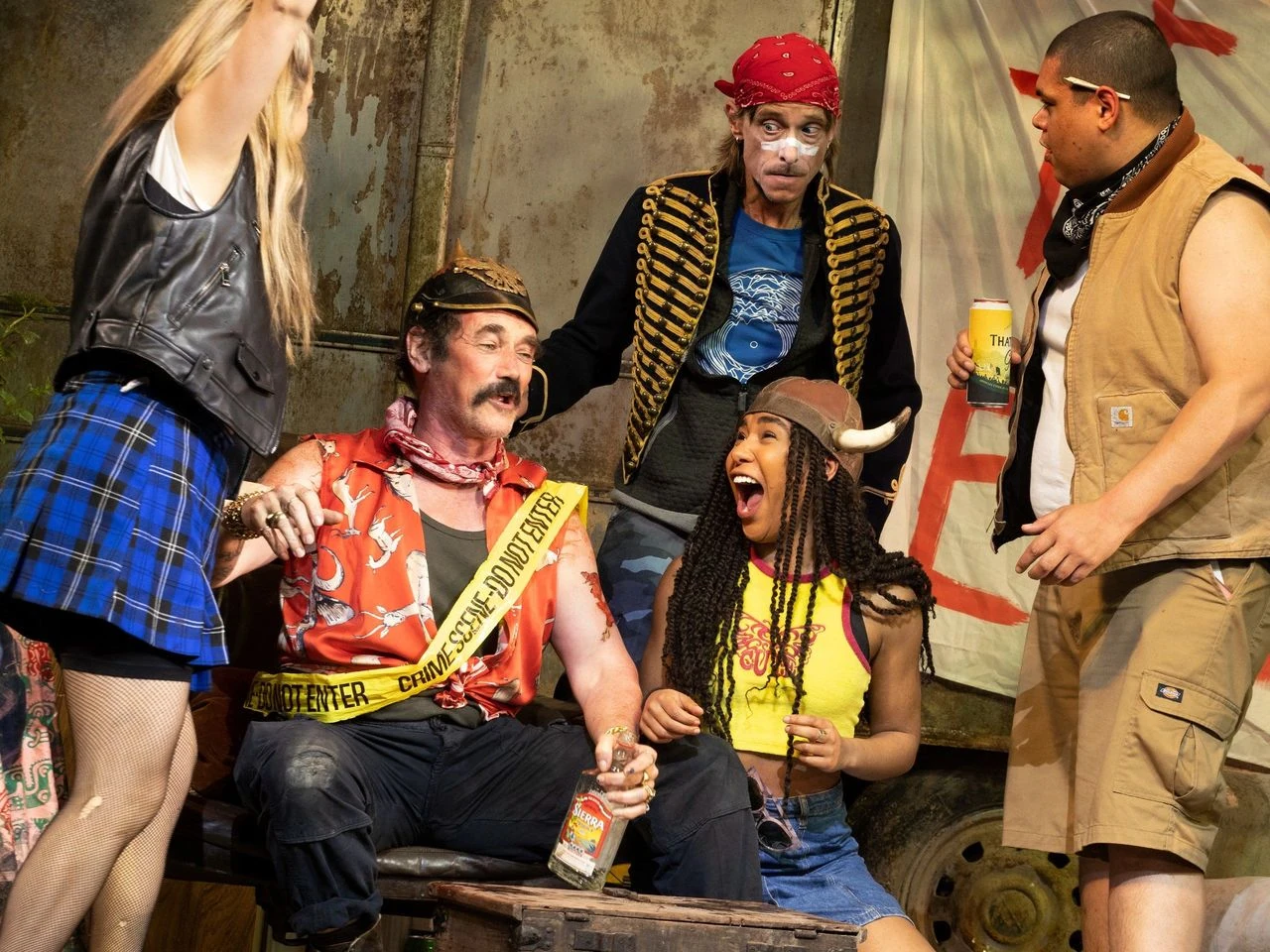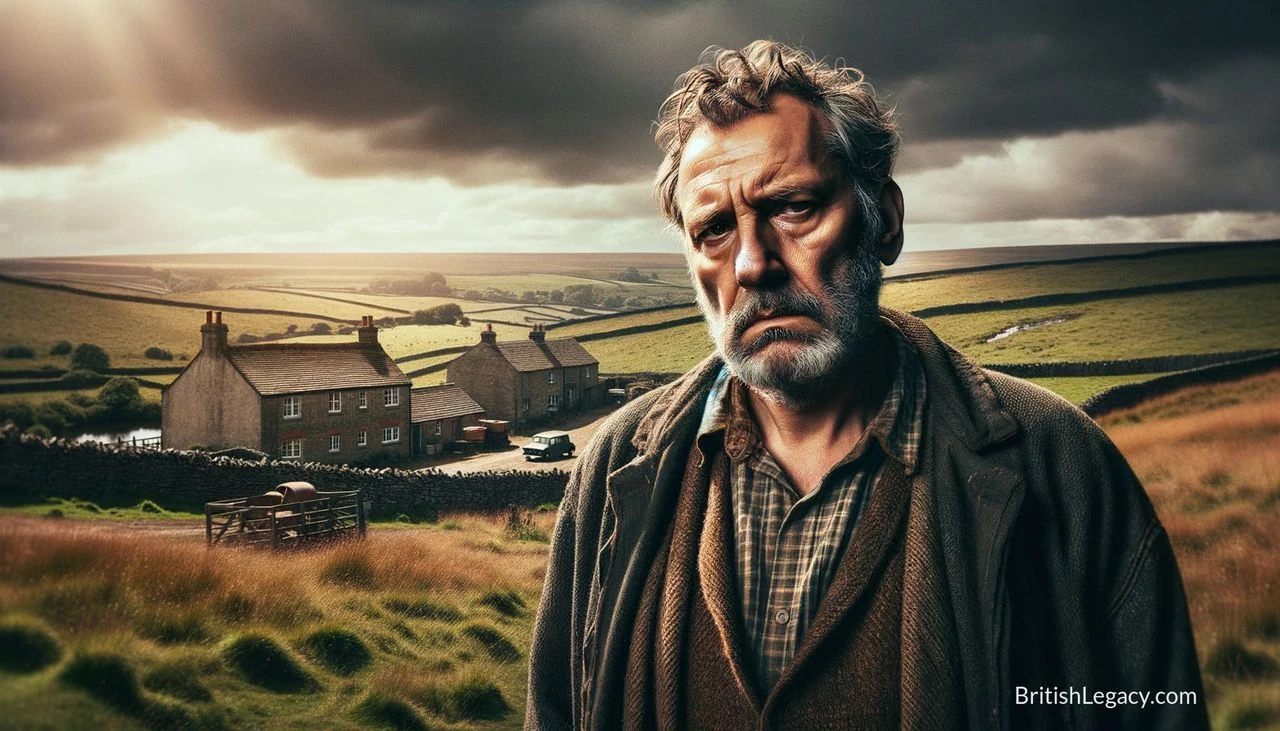
On St George’s Day, with the local county fair approaching, Johnny “Rooster” Byron wakes in his woodland caravan to the threat of eviction. The council wants him off the land; his young son wants a trip to the fair; and the young people around him come for company, drink, drugs and the tales he spins. Jez Butterworth’s Jerusalem makes this unruly encampment the setting for a larger argument about who belongs, what England remembers and what happens when a community tries to push its troublesome people aside.
A play born at the Royal Court
Butterworth’s play, written in English, opened at the Royal Court Theatre’s Jerwood Theatre in London on 15 July 2009. Mark Rylance played Byron, with Mackenzie Crook as Ginger. The production attracted strongly positive reviews and its run was extended. It was directed by Ian Rickson, and its deliberately vivid stage world included live chickens, a tortoise and goldfish, as well as real trees around the caravan.
The play’s original setting is a wood in Wiltshire, on the morning of a county fair. Its community is not presented as a pastoral idyll: it is full of tensions, obligations and conflicting ambitions. Byron is a local “waster”, an ex-daredevil and a teller of improbable stories. Council officials seek to serve an eviction notice; his son Marky wants his attention; Troy Whitworth threatens violence; and Byron’s circle gathers at the caravan. The day’s events bring together the everyday pressures of family, money and local authority with the half-mythic atmosphere of Byron’s storytelling.
Rooster and the people around him
Byron’s charisma does not make him a simple hero. He holds parties, gets drunk and supplies drugs, including to under-age people. He rarely sees his young son, and his ex-girlfriend Dawn disapproves of his way of life. His stories and generosity draw people in, but they sit alongside choices that cause harm. That friction gives the play’s attraction to its central figure a necessary complication: the people who find refuge at his caravan are also caught up in the consequences of his conduct.
Ginger, older than the other young people who spend time with Byron, still hopes to become a DJ while working as an unemployed plasterer. Lee plans to leave for Australia despite having little money; Davey, a teenage abattoir worker, cannot bear the thought of leaving Wiltshire. The Professor, an elderly, whimsical friend of Byron’s, offers a different kind of companionship. Around them are local girls Pea and Tanya, pub landlord Wesley, council officials Linda Fawcett and Luke Parsons, and the Whitworth family. Phaedra, Troy’s stepdaughter, appears singing the hymn “Jerusalem” in fairy wings; her disappearance and eventual discovery in Byron’s caravan connect the day’s festivities to a more troubling domestic story.
These characters make the caravan more than a refuge from the council. It is a meeting place for people whose plans and prospects do not fit neatly with the community’s expectations. The play does not erase the risks of Byron’s influence, or the vulnerability of those around him. Instead, it places his appeal and his failings in the same crowded space.
England in a song
The title draws on William Blake’s lyrics to “Jerusalem”, and the hymn recurs within the play. That allusion brings an idealised image of England into contact with a less settled rural present. Butterworth’s Wiltshire is neither a simple celebration of tradition nor a rejection of it: fair-day customs, Morris dancing and local attachments coexist with eviction, family conflict and the possibility that young people will leave.
Byron’s fanciful accounts lend the play a modern-mythic dimension. He can seem like a Pied Piper, gathering people around him, yet his stories do not resolve the material disputes of the day. The eviction notice remains; so do the demands of parenthood, the desire to escape and the prospect of violence. The play’s tension comes partly from holding those scales together: a particular woodland and its inhabitants are made to carry questions about national identity and belonging without turning into symbols stripped of their messy human lives.
From London to Broadway and back
After its Royal Court run, Jerusalem transferred to the Apollo Theatre in London in January 2010, opening there on 28 January for a limited engagement that closed on 24 April. Rylance won the Laurence Olivier Award for Best Actor for his performance. The production went to Broadway in 2011, opening at the Music Box Theatre on 21 April after previews. It was extended and returned to the West End’s Apollo in October, where it played until January 2012.
The Broadway production received a Tony nomination for Best Play. Rylance won the Tony Award for Best Actor in a Play; Crook was nominated for Best Featured Actor. The production also received nominations in categories including sound, lighting and scenic design, while Rylance was nominated for a Drama Desk Award and an Outer Critics Circle Award. The current article also reports an Evening Standard Award for Best Play.
The play continued in other forms and settings. A 2014 outdoor production, made by Common Players with Northcott Theatre, toured Devon and Somerset as New Jerusalem. The Watermill Theatre near Newbury staged the play in 2018 with Jasper Britton as Byron. Productions followed in Toronto, Vancouver, Barcelona and Helsinki, among other places; the Toronto production won six Dora Mavor Moore Awards and the John Caplan Audience Choice Award. In 2022, Rylance, Crook and other members of the earlier company returned to the Apollo for another West End run.
A lasting place in British theatre
Jerusalem has been included in Played in Britain: Modern Theatre in 100 Plays, a selection of influential plays performed in Britain between 1945 and 2010. Public polls have also registered its standing: it placed sixth in English Touring Theatre’s 2013 poll for the nation’s favourite play and ninth in a 2014 WhatsOnStage poll of the top 100 plays. In 2015, critic Michael Billington included it among his 101 greatest plays written in any Western language. Later lists by The Guardian and The Independent placed it among the leading works of modern theatre.
Its reputation has travelled alongside productions rather than resting on a single London engagement. The Broadway season carried the original production to a new audience; Canadian and European stagings have given the play other casts, languages and theatrical contexts. In Britain, its return to the Apollo in 2022 demonstrated the continuing interest in seeing Rylance’s Byron and Butterworth’s crowded, sharply observed world on stage. The work’s reach is therefore both local in its subject and international in its theatrical life.
Why Jerusalem deserves a place in British Legacy
Jerusalem deserves a place in British Legacy because it makes a recognisably English setting do more than supply local colour. A Wiltshire fair, Morris dancing, a woodland caravan and Blake’s hymn are placed beside council procedure, precarious lives and the strained ties between parents and children. The play’s British connection lies in that specific encounter between national myth and ordinary rural pressures. It neither treats England as an untouched pastoral refuge nor lets the hymn’s idealised vision stand without challenge.
Its achievement is also visible in the life of the production. From the Royal Court premiere and Olivier-winning West End run to Broadway, international stagings and the Apollo revival, the play has travelled without losing the particularity of its setting. Its recognition in theatre selections and public polls offers further evidence of its place in modern British drama. Just as importantly, Butterworth gives that status to a work whose central figure is compelling but compromised, and whose community contains people with divergent needs and futures. The result keeps questions of belonging, storytelling and social exclusion within the reach of an audience, while leaving the play’s tensions unresolved. That combination of theatrical ambition, cultural specificity and continuing performance makes Jerusalem a substantial part of Britain’s contemporary stage heritage.
Sources
Jerusalem (play), revision 1377892182
Adapted in part from Jerusalem (play) by Wikipedia contributors, under CC BY-SA 4.0. Text has been edited and combined with the existing article; this adapted text is shared under the same licence. Contributor history.