At sea, knowing how far north or south a ship had travelled was not enough. Sailors could still be dangerously uncertain of their east–west position, and a mistake could mean a missed harbour or a wreck. John Harrison, a carpenter from Yorkshire who taught himself clockmaking, spent decades tackling that problem. He developed timekeepers capable of keeping dependable time through the motion and changing temperatures of a long voyage. His work showed that a clock could help a navigator establish longitude at sea—and made precision time a practical instrument of navigation.
Harrison’s story is not a simple tale of one invention receiving an immediate reward. It is a sequence of machines, experiments and disputes over what counted as proof. His sea clocks developed through trial and revision; the compact H4 succeeded where earlier designs had not. Even then, recognition and payment came slowly. The importance of his work lies both in that achievement and in the practical clockmaking innovations that helped make it possible.
The longitude problem
Longitude was difficult to establish because a ship’s position estimated by dead reckoning could drift further from the truth as a voyage went on. Latitude could be found with greater confidence, but determining how far east or west a vessel had travelled remained a serious navigational challenge. Parliament recognised its national importance in the Longitude Act of 1714, which offered rewards of up to £20,000 for a practical solution.
One proposed approach used astronomy: navigators could compare what they observed in the sky with predicted positions. Harrison pursued a timekeeping solution. If a ship carried the time at a fixed reference point and its crew compared that with local time, the difference could indicate how far east or west the ship had travelled. The idea depended on a clock that could keep accurate time for a long period at sea.
That was a demanding engineering problem. A vessel rolled and pitched; it encountered changes in temperature and corrosive salt air. Conditions that a clock could tolerate on land could disrupt it at sea. Metal expanded and contracted, springs changed with temperature, and lubricants could fail. The obstacle was not simply to make a clock accurate in a workshop, but to preserve its accuracy through conditions that worked against it. Harrison set out to make a timekeeper suited to that environment.
A Yorkshire craftsman and clockmaker
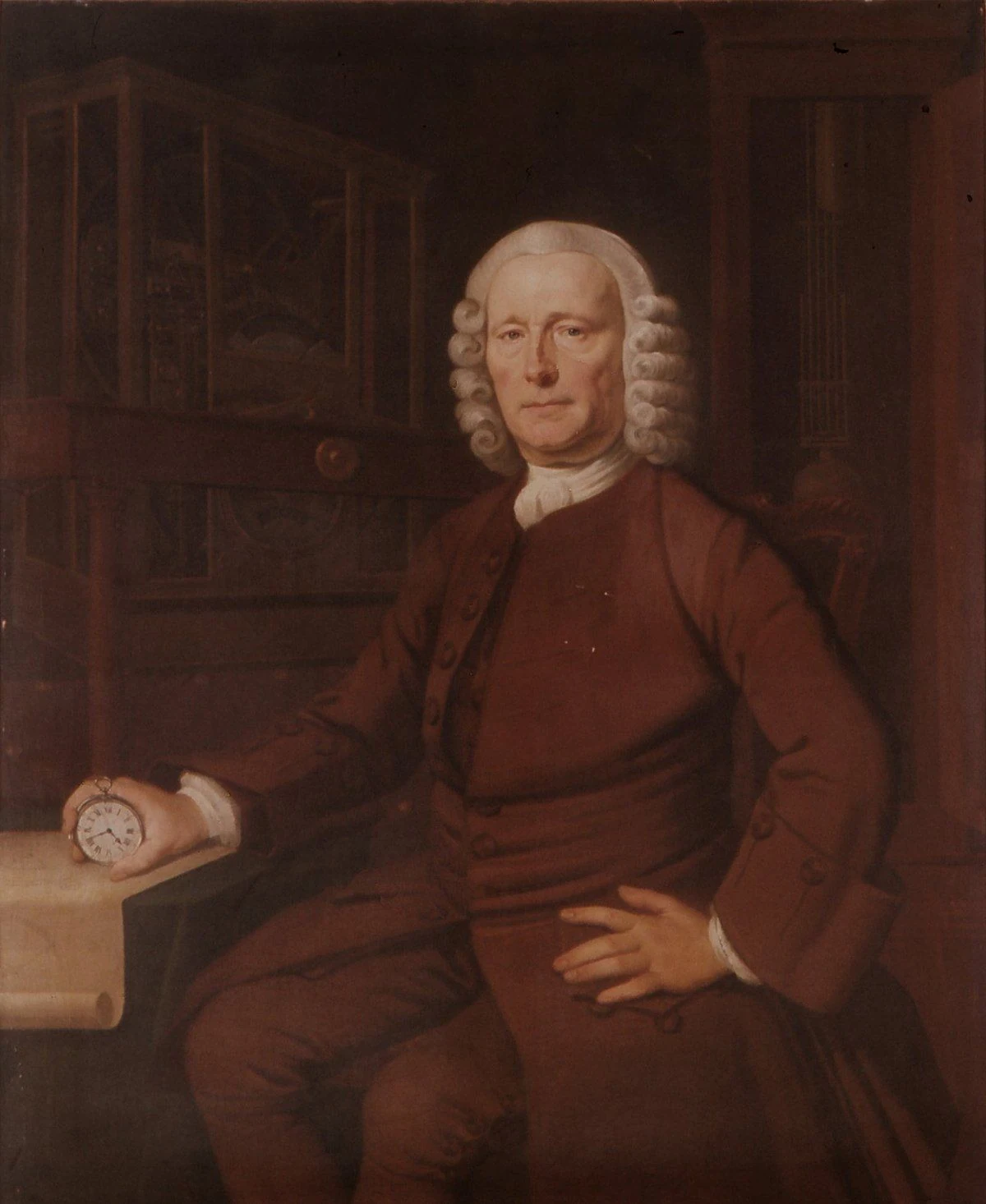
Harrison was born on 3 April 1693 in Foulby, in the West Riding of Yorkshire. The family later moved to Barrow upon Humber in Lincolnshire. He followed his father’s trade as a carpenter and taught himself clockmaking. His practical experience with materials informed the way he approached the problem: precision depended on how a mechanism behaved, where friction arose and how its parts responded to their surroundings.
He built his first longcase clock in 1713, and several of his early wooden clocks survive. In the 1720s, he made precision clocks and developed two devices that reflected his interest in controlling the effects of friction and temperature. The gridiron pendulum used different metals to counteract thermal expansion. His grasshopper escapement controlled a clock’s motion with little friction and reduced the need for lubrication. His precision longcase clocks were reported to reach an accuracy of about one second a month—evidence that his work on reliable timekeeping had advanced on land before he began his most famous sea-going designs.
Those inventions were not a separate prelude to the longitude work. They formed part of the same practical effort: understanding how a timekeeper could stay accurate when its materials and moving parts were subject to change. Harrison’s expertise came from working through those physical constraints rather than treating accuracy as a matter of theory alone.
From H1 to H4
In 1730, Harrison took his ideas to London. Edmond Halley directed him to the clockmaker George Graham, who was sufficiently impressed to lend him money for a model. Harrison spent five years making what became known as H1. This was not a portable watch but a large sea clock, using linked balances rather than a pendulum. On a trial voyage to Lisbon in 1736, it performed well enough to win support from the Board of Longitude for further work.
Harrison continued with H2 and H3, but neither brought the problem to a conclusion. H2 revealed a weakness associated with a ship’s turning motion. H3 took seventeen years and fell short of Harrison’s hopes. That extended work nevertheless produced useful ideas, including the bimetallic strip and the caged roller bearing. Harrison did not simply repeat his earlier approach: he used what he had learned to rethink the form a successful sea timekeeper might take.
The change of direction led to H4, completed in 1759. Unlike its large predecessors, it looked more like an oversized watch than a shipboard clock. Its compact form brought together Harrison’s work on balance, friction and compensation in a timekeeper a navigator could use. H4 was trialled across the Atlantic in 1761–62, travelling to Jamaica in the care of Harrison’s son William. Its error on arrival was small enough to correspond to roughly a nautical mile in longitude. A further trial to Barbados provided another test of its performance.
H4 mattered because it demonstrated that timekeeping could work as a way of finding longitude at sea. Harrison’s achievement was not that every ship immediately carried one of his instruments. It was that he had made a solution work in the conditions it needed to meet, after years of building and testing different designs.
Trials, recognition and reward
Success did not end the dispute over Harrison’s work. The Board of Longitude did not simply award him the full £20,000 offered under the 1714 Act after H4’s trial. Commissioners wanted further trials, disclosure of the mechanism and confidence that the method could be reproduced in practice. Those requirements reflected the public purpose of the reward, but the process became contentious. Disagreements between Harrison and Astronomer Royal Nevil Maskelyne sharpened the arguments over testing and interpretation.
Recognition came in stages. The Royal Society awarded Harrison the Copley Medal in 1749, before the longitude dispute was settled. Later, having built H5 and secured the support of George III, he received a parliamentary award of £8,750 in 1773. He had received substantial sums during the wider process, but his reward was not the straightforward payment of an uncontested £20,000 sometimes suggested by a compressed account of the story. The years of argument show how difficult it could be for an inventor to secure recognition and payment even when the work had demonstrated its practical value.
Harrison died on 24 March 1776. His timekeepers remained part of the material record of his work: H1, H2, H3 and H4 are displayed at the Royal Observatory, Greenwich, while H5 is held in the Science Museum Group collection. Their survival makes the stages of his effort visible, including the machines that helped him reach a working design and those that preceded it.
From a demonstration to wider use
Harrison’s instruments were the beginning of a wider development in marine timekeeping, not the end of it. Larcum Kendall made K1, a copy of H4, which accompanied James Cook on later voyages and helped produce notably accurate charts. In subsequent decades, makers including John Arnold and Thomas Earnshaw helped move marine chronometers towards wider use. Harrison’s contribution was foundational: he proved that a timekeeper could provide a practical means of finding longitude at sea, leaving later makers to develop instruments that could be reproduced and bought more widely.
The benefit was relevant to naval, commercial and exploratory voyages. More dependable position-finding helped ships make landfalls more safely and plan passages with greater confidence. Better navigation also supported more accurate chartmaking. These outcomes should not be confused with Harrison personally supplying every vessel or single-handedly transforming maritime travel. His specific achievement was to show that the core method worked; other makers and navigators carried that demonstration into broader use.
His legacy also reaches beyond the marine chronometer. The gridiron pendulum, grasshopper escapement, bimetallic strip and caged roller bearing all emerged from his attention to the behaviour of clocks and their components. His career connects workshop practice with a national problem: a carpenter-clockmaker from Yorkshire developed mechanisms that helped make accurate time useful to sailors far from land.
Why John Harrison deserves a place in British Legacy
John Harrison deserves a place in British Legacy because he joined skilled making to a problem with direct consequences for people at sea. Longitude was not an abstract puzzle: a ship that could not establish its east–west position reliably risked missing its destination or wrecking. Harrison developed a way to carry accurate time through a long voyage, tested it in sea-going instruments and demonstrated that timekeeping could solve the navigational problem. His work helped make position-finding more dependable and supported safer landfalls, improved charts and more reliable passages for commercial, naval and exploratory ships.
His achievement also has a distinctly practical shape. H1, H2 and H3 were not simply discarded failures; they were stages in a sustained process that led to H4. The surviving machines, now held at the Royal Observatory, Greenwich, and in the Science Museum Group collection, make that development tangible. Harrison’s other innovations—the gridiron pendulum, grasshopper escapement, bimetallic strip and caged roller bearing—show how closely his major result was connected to a wider body of clockmaking work. Later makers adapted and spread the marine chronometer, but Harrison’s demonstration made that progress possible. Remembering him means recognising not only an ingenious instrument, but the persistence, technical judgement and public usefulness behind it.