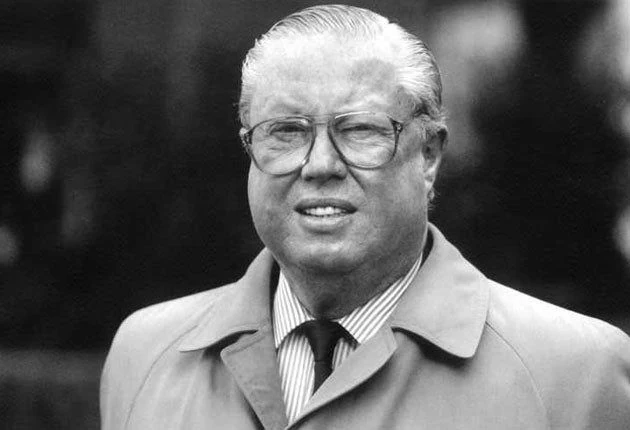
On 27 June 1967, customers at a Barclays branch in Enfield, north London, could withdraw cash from a machine outside the bank. It was not a modern ATM: users needed a special single-use token, and the maximum withdrawal was £10. But the machine offered something new: access to cash without a clerk serving at the counter. John Shepherd-Barron led the team behind that first installation. His place in the history of the cash machine is significant, though the story is not one of a lone inventor working in isolation.
A life between continents
John Adrian Shepherd-Barron was born on 23 June 1925 in Shillong, then in British India, to British parents. His father, Wilfred Shepherd-Barron, was an engineer who later became president of the Institution of Civil Engineers. His mother, Dorothy, was an Olympic tennis player and Wimbledon ladies’ doubles champion. The family’s achievements in engineering and sport are notable parts of his background, but they do not provide a simple explanation for the invention that later made his name.
He attended Stowe School and studied at the University of Edinburgh. He also went to Trinity College, Cambridge, but left before successfully completing his first year in economics. During the Second World War, he served in the airborne forces with the 159th Parachute Light Regiment. These were distinct stages in a life that crossed countries and institutions; his eventual role in British banking technology came through his work in industry rather than an academic career.
In the 1950s Shepherd-Barron joined De La Rue as a management trainee. The British company was associated with banknotes and secure documents. That experience is central to understanding the cash machine: dispensing money required more than a mechanism for pushing notes through a slot. The system had to accept a means of identifying the customer and release a controlled amount of cash. Shepherd-Barron rose to become managing director of De La Rue Instruments, placing him in a position to lead the work on a new kind of cash service.
The problem of banking hours
Shepherd-Barron later recounted that the idea came after he arrived at a bank too late to withdraw money. He began thinking about chocolate vending machines and whether a comparable machine could dispense cash. In his account, the attraction was being able to get his own money without having to arrive during a bank’s opening hours. The story offers a clear explanation of the problem that interested him, but it should not be treated as a complete account of the development of automated banking. Other engineers and organisations were also working on cash-dispensing systems.
The practical question was how to turn that proposition into something a customer could use. A bank counter brought staff, records and established procedures together; an unattended machine needed a more limited task and a way to check the person asking for money. The De La Rue system concentrated on dispensing cash, rather than trying to reproduce every service provided by a bank clerk. That focus made the first machine different from the networked, card-based devices familiar today. It was an answer designed for the possibilities and constraints of its own period.
Barclays backed the experiment, and De La Rue developed the Automatic Cash System, also known as Barclaycash. The project joined the bank’s willingness to put the device into public use with a company experienced in secure documents and Shepherd-Barron’s leadership of the team. The first machine was installed outside the Barclays branch in Enfield in June 1967. Actor Reg Varney was the first person to withdraw cash from it. An early installation outside Britain followed in Zürich in November that year, where the machine was called a Geldautomat.
The Enfield installation mattered because the public could use an automated cash dispenser at a bank branch. That achievement is more precisely described as a first public installation than as proof that one person invented every feature of the modern ATM. The machine was a working service, but it belonged to a field in which different systems and approaches were being developed.
Tokens, carbon-14 and the four-digit PIN
Barclaycash did not take a reusable plastic bank card. Customers used cheque-like tokens obtained in advance. Inside the machine, a token was cut to the size of a normal cheque; it had been impregnated with a radioactive compound of carbon-14. The machine detected its signal and matched it against the personal identification number, or PIN, entered on a keypad. Withdrawals from the first machines were limited to £10.
The carbon-14 method can sound startling from a modern perspective, but it illustrates the design challenge rather than a resemblance to present-day technology. The machine needed a way to test whether a transaction was authorised before it released money. Its combination of token and keypad supplied that check in a form developed for the system. The customer, meanwhile, had to obtain the token before using the machine. Barclaycash offered a service beyond the staffed counter, but it did not yet offer the convenience of a reusable card.
The PIN became one of the lasting elements associated with Shepherd-Barron’s work. He initially proposed a six-digit number, then said he tested the idea with his wife, Caroline, and found that four digits were easier to remember. The system used four-digit PINs. The account connects a simple design decision to an everyday user’s experience: authentication must be manageable by the customer as well as useful to the system. The four-digit format became a familiar feature of cash-machine use, although the early token-based machine was not otherwise the same as later ATMs.
The £10 limit also shows how carefully bounded the first service was. This was not a device for unrestricted access to an account. It offered a defined withdrawal, using a prepared token and a PIN. Those limits do not make the machine less historically important; they show what the first installation actually accomplished. It established that cash could be issued by a machine in a public banking setting without a clerk handing it over.
Why ATM credit needs care
Shepherd-Barron received an OBE in the 2005 New Year Honours for services to banking. The honour recognised his role as an inventor of the automatic cash dispenser. Yet a careful account distinguishes the first installed cash machine from the subsequent development of the modern ATM, which involved other people and designs.
James Goodfellow, working at Smiths Industries, developed a different system with Anthony Davies. Their approach allowed the customer’s PIN to be stored on a reusable bank card rather than on a single-use cheque. The system was patented as GB1197183 and US3905461. In important respects, this card-based approach more closely resembled later ATMs than the original Barclaycash machine did.
These contributions belong to related but distinguishable parts of the history. Shepherd-Barron led the team behind the first installed cash machine; Goodfellow and Davies developed a system based on a reusable card and PIN. Describing Shepherd-Barron as the sole inventor of the modern ATM would blur that distinction and turn a history of competing approaches into a simplified claim of individual authorship. His achievement does not depend on such a claim. The first installation itself marks a practical step from a proposed service to a machine operating outside a bank branch.
Nor should the Enfield machine be credited with creating every later form of electronic finance. The supplied evidence supports its place in the history of automated cash dispensing and records a separate reusable-card system. It does not establish that Shepherd-Barron’s machine directly produced debit and credit cards, online banking or mobile payments. Those broader developments should not be compressed into a single inventor’s story.
From an experiment to an everyday service
Before cash machines, withdrawing money from a bank counter depended on the branch being open and a member of staff carrying out the transaction. An automated dispenser changed that particular arrangement: a customer could obtain a limited amount of cash from a machine without a clerk handling the withdrawal. The first version required advance preparation and offered a restricted service, but it made cash dispensing outside counter service a public reality.
That change was practical rather than all-encompassing. The machine did not replace a bank branch or perform all the work of a teller. It did, however, introduce a way to make one transaction available through a machine. Customers had to use a token and PIN; the bank and its technical partner had to make the equipment function as a cash service. The arrival of that arrangement helped make automated self-service part of banking’s changing relationship with customers.
The difference between Barclaycash and later machines is important. Shepherd-Barron’s team used single-use tokens carrying a carbon-14 marker, while Goodfellow and Davies developed a system with a reusable card. Later card-based and digital banking depended on developments beyond the Enfield machine. The first installation is best understood as a demonstrable early service, not as a complete blueprint for every banking technology that followed.
In 1953 Shepherd-Barron married Caroline Murray, daughter of Sir Kenneth Murray, who had been chairman of the Royal Bank of Scotland. They had three sons. Shepherd-Barron died in Inverness on 15 May 2010, aged 84, after a brief illness. By then, cash machines had become a familiar part of daily life. That familiarity can make it easy to overlook the decisions behind the first system: what task the machine should perform, how it would recognise an authorised transaction and how a bank might offer the service beyond its staffed counter.
Why John Shepherd-Barron deserves a place in British Legacy
John Shepherd-Barron deserves a place in British Legacy because he helped turn automated cash dispensing into a public service in Britain. The Enfield machine answered a practical inconvenience: customers could not withdraw cash from a bank counter after it had closed. With De La Rue and Barclays, Shepherd-Barron helped bring a machine outside a bank branch into operation. Its single-use tokens, carbon-14 authentication and £10 limit make clear how different it was from a modern ATM. They also show the concrete problem the team had to solve: how to identify a customer and release cash without a clerk handing it over. This was not merely an idea about convenience; it was a system put to use in a British high-street setting.
His place in the story is strongest when the credit is kept accurate. Goodfellow and Davies developed a separate reusable-card system, and later banking technologies cannot be attributed to Shepherd-Barron alone. His distinction is that he led the team behind the first installed cash machine and helped demonstrate that a bank could provide access to cash beyond its staffed counter. The British connection lies in the work’s setting and collaborators: De La Rue developed the system, Barclays backed its use, and the first machine was installed in Enfield. Together, those details make a more substantial legacy than the label “father of the ATM”. They show how an invention can change expectations by making a specific service available in a new way—and why public adoption, technical design and collaboration all matter to the history of innovation.
Sources
Adapted in part from John Shepherd-Barron by Wikipedia contributors, under CC BY-SA 4.0. Text has been edited and combined with the existing article; this adapted text is shared under the same licence. Contributor history.