Joseph Aspdin’s most influential work is usually concealed inside the buildings and structures made with cement. The Leeds bricklayer did not produce the modern material in its finished form, but in 1824 he patented a process for an artificial stone and gave it a name that endured: Portland cement. His story is not that of a lone inventor delivering a complete technology in one stroke. It is a more revealing account of how trade knowledge, patenting and early manufacture created a platform that later makers could improve.
A bricklayer in Leeds
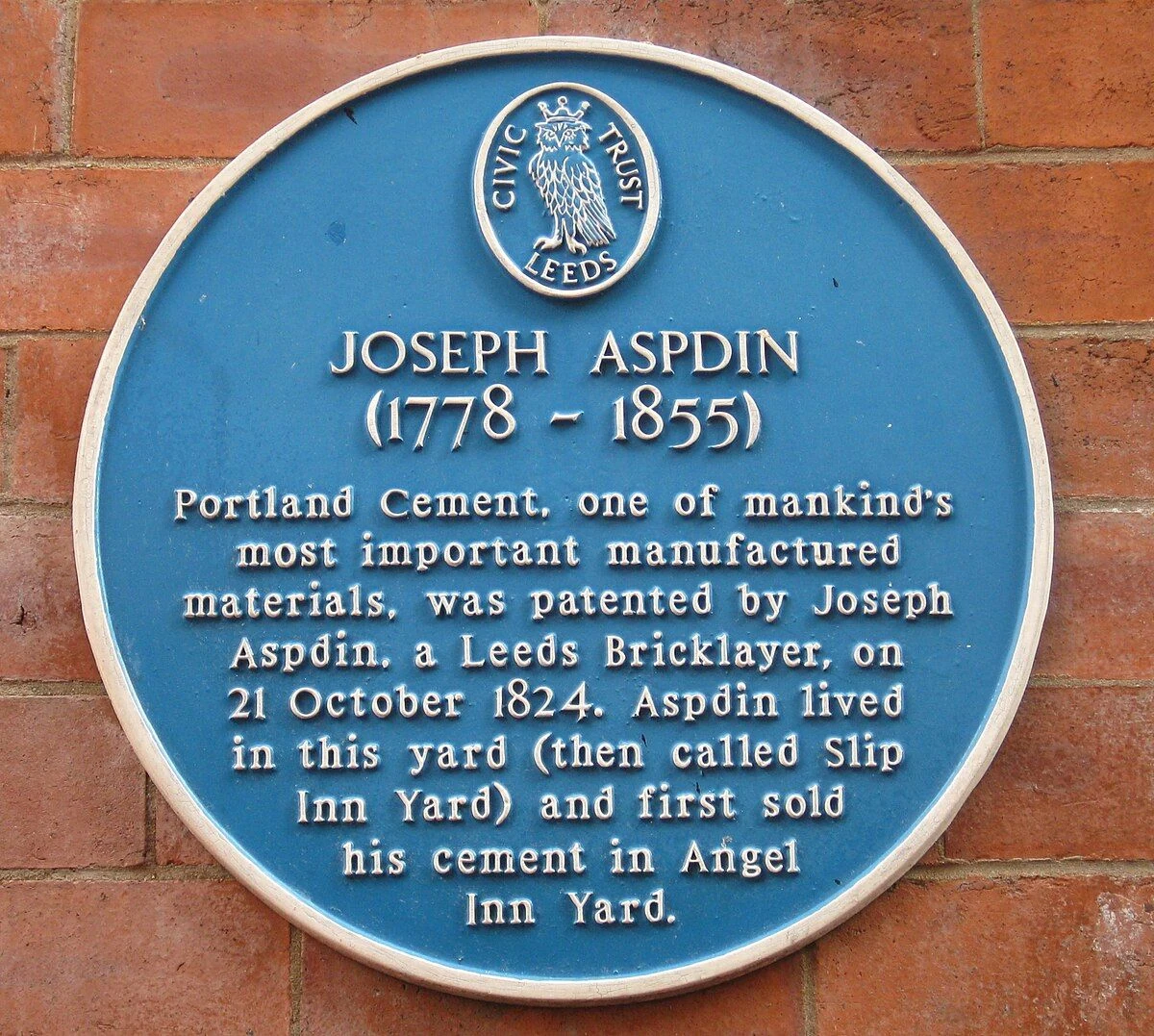
Aspdin was born in Leeds on 25 December 1778, the eldest of six children of Thomas Aspdin, a bricklayer in Hunslet. He followed his father into the trade and married Mary Fotherby at Leeds Parish Church on 21 May 1811. By 1817 he had established himself in business in central Leeds. Those details place his work in the world of practical building: a trade in which the behaviour of mortar and other materials mattered directly to the quality and durability of a job.
His later patent describes a product intended for stuccoing buildings, waterworks, cisterns and other purposes. It also makes clear that he was working with materials close at hand. Aspdin wrote of limestone used for making or repairing roads, including material reduced to a powder or puddle; if that supply was unavailable, he said, limestone itself could be used. He mixed it with clay and water, dried the mixture, fired it and ground the resulting material to a fine powder. The patent’s account is practical rather than grand: a recipe for making a usable product from familiar ingredients.
Cement is a binder: mixed with water and other materials, it helps turn loose particles into a coherent mass. Aspdin’s patent matters partly because it documents an attempt to make such a material for building work and to secure a commercial identity for it. But the document does not describe Portland cement in the form most people would recognise today. The distinction is essential to understanding both his achievement and the later history of the material.
The patent and the name
On 21 October 1824 Aspdin was granted British Patent BP 5022, entitled An Improvement in the Mode of Producing an Artificial Stone. The specification set out his process and named the product Portland cement. Aspdin chose the name because mortar made from it, once set, resembled what he called “the best Portland stone”. Quarried on the Isle of Portland in Dorset, that stone was a prestigious building material. The comparison gave a new manufactured product a familiar point of reference.
The patent describes limestone and clay mixed with water to a fine consistency. Aspdin then proposed evaporating the water, breaking the dried mixture into lumps, calcining it in a furnace until carbonic acid had been expelled, and grinding the calcined material into powder. Mixed with water again, it could be brought to the consistency of mortar. The process and the carefully chosen name were both part of his contribution: he claimed a method and presented the resulting material to potential users under an identity that survived.
Yet the patent is not proof that Aspdin had already produced the high-strength Portland cement used in modern construction. The source account says the process was fired at a comparatively low temperature and that its intended market included stucco and architectural mouldings. It describes a fast-setting, low-strength product, not the later material’s full capabilities. Aspdin’s cement is therefore better understood as an early stage in a continuing development than as a finished modern formula.
That qualification is not a reason to dismiss his work. The patent records a named product, a specified manufacturing route and a serious effort to put the material into use. It also preserves the practical details of an early industrial process, from the choice of raw materials to the grinding of the final powder. Invention in manufacturing is often cumulative: an early method can establish a route that later makers alter, test and extend. Aspdin’s importance lies in that beginning, not in a claim that every later advance was already present in his 1824 product.
From patent to production in Wakefield
Aspdin moved quickly from patenting to manufacture. In 1825 he formed a partnership with William Beverley, a neighbour from Leeds, and established a production plant in Kirkgate, Wakefield. Beverley remained in Leeds, while Aspdin moved with his family to Wakefield. In the same year Aspdin obtained a second patent, this time for a method of making lime. His work was no longer only a specification on paper: it involved a plant, a partner and the practical demands of producing material for sale.
The enterprise was affected by the infrastructure changes of the period. In 1838 the Manchester and Leeds Railway Company compulsorily purchased the land occupied by the original Kirkgate plant. Aspdin moved his equipment to another nearby site. The episode offers a small-scale view of industrial change: railway expansion altered the circumstances of a manufacturer even as the growth of industry created demand for new materials.
Aspdin’s sons also became involved. James worked as an accountant in Leeds, while William ran the plant. In 1841 Joseph entered into partnership with James and published a notice stating that William was no longer employed by the firm and was not authorised to receive money or contract debts on its behalf. The notice makes clear that the change was a business matter with practical consequences, rather than a simple family succession.
In 1843 William established his own works at Rotherhithe, near London. There he introduced a substantially stronger cement, described in the supplied biographical account as the first modern Portland cement. The distinction between father and son is important: Joseph patented and manufactured an earlier product, while William’s modified process produced a stronger material. Joseph retired in 1844, transferring his share of the business to James. James later moved the plant to Ings Road, where it continued in operation until 1900. Joseph died at home in Wakefield on 20 March 1855, aged 76.
A material improved by successive makers
The development of cement did not stop with the Aspdin family. The source account credits later makers, including Isaac Charles Johnson, with further improvements to firing, proportions and grinding. William’s changes included using a mix with a higher limestone content, firing it at a higher temperature and grinding the harder clinkered material. Those changes helped produce a stronger cement, but they also meant more wear on the grinding equipment. The history is one of adjustments to both the material and the means of manufacturing it.
Aspdin’s own product belonged to a period in which manufacturers were developing artificial cements to compete with Roman cement. Its double-burning method first treated the limestone and then fired it again after it had been mixed with clay. The source text describes this as a practice used by manufacturers working with hard limestone. Such detail helps explain why the patent should not be read as a complete blueprint for later cement: production depended on the materials available, the equipment in use and the properties a maker sought.
William’s later work also illustrates how a useful invention can be inherited without remaining unchanged. The first product bearing the name Portland cement and the stronger material that followed were related, but not identical in capability. Joseph’s patent and early production provided part of the foundation for the subsequent industry; refinement by other makers extended what the material could do. Giving credit accurately means recognising both the initiating work and the later development.
Why the distinction matters
It is tempting to compress Aspdin’s life into the claim that he invented modern Portland cement. That version is simple, but it blurs the technical history. The evidence supplied here supports a more precise account: he obtained a patent in 1824, used the name Portland cement, described a process for producing an artificial stone and established a manufacturing works in Wakefield. The product described in the patent was not the high-strength cement that later came to define modern Portland cement.
This precision does not diminish Aspdin’s place in the story. It shows what innovation can involve before a material reaches its mature form: a working method, a name, a patent and an attempt to make and sell the product. His career connected craft and manufacture. He came from a family of bricklayers, entered the same trade and pursued a new building material through a patent and a commercial works. Later improvements did not erase that contribution; they make its character easier to see.
Why Joseph Aspdin deserves a place in British Legacy
Joseph Aspdin deserves a place in British Legacy because his contribution is specific and enduring. A bricklayer from Leeds, he secured a British patent for an artificial stone in 1824, gave the product the name Portland cement and took the work into production in Wakefield. His achievement linked a skilled trade to an emerging manufacturing enterprise. It also gave later makers a starting point from which they could alter the process and develop stronger cement. That is a substantial contribution, even when it is described without the inaccurate claim that Aspdin alone produced the modern material in its final form.
The British connection is rooted in the evidence of his life and work: his family and trade in Leeds, his patent in Britain, his manufacturing partnership and plant in Yorkshire, and the later business carried forward by his son. Portland cement’s name also drew on Portland stone from Dorset, connecting a new manufactured product with a renowned British building material. Aspdin’s legacy is therefore not a vague claim to national ingenuity. It rests on an identifiable process of invention and manufacture, and on a name still attached to a major family of cement. Remembering him accurately gives credit to practical experiment while acknowledging the later work that made the material stronger and more widely useful.
Sources
Joseph Aspdin — supplied Wikipedia revision
Adapted in part from Joseph Aspdin by Wikipedia contributors, under CC BY-SA 4.0. Text has been edited and combined with the existing article; this adapted text is shared under the same licence. Contributor history.