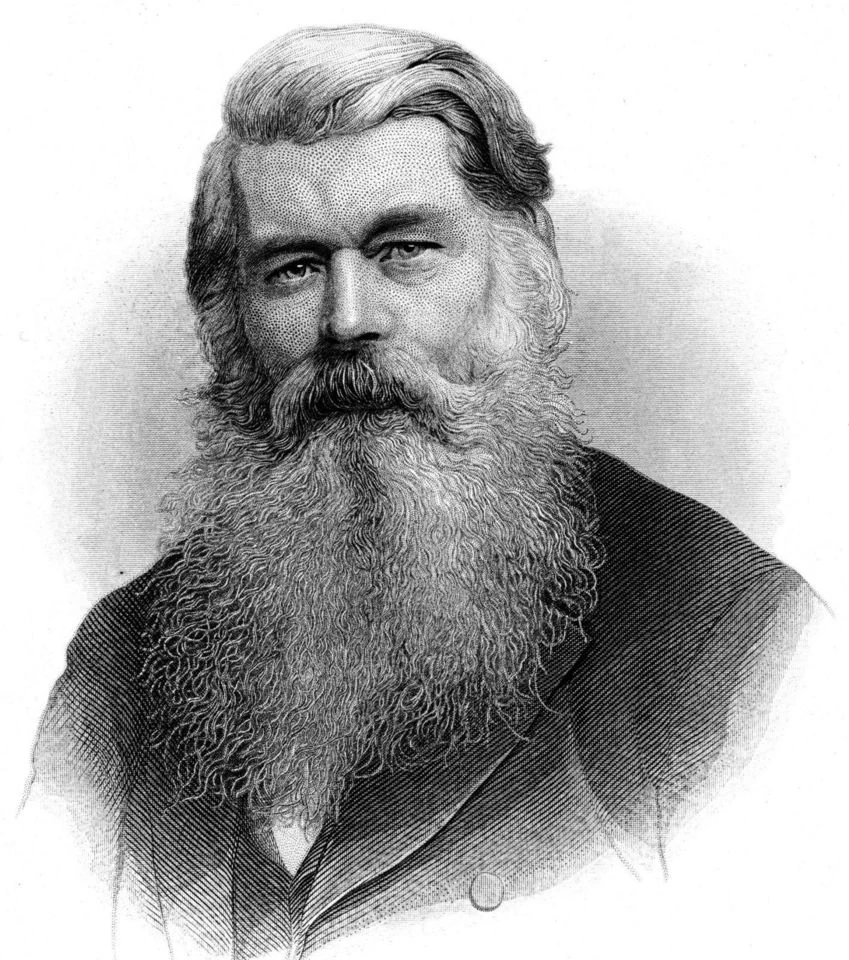
Electric light did not arrive in Britain in a single flash of inspiration. Joseph Wilson Swan spent decades working through the practical obstacles: how to make a filament glow without burning away, how to remove enough air from a glass bulb, and how to turn an experiment into a lamp that could be installed and used. His work helped bring incandescent lighting from demonstrations into homes, public rooms, ships and theatres. He was also an important photographic inventor, improving the convenience and permanence of printed images.
A chemist’s education in the north-east
Swan was born at Pallion Hall, near Sunderland, on 31 October 1828. His formal schooling was brief. At about 14 he was apprenticed to Hudson and Osbaldiston, a Sunderland firm of pharmacists and druggists. Both partners later died, and Swan subsequently joined Mawson’s, a manufacturing chemist in Newcastle upon Tyne. He was offered a partnership in 1846. The business was run by John Mawson, his brother-in-law, and later became known as Mawson, Swan and Morgan.
His education continued beyond the workplace. Swan read at Sunderland Library and attended lectures at the Sunderland Atheneum. He later lived at Underhill in Low Fell, Gateshead, where a large conservatory gave him room to conduct experiments. His inventions grew from long engagement with chemicals and materials, and from testing how they behaved in particular conditions. That working knowledge underpinned a career which ranged well beyond electric lighting.
The north-east’s chemical trades and industrial activity gave Swan a setting in which practical experiment mattered. He worked in a manufacturing chemist’s business, attended public lectures and brought inventions before learned societies. His career connected the working processes of a local business to wider scientific and engineering discussions. The materials he handled in one field could suggest possibilities in another, and his inventions repeatedly depended on careful adjustment rather than a single dramatic insight.
The long development of the incandescent lamp
Swan began investigating incandescent lighting in 1850. His early design used a carbonised paper filament inside an evacuated glass bulb. By 1860 he could demonstrate a working lamp, but it was not yet effective everyday lighting. The vacuum was inadequate, the available electrical supply presented difficulties and the filament’s life was short. Making a lamp glow was not enough; it had to keep working and do so with equipment that could be used outside the laboratory.
In 1863 Swan presented a design for a vacuum pump at a meeting of the British Association for the Advancement of Science. The pump used mercury falling through a tube to trap air from the system being evacuated. He returned to the lamp problem in 1875, working with a better vacuum and a carbonised thread filament. Keeping oxygen out of the bulb mattered because the filament had to become incandescent without catching fire. Yet his early lamps had low electrical resistance. They required heavy copper wires and were poorly suited to the large parallel systems that Edison was developing.
Swan’s public demonstrations in Newcastle made his progress visible. On 18 December 1878 he showed an incandescent carbon lamp to the Newcastle upon Tyne Chemical Society. It shone brightly for a few minutes before breaking down under excessive current. He repeated the lecture successfully on 17 January 1879, with the lamp operating. On 3 February he demonstrated a working lamp to an audience of more than 700 at the Literary and Philosophical Society of Newcastle upon Tyne, with Sir William Armstrong presiding.
After those demonstrations Swan continued improving the filament and the means of attaching it. He devised a method of treating cotton to produce what he called “parchmentised thread”, and obtained a British patent for it in November 1880. The sequence of experiments, failures and improvements is important: the lamp became a practical proposition through the solution of several connected problems, not simply because someone first conceived the idea of electric light.
Swan was not the sole inventor of every incandescent lamp. He was an independent early developer of a successful design, while Edison pursued his own line of work. Their lamps had different characteristics and were being developed for different uses. Swan’s demonstrations and British patents mattered, but his early low-resistance lamps needed heavy conductors and had a shorter operating life than was desirable for large-scale supply. Those limits help explain why invention and the systems built around an invention cannot be separated.
From experiments to homes, ships and theatres
Swan’s house, Underhill, became the first residence to have working light bulbs installed. The Lit & Phil Library in Newcastle became the first public room lit by electric light, during a lecture by Swan on 20 October 1880. These installations made the new technology tangible in a home and a public institution. In 1881 Swan founded the Swan Electric Light Company and began commercial production at a factory in Benwell, Newcastle.
The Savoy Theatre in London provided a particularly conspicuous public demonstration. Built by Richard D’Oyly Carte, it became the first public building in the world lit entirely by electricity. Swan supplied about 1,200 incandescent lamps, powered by a generator on open land near the theatre. Electric light addressed a specific discomfort of gas-lit auditoriums: gas burners consumed oxygen and produced considerable heat. Incandescent lamps consumed no oxygen in the auditorium and produced no perceptible heat by comparison.
The change was not quite as immediate as the headline suggests. The first generator could not power the whole building, and the stage continued to use gas until 28 December 1881. At that performance Carte broke a glowing bulb on stage to demonstrate the technology. The episode shows both the promise of the installation and the practical limits of early electric lighting: even a striking new system depended on the capacity of its generating equipment.
Swan lamps were installed at Cragside, the Northumberland home of his friend William Armstrong, who received the first private-residence installation after Swan’s own. Swan personally supervised the work there in December 1880. The ship City of Richmond was fitted with incandescent lamps in June 1881, and the Royal Navy introduced them to its ships soon afterwards. During construction of the Severn Tunnel, electric lamps were used in temporary pilot tunnels. Together, these installations show how the lamp moved from a public demonstration to settings with very different demands.
Swan also developed electric safety lamps for miners. He exhibited an early model in Newcastle in May 1881; it required a wired supply. The following year he presented a battery-powered version, and later designs improved its light output. A lamp with better output than a flame safety lamp was in production by 1886, but reliability remained a problem. It was not a commercial success, and effective electric miners’ lamps required further development by others. This was one of the applications in which the limitations of an early invention had direct practical importance.
Independent work and the making of Ediswan
Swan and Thomas Edison pursued incandescent lighting independently. Edison’s aim was a long-life, high-resistance lamp that could work economically in parallel as part of a large electric-lighting system. Swan’s original low-resistance design was not well suited to that arrangement. The distinction is more useful than a simple contest over who “invented the light bulb”: their work addressed related technical problems, but the lamps fitted different electrical systems.
Swan’s British patents gave him a strong position in the market. In 1883 the two competing businesses combined as the Edison and Swan United Electric Light Company, commonly known as Ediswan. The merger brought together their inventions and commercial interests. Swan’s work on cellulose filaments added to the company’s products: in 1881 he had developed and patented a process for forcing nitrocellulose through holes to form conducting fibres. Ediswan used his cellulose filaments in its lamps.
Production moved to a former jute mill at Ponders End in 1886. In 1916 the company established the United Kingdom’s first radio thermionic valve factory there. The area subsequently became a centre for the manufacture of thermionic valves and other electrical equipment. Ediswan later became part of British Thomson-Houston and Associated Electrical Industries. Those later developments belong to a wider industrial history rather than to Swan’s personal work, but they show how an early lighting business became part of a changing electrical industry.
Photography and work with materials
Photography was not a sideline in Swan’s career. In 1864 he patented a transfer process using carbon tissue to make carbon prints permanent. The transfer process made it possible to produce photographs with a full tonal range and addressed the durability of images. Swan sold his patents to the Autotype Company of London in 1868.
While working with wet photographic plates, Swan noticed that heat increased the sensitivity of silver bromide emulsion. By 1871 he had devised a method of using dry plates and substituting nitrocellulose plastic for glass plates. This contributed to more convenient photographic practice. In 1879 he patented bromide paper, which became an important material for black-and-white photographic prints. The developments addressed different practical problems: the preparation of photographic plates, the ease of making prints and the prospect of images that would last.
His investigations extended to other materials and applications. The process for forming nitrocellulose fibres began as part of the search for better lamp filaments and also had textile uses. Later work included chrome tanning derived from his carbon-process investigations and a cellular lead plate for rechargeable batteries. The applications differed, but they reflect a repeated feature of his work: close attention to how materials could be altered to improve their performance.
Honours and final years
Swan was elected a Fellow of the Royal Society in 1894. He served as president of the Institution of Electrical Engineers, the Society of Chemical Industry and the Faraday Society, and received an honorary Doctor of Science degree from Durham University in 1901. In 1904 he was knighted by King Edward VII and received the Royal Society’s Hughes Medal. The Royal Society of Arts awarded him the Albert Medal in 1906. France had awarded him the Legion of Honour after the 1881 Paris exhibition of electric lighting and other inventions.
Joseph Swan died at Warlingham, Surrey, on 27 May 1914, aged 85. His career had ranged from pharmaceutical chemistry to electrical engineering and photographic processes. Electric lighting and photography both developed through the work of many people and further advances. Swan’s place in those histories rests on the practical designs, processes and demonstrations he contributed, and on the way his work connected experimentation with production and public use.
Why Joseph Swan deserves a place in British Legacy
Joseph Swan deserves a place in British Legacy because his work helped turn electric lighting from an experiment into something that could serve British homes and public life. He spent years addressing the practical difficulties of incandescent lighting, then demonstrated working lamps to audiences in Newcastle and moved towards commercial production. Underhill in Gateshead and the Lit & Phil Library in Newcastle made the change visible in domestic and public settings. At the Savoy, Swan’s lamps showed how electric light could be used in a major theatre, where reducing the heat and oxygen consumption associated with gas burners mattered to the people in the auditorium as well as to the spectacle.
His significance is not confined to the lamp. Swan’s carbon-printing process helped make photographs more permanent; his work on dry plates and bromide paper contributed to more convenient photographic practice. His experiments with cellulose filaments also show how improvements in one application could carry into another. The British connection is specific: Swan was born and worked in the Sunderland and Newcastle region, demonstrated his lamps there, and developed lighting that was manufactured and installed in Britain. Remembering him does not require portraying him as a lone inventor who settled every problem. It means recognising a chemist whose tested improvements helped people light homes and public buildings, travel by electrically lit ships and make photographic images more convenient and lasting.
Sources
Joseph Swan — supplied Wikipedia revision
Adapted in part from Joseph Swan by Wikipedia contributors, under CC BY-SA 4.0. Text has been edited and combined with the existing article; this adapted text is shared under the same licence. Contributor history.