
In Shakespeare’s Julius Caesar, the murder of a ruler is presented not as a clean defence of liberty but as the beginning of another struggle for power. Brutus joins the conspiracy because he fears Caesar may become a tyrant; Mark Antony then turns the crowd against the assassins, and civil conflict follows. The play’s subject is ancient Rome, but its enduring dramatic force lies in the questions its characters cannot settle: who has the right to rule, what can justify political violence, and how easily public opinion can be moved.
A Roman crisis on the English stage
William Shakespeare wrote the tragedy in the late sixteenth century. The current account dates its first performance to about 1599 at the Globe Theatre in London, though the play’s precise first performance is not established here. Its setting reaches back to the Roman Republic, where Julius Caesar had become dictator and was assassinated by a group of senators on 15 March 44 BC. The historical Caesar had crossed the English Channel on expeditions to Britain in 55 and 54 BC during his campaigns in Gaul; Shakespeare’s play, however, is not a chronicle of those expeditions. It concentrates on the political crisis surrounding Caesar’s power and death.
For an Elizabethan audience, a story about the concentration of authority and the prospect of monarchy could invite reflection on political power at home. The existing account connects the play with concerns about succession and the relationship between monarchy and republicanism in late sixteenth-century England. Those parallels should be understood as a context for interpretation, rather than proof that Shakespeare was making a direct political statement about a particular English event.
The tragedy belongs to a long British theatrical tradition of returning to Shakespeare’s plays. Its Roman setting and political arguments have also made it available to productions and audiences beyond Britain. The historical distance does not blunt the action: the play makes the consequences of political choices immediate, first in the killing and then in the public response to it.
How conspiracy becomes civil war
The play opens after Caesar’s military success and return to Rome. His growing authority alarms some senators, among them Cassius, who persuades Brutus to join a plot against him. Brutus is Caesar’s friend, but he believes that loyalty to Rome may require him to act against a man who could become a tyrant. Shakespeare gives the conspiracy an argument, not merely a villain: the conspirators claim to be preventing oppression, while the play asks what their methods will actually achieve.
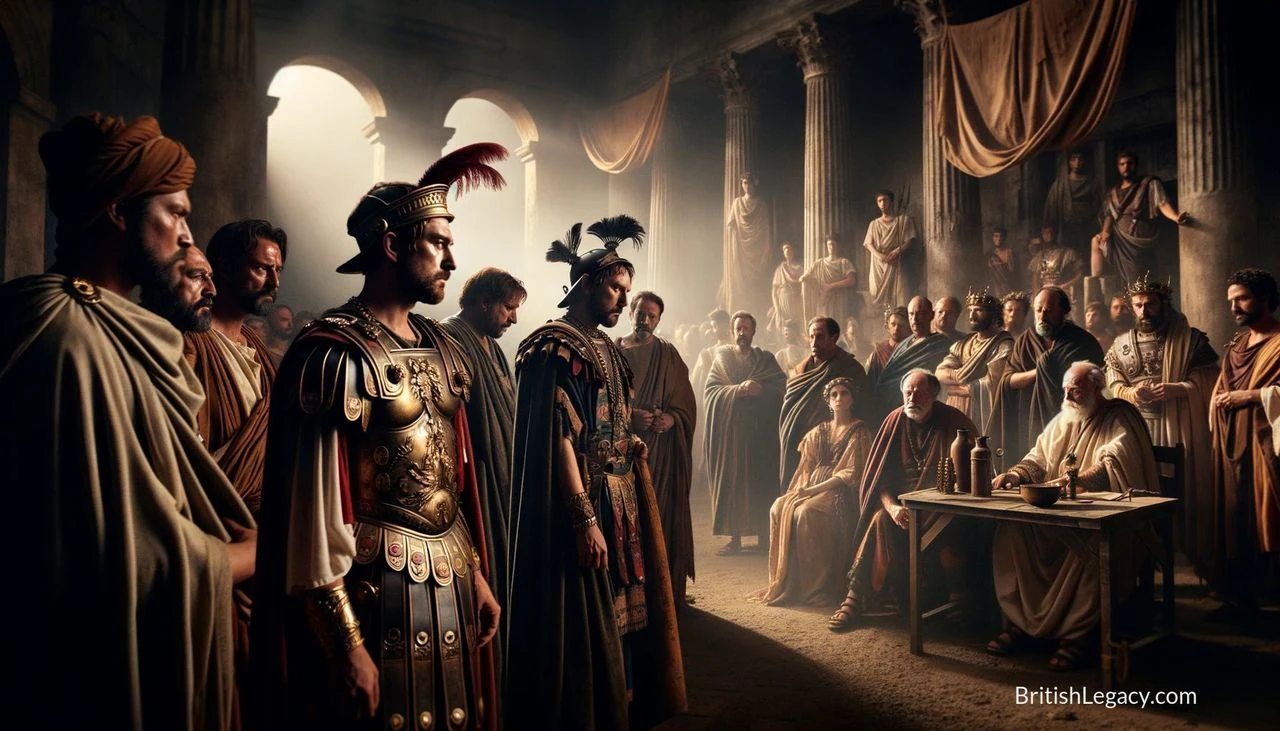
On the Ides of March, the senators kill Caesar. The familiar line “Et tu, Brute?” gives the moment its sharpest expression of personal betrayal. Yet the murder does not restore political calm. Mark Antony addresses the crowd after the conspirators have explained their actions. His funeral oration contests their account and shifts popular feeling against them. The public is not a settled audience judging events from a distance; it becomes a force that political speakers try to direct.
Antony’s intervention helps drive Rome towards civil war. Brutus and Cassius initially achieve success, but they are ultimately defeated and die by suicide. Antony and Octavius Caesar emerge as victors. The ending points towards the end of the Republic and the rise of a new order, but offers no simple confirmation that the assassination has secured freedom. By making the conspiracy’s consequences part of the tragedy, Shakespeare tests the distance between an intention to resist tyranny and the disorder that may follow political violence.
Persuasion, character and the play’s lasting argument
Shakespeare’s drama turns on conflicting accounts of the same events. Brutus speaks as a man trying to reconcile friendship with public duty; Cassius is more practised in the work of drawing others into a scheme. Antony’s speech, meanwhile, demonstrates how rhetoric can change the meaning a crowd attaches to an act. The contrast makes language part of the political action: speeches do not merely describe Rome’s crisis, but help shape what happens next.
The play therefore keeps moral judgement unsettled. Caesar’s power gives the conspirators a reason to fear what he might become, yet killing him fails to end political conflict. Brutus’s motives may be honourable, but the consequences of his decision are catastrophic. Antony’s success in turning the crowd does not simply return Rome to order; it becomes part of a struggle that ends in defeat for the conspirators and the consolidation of power by their opponents.
That balance of character and argument has helped make Julius Caesar a durable part of Shakespearean performance and study. Its treatment of ambition, betrayal, political assassination and the manipulation of public feeling can be staged in changing times without requiring audiences to mistake Rome for their own society. The play gives each generation a dramatic structure through which to examine political language and its effects.
Why Julius Caesar deserves a place in British Legacy
Julius Caesar deserves a place in British Legacy because it shows British theatre engaging with history as a means of examining power. Shakespeare took the political rupture surrounding a Roman assassination and shaped it into a drama in which public speech, personal loyalty and political calculation collide. The result is not a simple celebration of resistance or a defence of rule by one man. Instead, the play makes its audience follow the consequences of an attempted act of political prevention: the conspirators kill Caesar, but they cannot control what follows.
That complexity gives the work continuing value on stage and in discussion. Its Roman characters make arguments about authority, liberty and public opinion that remain intelligible without erasing the distance between ancient Rome and Shakespeare’s England. The British connection is specific: the play was written by Shakespeare and entered the country’s theatrical repertoire through performance and revival, while its first reported performance is associated with London’s Globe. Its reach beyond Britain adds to, rather than replaces, that history. In bringing a Roman crisis into English drama, Shakespeare created a work that can travel across languages and eras while retaining its central challenge: political action must be judged not only by the purpose its advocates claim, but also by the world it leaves behind.
Sources
Julius Caesar — Wikipedia, revision 1378696395
Adapted in part from Julius Caesar by Wikipedia contributors, under CC BY-SA 4.0. Text has been edited and combined with the existing article; this adapted text is shared under the same licence. Contributor history.

_(cropped).jpg)